Agathumas
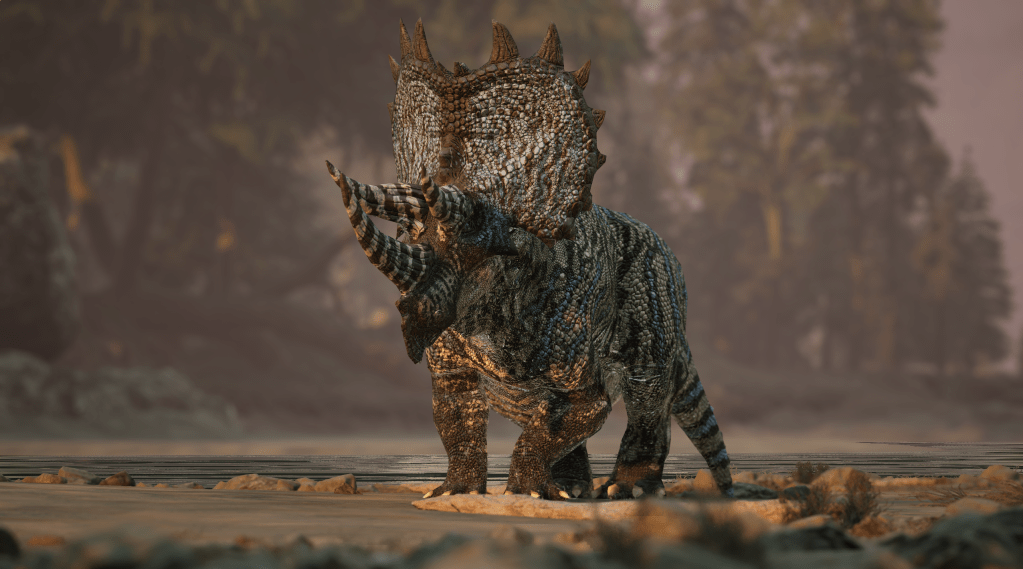
Agathaumas was a large horned dinosaur that lived during the Late Cretaceous period, about 68 to 66 million years ago. It lived in what is now Wyoming, in North America. At that time, the area had rivers, forests, and a warm climate. As a ceratopsian, Agathaumas would have been a plant-eater, using its beak-like mouth to feed on low-growing plants.
Tier: 4
Dimorphism: Males feature bolder, more striking colors, sharper and more prominent dermal spikes, taller and thinner frills, and taller, more impressive horns.
Habitat: Redwoods and Cedrus Forest
Diet: Herbivore
Active Times: Agathaumas, like most large plant-eating dinosaurs, was active during the daytime (diurnal).
Group Limit: Unlimited
Defense: 3 individuals
Nesting Season: Spring & Summer
Offspring: Up to 5
Adoption: ✅
Behavior
Agathaumas is highly aggressive, even more so than other ceratopsians. It does not back down from fights, often battling rivals or even apex predators to the death, even when alone. Most charge without warning and are fiercely protective of their own, attacking immediately without hesitation or question to defend themselves or their herd from any perceived threat. Herds are led by one dominant bull who will tolerate his sons until they come of age or longer, as long as they do not attempt to court the herd’s females. The females were more affectionate within the herd, communicating through low vocalizations and often resting close together. During large seasonal migrations, they tolerated the presence of other herbivores moving alongside them, but outside of those periods, they are openly hostile and territorial toward other plant-eating species.
Courting and Nesting
Each herd is led by a dominant bull. Challengers are often his grown sons or a lone bull seeking to take over the herd. Males engage in fierce battles, clashing with horns and frills in contests of strength, usually stopping just short of death. Females keep very hidden nests and are typically very moody during this time, even toward the bull. If he gets too close to the nest or their young, the females aggressively call at him as a warning that he is much too close. Females only tolerate other females nearby.
However, in times of danger, the female allows the bull to come closer if it means increased protection for her offspring. Females can also choose to leave after a new bull is chosen and follow an older bull if they have been with him for multiple seasons and he has proven himself a strong and capable protector. In rare cases, the female decides to leave the herd if the bull isn’t up to her standards (poor protector).
Mandatory Behavior
Never Back Down, Never What?
Agathaumas are extremely aggressive ceratopsians that rarely back down, even when the odds are against them. A lone Agathaumas stands its ground, even if the danger it is facing is an apex carnivore like a T. rex, preferring to fight to the death rather than flee. Due to their relentless fighting nature, many bulls are heavily scarred and worn from countless battles, their frills and horns bearing the marks of previous confrontations. These scars serve as a warning to rivals and a testament to their resilience and dominance. (This is mandatory only for battle-worn subspecies like Broken Horn and or Hole in the Crest, for other subspecies, it is optional)
Thwack Norris
Agathaumas love to fight and often seek out other dinosaurs to spar with, using loud calls and aggressive displays to provoke challengers. These battles are rarely fatal but often leave one or both combatants with deep, permanent scars, visible reminders of their skill and toughness. Even outside of dominance disputes, Agathaumas engage in these fights for practice or challenge, showing their relentless drive to assert themselves and prove their strength among other dinosaurs.
Danger A – Foot
Agathaumas has always despised Deinocheirus, not just out of jealousy, but because of the constant rivalry over water. Sturdy and armored, proud of his sharp horns and heavy frill, Agathaumas fiercely guards the watering holes within his territory. When the towering Deinocheirus lumbers in with its enormous claws and awkward frame, wading into the shallows as if it owns the place, Agathaumas sees red. He hates sharing what he has claimed. With snorts and pounding steps, he charges, forcing the long-armed giant to retreat from the water’s edge. Again and again, Agathaumas chases Deinocheirus away, determined to keep both his territory and his pride untouched.
Frill at the Fill
Agathaumas are rarely found far from water, preferring to anchor their territory around rivers, lakes, and deep watering holes. They typically move only when a water source begins to dry or competition becomes too intense, traveling from one claimed basin to the next. While territorial, Agathaumas cannot claim an entire lake or river system (such as all of Redwood or Wollemi Lake); their claim extends only to the immediate section of water and shoreline they are actively occupying. Agathaumas are territorial only toward ceratopsians of similar or larger size that they perceive as a threat to the resources within their occupied area. They are otherwise defensive in nature and do not initiate fights (outside of noviana), responding only if attacked. When defending their territory, they will not pursue opponents far onto land, and if the opposing dinosaur retreats approximately 2–3 Spinosaurus lengths from the occupied area, the Agathaumas must disengage and return to the water. With fresh water no longer limited to the shoreline, Agathaumas ventures inland, expanding its range and asserting dominance over newly formed watering grounds before the dry season returns. In rare cases, if an inland watering hole is large, resource-rich, and defensible, the herd may attempt to claim it permanently. Only after successfully holding that watering hole through four full seasons of droughts, storms, migration pressure, and predator threats will they consider it secure enough to establish nesting grounds and raise their young there. ( If a lone male aga he may claim a small territory in hopes of females coming there, if a lone female you may not claim territory )
Optional Traits
Females may adopt other ceratopsian hatchlings or juveniles if they find them. Despite the species’ aggressive nature, females show a soft spot for young ceratopsians, but only until they reach late adolescence or sub-adulthood. Once the young begin to look noticeably different from the herd, the female usually chases them out, though in rare cases she continues to tolerate her unusual “adopted” offspring.
Mother Knows Best
When Agathaumas have hatchlings or juveniles, the herd becomes extremely protective. The females are the first to confront and kill any young apex carnivores they encounter, while the bulls join in to lend their strength and size. By eliminating these potential threats before they mature, the herd greatly increases the chances of survival for their young, showing just how far they go for their herd.
Calm Beneath The Crest
Agathaumas show a surprising tolerance toward smaller ceratopsians. The younger and lighter-framed horned dinosaurs are not seen as threats, nor as serious competitors for territory. In fact, their presence often brings a sense of familiarity, shared frills, shared horns, shared instincts. At the water’s edge, Agathaumas stands watchful but calm as the smaller ceratopsians drink nearby, accepting them as distant kin rather than rivals. The little horned cousins are allowed to linger, moving through the territory under the quiet protection of their larger, more armored relatives.
No Crocs Allowed:
Agathaumas view crocodilians with open disdain, insulted that such low, sliding beasts dare enter waters they claim. Their sudden, snapping jaws and scaly hides only fuel their outrage, and none of them tolerate their presence. With snorts, stomps, and threatening charges, they drive them away from the shoreline/water, making it clear that these intruders are neither welcome nor respected. To Agathaumas, the waterholes are his domain, and any crocodilian foolish enough to wade into them challenges not just his space, but his pride.
Credits : Littlered with support from KushalaDarora
Sources:
https://en.wikipedia.org/wiki/Agathaumas https://extinctanimal.fandom.com/wiki/Agathaumas
Last updated: 2/17/2026

