Apatosaurus
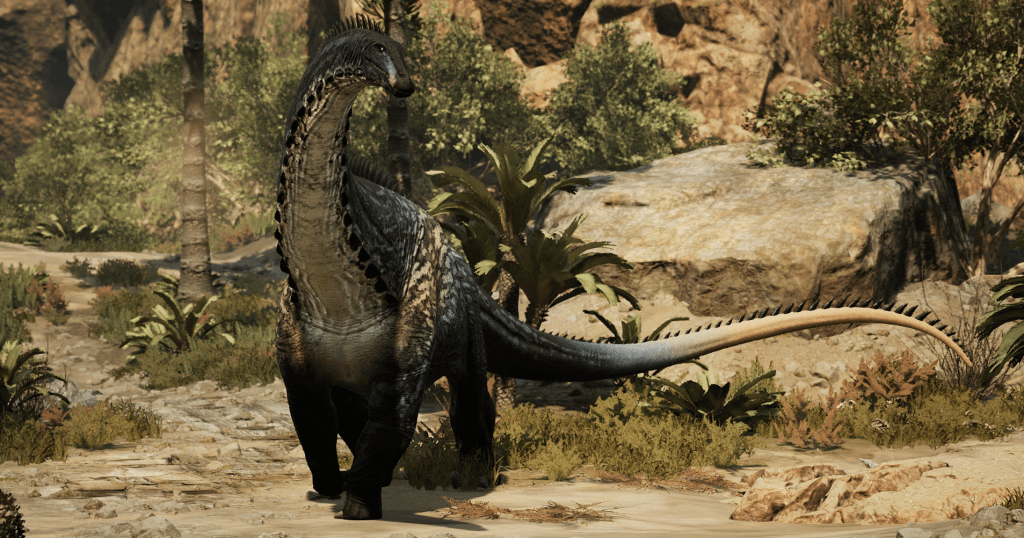
Apatosaurus was a massive herbivorous sauropod dinosaur that lived in western North America during the Late Jurassic period, around 152 to 151 million years ago. Its name means “deceptive lizard,” referring to early confusion in its classification.
It was a long-bodied, four-legged dinosaur with a thick neck, powerful limbs, and a long, whip-like tail. Adults measured roughly 21 to 23 meters (69 to 75 feet) in length and weighed an estimated 16 to 22 metric tons. The skull was small compared to the body and equipped with peg-like teeth adapted for stripping vegetation rather than chewing.
Apatosaurus belonged to the diplodocid sauropods and had extensive air-filled bones that reduced weight while maintaining strength. It likely fed on low to mid-level plant matter and lived in floodplain environments alongside other large Jurassic dinosaurs, including major predators and fellow sauropods.
Tier: 6
Dimorphism: Yes. Males display brighter neck coloration, while females exhibit more muted tones.
Habitat: Cedrus Forest, Wollemi Forest, Redwoods, Blackfern Hills, Dryfang Canyon
Diet: Herbivore
Active Time: Diurnal. Most active during daylight hours, grazing and socializing under the sun while maintaining close herd bonds.
Defense: 1 adult if no offspring younger than sub-adult are present. 2 adults or 1 adult and 1 sub-adult if offspring younger than sub-adult are present.
Nesting Season: Spring and Summer
Offspring: Up to 5
Adoption: ✅
Behavior
Apatosaurus are deeply social, herd-oriented herbivores whose well-being depends on constant companionship. Despite their immense size, they thrive in the presence of others and actively seek social bonds, whether with their own kind or within mixed herbivore groups. Herds are typically structured around adult females (cows), with males (bulls) occupying looser, less central roles. Prolonged isolation causes stress and instability, driving them to seek out nearby herds or individuals rather than remain alone.
Apatosaurus does not group with Argentinosaurus, as it is uncomfortable around creatures larger than itself and prefers herds made up of equals or smaller herbivores.
Naturally calm and confident, Apatosaurus are generally friendly toward non-hostile creatures and are seldom fearful due to their sheer size. Other herbivores often gravitate toward them, finding safety in both their numbers and their presence. While peaceful by nature, they are not passive. When their offspring are threatened, Apatosaurus become fiercely defensive, readily standing their ground against apex predators to protect their young.
They are also drawn to water, frequently resting or bathing in rivers, lakes, and creeks. Water serves both as a place of relaxation and, when necessary, a defensive refuge. Whether grazing under the sun, bonding within a herd, or guarding their offspring, Apatosaurus behavior is defined by social connection, calm confidence, and unwavering protectiveness.
Grouping & Defensive Behavior
Apatosaurus normally defend with one adult at a time.
When offspring younger than subadult are present, a mother may also defend, as females with young are fiercely protective.
If a herd is reduced to a single adult over time and offspring younger than subadult are still present, a subadult may assist in defense alongside the remaining adult.
Courting
The bull performs the curved up arrow emote as a display, lifting and angling his neck to emphasize his brighter coloration. This is how bulls compete for a cow’s attention and affection. Cows typically show preference toward bulls displaying more vibrant neck coloration during these displays.
The cow responds with acceptance by moving to the bull of her choice and using either the curved down arrow emote or the heart emote.
Nesting & Offspring
Apatosaurus choose nesting sites with care, favoring areas that provide access to water and room for the herd to gather. Nesting often occurs near rivers, lakes, or creeks, where adults can anchor themselves defensively and reduce the risk of flanking attacks. Open terrain is preferred over dense cover, allowing threats to be seen long before they approach. Herd presence is a key factor in site selection, as safety comes from numbers as much as size. Adults form the defensive backbone of the herd. Their size and strength are used to block approaches, limit flanking, and deter threats, particularly near nesting areas and vulnerable young.
Hatchlings remain at the nest or within its immediate surroundings and retreat into concealment as soon as a predator is detected. Due to the sheer size of the adults, remaining directly beneath them during defensive movements risks accidental harm. When threatened, hatchlings and juveniles are expected to hide in foliage rather than crowding around adults.
During calm periods, juveniles explore short distances while remaining under constant watch. They are expected to retreat toward adults at the first sign of danger and avoid lingering on the outskirts of the herd. They browse low vegetation, investigate nestmates and nearby sounds, and interact briefly through gentle nudging or imitation of adult behaviors. All activity remains close enough for quick retreat should danger arise.
Adolescents begin to test independence and move more freely than juveniles, often drifting farther while grazing, but remain attentive to adult positioning and herd movement. When threats appear, they retreat rather than stand their ground. Adolescents do not linger in the conflict area.
Subadults assist in maintaining threat awareness by alert calling.
Mandatory Traits
Echo of the Herd
Being solitary is unacceptable for these large herbivores. Being a part of a family or herd, whether with their own kind or other herbivores, is a must. If left to live alone for extended periods, the individual may begin to lose stability, actively seeking companionship rather than remaining isolated.
Waters of Refuge
Apatosaurus are drawn to water for rest and relief, often lingering in lakes, rivers, or creeks. When threatened, they may position themselves near or within shallow water to limit attack angles and prevent flanking, using the terrain to their advantage rather than fleeing outright.
Note: Water is to used as a place of stability and defense, not as a means of escape or body denial.
Bearing the Brunt
When part of a herd made up of non-Apatosaurus herbivores, an Apatosaurus may use its body to shield or block attacks against the herd without actively attacking. This includes positioning to block access or prevent predators from reaching smaller herd members. While actively shielding, the Apatosaurus may use defensive strikes. Due to its immense size, these movements can be dangerous in close quarters, and care should be taken to avoid harming its own herd members. As attacks begin to focus on the Apatosaurus itself, remaining within the herd while using stronger or sustained attacks becomes increasingly dangerous to those it protects. Creating space away from the herd will allow it to defend itself more freely.
Optional Traits
Social Butterfly
Apatosaurus may actively engage with other herbivores beyond simple herd presence, showing curiosity, tolerance, and calm interaction within mixed groups. They are comfortable integrating into a wide range of herds and social settings, excluding Argentinosaurus, and may linger near or move alongside other species rather than keeping to themselves.
Living Bulwark
Apatosaurus may adopt a watchful role within a herd, lingering at the edges or near vulnerable members rather than remaining clustered at the center. This behavior reflects awareness and presence, not aggression, and does not require active defense.
Credits: MisslilBlue with assistance from LeviathanMosa
Sources: https://en.wikipedia.org/wiki/Apatosaurus
Last Updated: 1/18/25
 Ashes of Apex Fantasy Realism