Asylum Feline
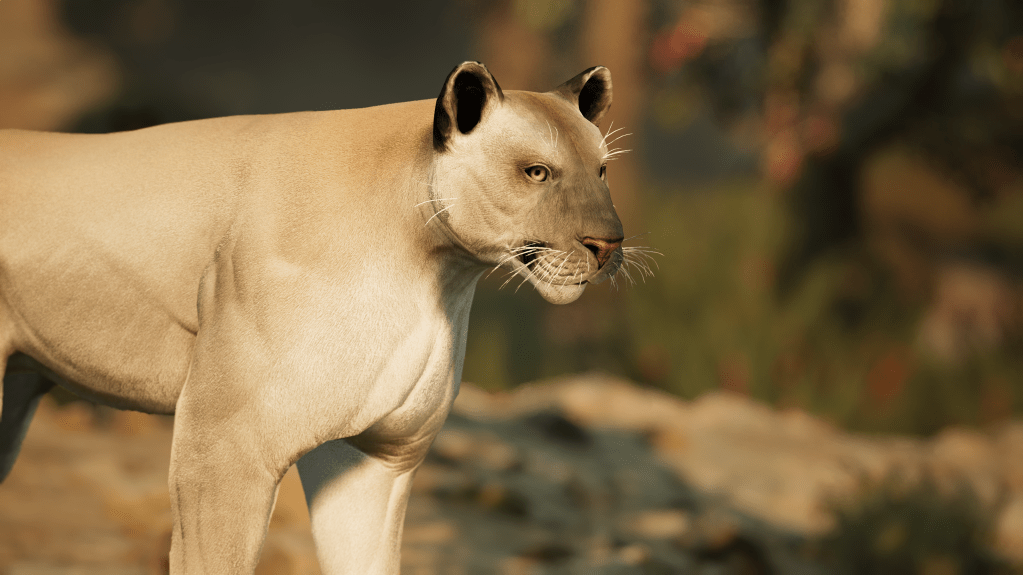
Felines are powerful, solitary carnivores that roam across vast territories ranging from dense forests to open mountains and coastal regions. Having first appeared roughly 500,000 years ago, they are among the most adaptable big cats in the world, capable of surviving in nearly any biome.
Tier: 2
Dimorphism: No
Habitat: Can be found nesting anywhere in Riparia. Suggested areas are Redwoods, Hollow Hills, and Dry Fang Canyon.
Diet: Carnivore
Active Time: They are primarily crepuscular, most active at dawn and dusk, using stealth, patience, and explosive speed to ambush prey. Sunbathing during the day. If territory claimed, constant patrolling.
Grouping: 8 adults/subadults; 7 babies maximum.
Hunting and Defense: 6 Adults/sub-adults. Subadults may be brought to learn.
Nesting Season: Spring and Summer
Offspring: Up to 5
Adoption: Check species
Behavior
Felines communicate through low growls, chirps, and screams, and claw scrapes to define their territories and signal their presence to others. Courting between males and females is vocal and expressive; partners exchange calls across their range, meeting for displays of affection that include playful circling, gentle swats, and nuzzling to build trust. Once bonded, pairs may remain together through a breeding season, sharing the duties of defending their range and caring for their young. Both parents help raise the cubs, keeping them in secluded dens and teaching them to hunt through stealth and patience. When confronted by larger predators such as Smilodon or packs of carnivores, felines rely on agility, teamwork, and terrain advantage, often retreating to higher ground or dense cover. However, if cornered or their young are threatened, they fight with fierce coordination and precision, striking quickly before vanishing back into cover. Easily startled felines will immediately trigger their Tail Ability (Adrenaline Rush) whenever they are ambushed, spooked, or cornered.
Courting & Nesting
During courtship, males chase females. Sometimes engaging in a fight (never getting below 70%), mostly nipping at each other. They often purr and chuff at one another after courting, strengthening their bond. The female selects a well-hidden, sheltered den site to protect her cubs. These dens are typically located in areas that offer strong natural cover and minimal disturbance, such as dense thickets or brush, rocky outcrops, steep canyon walls, and/or ledges. The key factor is concealment and safety from predators (including other felines or bears). Parents call to their offspring with soft chuffs and chirps. (On the emote wheel clockwise: 🔈) #1, 🔈)) #2, ❔#1, ❔#3, and ❤️)
Mandatory traits
Born Outcast
If a cub of a different subspecies is born into a litter, the mother’s response can vary. Most commonly, she will remove the cub from the nest and abandon it elsewhere, or, in harsher cases, kill the cub and use it as food for her remaining offspring. In rare instances, particularly with young or inexperienced mothers, the odd cub may be raised alongside its siblings. However, as the cub reaches mid-to late adolescence and its differences become more noticeable, the mother may become less tolerant of its presence, often resulting in the cub being driven away from the family group.
Whispers of the Hunt
Felines are stealth-based ambush predators and hunt with patience and precision. The females are almost always the ones who initiate combat. If two are severely wounded (under 20%), they may switch out for 2 males in the group (can also do 1 wounded to one male if there is only one adult male in the group). They rely on stalking, cover, and surprise rather than open chases. Hunts are carefully chosen and executed efficiently, with unnecessary risks or prolonged fights.
Shadows of the Den
Feline parents share responsibility in raising and protecting their young, forming a strong protective unit around their offspring. Cubs must remain hidden within dens or secure sheltered areas during early development stages to avoid detection by predators. Both adults actively defend the den site, responding aggressively to any perceived threat. This cooperative protection ensures higher survival rates and reinforces parental bonds within the family unit.
Bond of the Ridge
Mated feline pairs maintain a cooperative and territorial partnership, often traveling, resting, and hunting within shared ranges. Together, they defend their territory from intruders and coordinate their movements to increase hunting success and security. Unmated felines are expected to remain solitary, avoiding unnecessary interaction with other adults to reduce conflict and maintain natural spacing between individuals.
Fangs of the Silent
When faced with larger predators or rival carnivores, felines prioritize avoidance over confrontation whenever possible. They use agility, speed, and knowledge of terrain to escape dangerous encounters. However, when escape is not an option, especially when defending cubs or territory, they will respond with precise and highly aggressive strikes aimed at creating an opportunity to disengage or eliminate the threat.
Echoes of Territory
Felines are highly territorial and regularly maintain their range through vocalization and patrolling behavior. These signals communicate ownership and help reduce unnecessary conflict with neighboring individuals. Entering another feline’s established territory without cause, such as pursuing prey or seeking a mate, is discouraged, as it can lead to aggressive encounters and instability within overlapping ranges.
Grace of the Cliffs
Felines are skilled climbers and strategic observers, often favoring elevated terrain such as cliffs, rocky outcrops, or high ledges. These vantage points provide safety, awareness, and tactical advantage when tracking prey or monitoring territory. When resting or nesting, felines prefer secluded high ground that offers both concealment and a clear view of their surroundings, reinforcing their role as cautious and intelligent predators.
Optional traits
Sun-Dappled Rest
Felines frequently spend time resting on sun-warmed rocks, ledges, or low tree limbs, where they groom, stretch, or sleep between hunts. These quiet periods are essential for conserving energy after stalking or hunting and reflect their mostly solitary, low-interaction lifestyle. For bonded pairs, these moments can also serve as calm, low-stress social time that reinforces familiarity and trust without the need for constant movement or vigilance.
Prowler’s Dance
Felines often engage in playful stalking and mock ambush behaviors, particularly between mates or adolescent individuals. These interactions mimic real hunting sequences in a low-risk environment, helping to sharpen stealth, timing, and reaction speed. Through repeated “practice hunts,” younger felines refine their instincts, while adults may use the behavior to reinforce coordination and maintain social bonds in a controlled, non-lethal context.
Stone Leap Trials
Felines naturally test their agility and strength through informal challenges involving jumps across rocks, cliffs, and uneven terrain. These contests are not formalized competition but instinct-driven displays of balance, power, and control. By navigating difficult terrain and attempting longer or more precise leaps, individuals reinforce their natural climbing ability and environmental mastery, reflecting the species’ adaptation to rugged, mountainous landscapes.
Sub-Species
- Puma Concolor – Cougar
- Panthera Uncia – Snow Leopard
- Acinonyx Jubatus – Cheetah
- Neofelis Nebulosa – Clouded Leopard
- Homotherium Latindens – Smilo with longer tail, different head shape
- Panthera Spelaea – Eurasian Cave Lion (Female)
- Short Mane – Male Cave Lion
- Long Mane – Male Cave Lion
- Panthera Tigris – Tiger
- Keef – Blind in left eye, bent tail
- Smilodon Fatalis – Smilodon
- Leopard – Leopard
Snow Leopard
Snow leopards are elusive, solitary predators found in cold, mountainous regions. They excel in stealth and terrain advantage, using high ground, narrow paths, and cover to ambush prey or avoid more serious threats. They are typically solitary throughout most of their lives, except during breeding and while raising cubs. A male and female may remain together as a bonded pair during the early rearing period, but once the cubs reach adolescence, the male always leaves. The mother continues raising the cubs alone until they reach the sub-adult stage, after which the young disperse and become independent.
Cheetah
Commonly found in Dry Fang Canyon. If in a group without other cheetahs, they will often take on a scouting role for larger felines, using their speed and keen awareness to spot threats, prey, or points of interest ahead of the group. Some big cats tolerate or even welcome this behavior, allowing the cheetah to act as an advance scout and occasional support in combat when conditions favor it. However, not all larger felines are willing to accept a cheetah’s presence; more territorial or solitary individuals may refuse assistance, preventing the cheetah from assuming this role. When permitted, the cheetah serves as a valuable companion, providing reconnaissance and situational awareness that its larger cousins may lack.
Clouded Leopard
Commonly found in Blackfern Hills, Coastland Swamp, East Passage, and Twisted Forest, clouded leopards prefer areas with dense cover, relying on their agility and stealth to remain hidden from both prey and rivals. Primarily solitary by nature, they typically only seek out others during mating season, though a mated pair may remain together while raising their young, with the male helping protect the family until the cubs reach adolescence. At that point, the male usually departs, leaving the female to finish raising and teaching the cubs until they are ready to live independently. Unlike some of their larger relatives, clouded leopards rarely target large prey, preferring animals their own size or smaller. As solitary hunters, they favor hunts with a high chance of success and a low risk of injury, as the dangers of pursuing larger prey often outweigh the potential reward.
Smilodon
Can only group with other Smilodon fatalis or Homotherium latidens. These cats are highly territorial and aggressive toward other large felines, viewing most outsiders as competitors rather than allies. If a mating pair produces offspring of a different subspecies, the female Smilodon or Homotherium will usually kill the cub shortly after birth. In rare cases, particularly with younger or inexperienced mothers, the cub may instead be carried away from the den and abandoned rather than killed outright. However, such cases are uncommon due to the naturally aggressive and uncompromising nature of these cats. To establish and maintain territory, they use Broadcast 3 three times in succession, signaling to nearby predators that the area has been claimed. While they rarely tolerate the presence of cheetahs, there are rare exceptions. On occasion, a female may discover an orphaned cheetah cub and, if she deems it useful, allow it to remain within the pride. Such cheetahs are typically raised alongside the group and later serve as scouts, using their speed and awareness to locate threats, prey, or intruders. Even in these rare cases, only a single cheetah is usually tolerated, and other big cats are almost always driven away or attacked on sight. For additional details regarding social structure, territorial behavior, hunting habits, and pride dynamics, refer to and follow the Smilodon profile.
Cave Lion
When claiming a territory, males will use broadcast 2 three consecutive times. Letting other males know their territory has already been claimed. Lions will group with smaller felines for their speed advantage. (Do NOT group with tigers.) In order to accept a smaller, unrelated feline into their group, the individual must first prove its usefulness. This may include scouting prey, tracking targets, or successfully catching small game that benefits the group. Only once the larger cats determine that the newcomer does not hinder the pride and may even contribute to its success will they allow it to remain under their protection and within their territory.
These cats are highly aggressive by nature and typically operate in small, tightly bonded prides, sometimes led by a single dominant male or a bonded pair of brothers. One or two accepted smaller felines may be integrated if deemed useful. Group structure is flexible but controlled, often consisting of a ruling male or brother pair alongside lionesses, with offspring remaining until they are old enough to disperse and establish their own territory. In some cases, certain offspring may choose to remain with the pride into adulthood rather than leaving, resulting in extended pride structures that persist across generations.
When leadership is challenged, conflict dynamics vary based on the number of dominant males involved. A lone male may attempt to overthrow a pride leader, or a pair of brothers may challenge an existing single male or another brother pair. In these encounters, combat can escalate into uneven engagements such as 2v1 or 2v2, depending on how many dominant males are defending the pride. If a challenger succeeds, they will often kill the previous male or males’ cubs to bring the females back into estrus and immediately mate, ensuring their own bloodline continues. However, if a lone male approaches while the head male or males are absent, lionesses may still mount a strong defense. They are fiercely protective of their cubs, and a group of dominant females can sometimes drive off an intruding male if he poses a direct threat to their offspring.
Depending on prey size and situation, lionesses act as the primary hunters and most active aggressors, often engaging in hunts and combat more frequently than the males. Male lions tend to be more “laid back” in comparison, providing raw strength and support when needed, particularly for bringing down large prey or driving off serious challengers to the pride. The pride will also aggressively attack hyenas (asylum wolves) on sight if they are detected within their territory, treating them as immediate threats
Tiger
Do NOT group with Cave Lions. Will group with smaller felines when beneficial, particularly those that can complement their hunting efficiency or scouting ability. Tigers are generally solitary by nature, but may tolerate limited association with select smaller felines if they prove useful and do not interfere with territory control or hunting behavior.
Communication is primarily non-verbal and low-intensity, most commonly using chuffs as a friendly or neutral signal between trusted individuals, cubs, or accepted companions. More aggressive vocalizations and body language are reserved for territorial disputes or threats. To establish and maintain territory, tigers use Broadcast 3 three times in succession, clearly marking an area as claimed and warning other predators to stay away. Their territorial behavior is strict, and intrusions are typically met with immediate force or intimidation.
A single male and a single female may share the same territory, even outside of mating periods, forming a loose long-term pairing rather than a full social group. However, only one adult male and one adult female tiger will occupy a territory at any given time, maintaining strict limits on density. After mating, the female remains within the territory to raise the cubs independently, taking full responsibility for their protection and development. The male may continue to range within the same territory, occasionally providing food by making kills and offering them to the female and her young, but he does not take part in directly raising the cubs. Despite this coexistence, males remain highly territorial and will aggressively chase off any other male tigers that enter the area, treating them as direct rivals. ( Only 1 male and 1 female tiger per group with 1-2 smaller felines.)
Keef
Keef is typically a solitary big cat, as he is blind in one eye (MUST use /blind 5 or /blind 7 command) , which leads most prides and larger groups to view him as less reliable for coordinated hunts or territorial defense. As a result, he is often excluded from group dynamics and forced into a mostly independent lifestyle, relying on stealth, patience, and opportunistic hunting to survive.
However, in rare cases, a lone Cave Lion or a solo tiger may encounter Keef and choose to form a bond with him. This is uncommon, and when it does occur, it is most often a solo male who develops an almost brotherly attachment to Keef, acting in a protective and supportive role. On very rare occasions, a lone female may form this bond instead.
In these unusual pairings, the companion may assist in hunts, share kills, and help defend territory, compensating for Keef’s reduced effectiveness due to his impaired vision. Having been born blind in one eye, it is also possible, though uncommon, that one or two of his siblings may choose to leave their pride to remain with him as long-term companions.
It is rare for Keef to be seen raising cubs, as he is not typically accepted into stable breeding pairs. However, if there is a lack of suitable partners, a lone female may choose to bond with Keef and raise young alongside him. If the bond becomes strong enough, she may remain with him even after the cubs have grown, forming one of the few long-term social bonds Keef is capable of maintaining. Due to the hardships of survival with one parent being partially blind, litters are typically small, usually only one to two cubs per season.
Liger
Liger cubs are produced exclusively from a pairing between a male lion and a solo tigress. Each breeding cycle is strictly limited to a bonded male-female unit and may only result in a maximum of two offspring. Once a lion and tiger pair has produced cubs, they cannot mate or nest together again, requiring new pairings for any future reproduction.
Offspring born from these unions are infertile and unable to produce cubs of their own, meaning they do not contribute to further lineage expansion. As a result, population growth is entirely dependent on new adult pairings rather than inheritance or generational continuation. This creates a controlled, non-recurring breeding structure where each lion–tiger pairing functions as a single-use reproductive cycle rather than a lasting family bond. (The male must leave once cubs are born; he does not stay in a group with the female)
Credits: Littlered
Sources:
https://en.wikipedia.org/wiki/Cougar https://www.nwf.org/Educational-Resources/Wildlife-Guide/Mammals/Mountain-Lion
https://www.britannica.com/animal/liger https://www.wwf.org.uk/learn/wildlife/snow-leopards https://nationalzoo.si.edu/animals/clouded-leopard https://cheetah.org/uk/cheetahfacts/ https://www.nationalgeographic.com/animals/mammals/facts/african-lion https://www.nationalgeographic.com/animals/mammals/facts/bengal-tiger https://www.britannica.com/animal/Bengal-tiger
Last update: 06/27/2026
 Ashes of Apex Fantasy Realism