Austroraptor
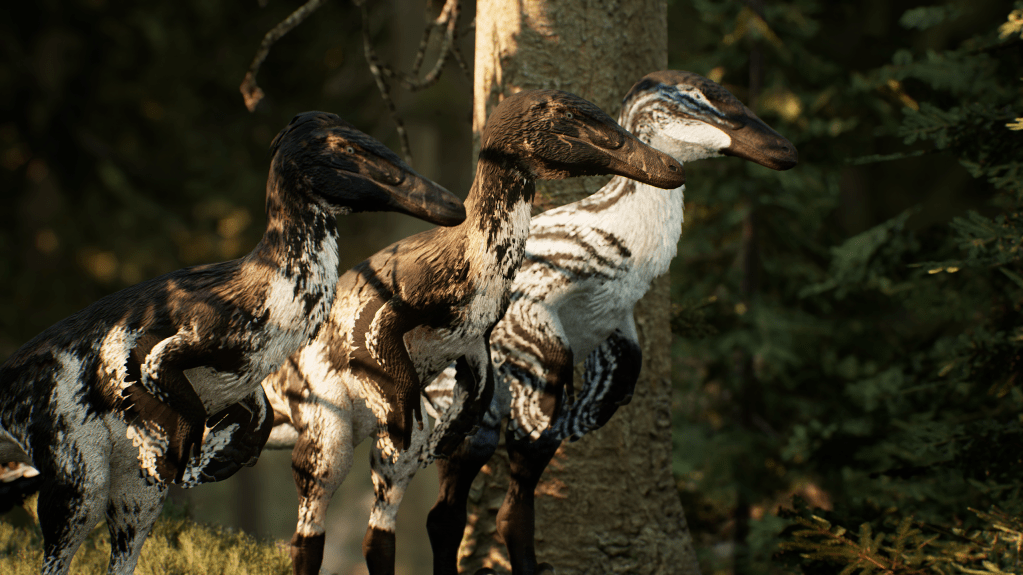
Austroraptor cabazai is the largest dromeosaur ever discovered in the southern hemisphere, and lived about 70-66 million years ago during the late Cretaceous period. They are believed to have reached up to 20ft long, 6ft tall, and weighed as much as 300-600lbs. This size rivals the largest raptors that we know of, such as the Utahraptor and Achillobator. They were distinct from these northern raptors, however, having longer skulls and conical teeth, similar to spinosaurids. This has led researchers to believe that Austroraptor’s diet consisted primarily of fish, though they may have been opportunistic predators that also hunted smaller, ground-dwelling creatures. They had long legs suited for running fast over long distances, allowing them to run down prey or flee from larger predators, such as the Maip.
Tier: 2
Dimorphism: Males have vibrant or colorful plumage, while females have very dark plumage. Melanism is common in females, and Albanism is common in males.
Habitat: Austroraptor prefer to nest near sources of freshwater that are deep enough to fully submerge in, but inaccessible to large aquatic predators.
Recommended areas include:
Riparia: Wind Tunnels, Cliff Edge Falls, Wollemi Forest
Gondwa: Young Grove, Birchwoods, Big Quill Lake
Diet: Piscivore, Carnivore
Active Times: Cathemeral; active at all hours and sleeping for short periods, day or night.
Grouping: Austroraptor may be in a group of up to 10 individuals, related or unrelated. Hunting parties consist of 6 offensive adult members and 4 subs, which replace offensive members one at a time as their stamina completely drains. A full group of Austroraptor can hunt up to Tier 4. When defending nesting sites or a claimed kill, Austroraptor groups may have up to 8 defenders.
Nesting Season: Spring and Summer
Offspring: Up to 5
Adoption: ✅
Behavior
Austroraptor is a highly social, nomadic dromaeosaur that can be found in riverine, estuarine, and coastal environments. They display a strong preference for the company of their own species and form tight, enduring social bonds, often choosing to travel with other Austroraptor over maintaining even well-established Flamekin bonds.
They are generally tolerant of other carnivores, only withdrawing when competition for prey, nesting sites, or fishing grounds becomes significant. Austroraptor are inquisitive, prey-driven, and keenly responsive to environmental changes, frequently altering their movement patterns based on freshwater quality levels, prey availability, and the presence of larger predators.
Courting and Nesting
Austroraptor form long-term pair bonds, often lasting for life. Courtship is an elaborate, highly visual process. Males display their colorful plumage, agility, and hunting proficiency, commonly presenting a fish or portion of meat to a prospective mate. This offering is followed by a ritualized dance, consisting of synchronized movements, posturing, and vocalizations.
Females respond by mirroring the male’s motions. The pair will take several attempts to align their movements; failure to achieve synchronization results in the ritual being abandoned, with the male seeking another mate. Successful pairs reinforce their bond through shared travel, cooperative hunting, swimming, preening, feeding, and often repeating their courtship dance.
Austroraptor flocks have been observed nesting in large and small groups, building their nests instinctively along brushy or rocky shorelines adjacent to water deep enough for diving. This placement allows hatchlings to quickly take to the water after emergence. Swimming serves as a key bonding activity, and family units grow increasingly coordinated as they practice together.
Lone or solitary pairs of Austroraptor are more likely to form bonds with Tier 3 or higher carnivores, particularly semi-aquatic species. The presence of these larger animals provides a perceived increase in safety and access to abundant waterways. In rare cases, Austroraptor may nest alongside these trusted companions, raising their young in close proximity to allied species.
Hatchling Behavior
Austroraptor hatchlings are alert, curious, and wily from the moment they leave the nest. Instinctively drawn to water, they eagerly explore the shorelines, shallows, reeds, and rocky edges, investigating movement, sounds, and ripples before retreating just as quickly. Though physically vulnerable, they rely on speed, unpredictability, and terrain to avoid danger, often slipping into water or dense cover when startled.
Hatchlings remain highly attentive to their parents and adult group members, responding to vocal cues and frequently being carried during travel. Through close observation, play, and mock chases or short swims, they gradually learn social signals, environmental awareness, and the foundations of hunting behavior under constant adult supervision.
Once Austroraptor chicks reach sub-adulthood, they are gently dispersed by their parent group if the group already contains 10 adults. The bond between parent and chick is strong, however, and so they are fond of and friendly with each other upon each meeting throughout their lifetime.
Mandatory Traits
Feathered Fishers
Austroraptor prioritizes fish as a major component of their diet and will actively dive in nearly any viable water source. Individuals frequently defend productive fishing areas, engaging in posturing or brief, non-lethal skirmishes over prime locations. This behavior is more commonly observed in males. Unmated females tend to associate with individuals capable of effectively securing and maintaining access to rich fishing grounds.
Fair-Weather Friend
Austroraptor are notably tolerant of other carnivores and readily form Flamekin bonds. They may exhibit relaxed social behaviors around significantly larger species, including Noviana and Spinosaurus. However, this tolerance is conditional and may dissolve if competition, aggression, or resource scarcity arises. The only unconditional bonds they share are with other Austroraptors.
- Austroraptor seeks safety in the presence of larger carnivores, and while they may fish for their large companions, they do not initiate or participate in hunts, or actively defend territory for them, unless Flamekin to the Leviathan.
Tide-Bound Wanderer
Austroraptor’s movement is subtly influenced by shifting water conditions and prey availability. Changes in water quality, predator presence, or fish populations often prompt individuals and groups to relocate, following productive waterways rather than remaining tied to a single territory. Austroraptors have also been observed spending significant periods of time traveling inland, between small freshwater sources to avoid predation and secure nesting grounds with abundant fish or critters.
Bond Reinforcement
Social bonds among Austroraptor are more actively maintained through shared behaviors rather than passive proximity. Vocalizations, swimming together, coordinated movement, cooperative hunting, preening, and displays all serve to strengthen group cohesion and pair bonds. These interactions improve coordination and trust, resulting in smoother group movement and more effective hunts.
Searing Security
Protection of the nesting site is a high priority for Austroraptor. Whether it is a temporary site along a migratory route or an established home range, vulnerable young and highly prized trophies are fiercely protected. Austroraptor will engage any threat, no matter how small or large, to ensure the safety of the site, even if no offspring are present.
- Austroraptor may initiate combat with any creature that comes within two Austroraptor body lengths of the nest, regardless of tier. The engagement ends when the intruder dies or leaves line of sight of the nest.
Optional Behavior
Flamebound Prey Drive
Austroraptor, especially those traveling inland, have been noted to have an extremely strong prey drive. They tend to target creatures they can run down, carry, and thrash, usually being Tier 1 animals and critters. They run down these targets as long as they have stamina, and vocalize excitedly after catching prey. This chase also serves as a form of enrichment or a sort of play for the Austroraptor, as they take great enjoyment in the hunt.
Trophy Stealers
Austroraptor display a fascination with the remains of fallen creatures, particularly bones, which they collect and use to decorate their nesting sites. Individuals may observe conflicts or hunts from a safe distance, remaining still and attentive until an opportunity presents itself. When a combatant falls, or a carcass is briefly unattended, Austroraptor may rush in to snatch a trophy before retreating. This behavior is inherently risky, and those who attempt it may suffer injury or even death if misjudging the victor’s awareness or tolerance.
Restorative Soaking
After hunts, play, or long hours of traveling, Austroraptors seek out calm or slow-flowing water to rest and recover. Soaking or floating in the shallows allows them to cool down and ease muscle strain, as well as preen each other to reinforce group bonds. Individuals remain watchful during these periods of downtime, ensuring each group member has enough time to escape via land or water should they be ambushed.
Credits: Onlooker
Sources:
https://en.wikipedia.org/wiki/Austroraptor
https://youtu.be/0mBdfFLBl44?si=D_tUntgkPDmifUUD
Last update: 2/8/2026
 Ashes of Apex Fantasy Realism