Barsboldia
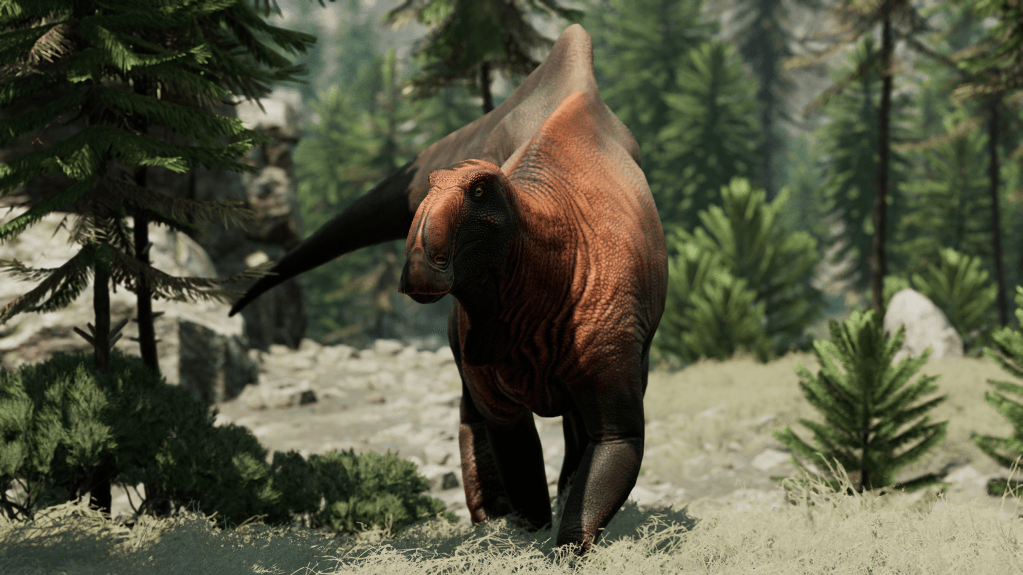
The Barsboldia is a Saurophine hadrosaur from the Late Cretaceous Mangolia. The Hadrosaurus belonged to the Ornithischian group- one of the two major divisions of dinosaurs, distinguished by their bird-like hip structure. Within this group, hadrosaurs are commonly divided into two subfamilies: Lambeosaurinae and Saurolophinae (also known as Hadrosaurinae). Members of the Lambeosaurinae subfamily are best known for their elaborate, hollow crests- examples include Parasaurolophus and Lambeosaurus. In contrast, the Saurolophinae lack these crests and are represented by genera such as Edmontosaurus and Barsboldia. The Barsboldia was roughly 32.8 feet (10 meters) in length, 13 feet in height (3.9624 meters), and weighs roughly 5,100 lbs (2313.321 kg)
Tier: 5
Dimorphism: None
Habitat: East Passage, Wollemi Forest
Diet: Herbivore
Active Times: Diurnal (Meaning active during the day and resting during the night)
Group Size: Unlimited
Defense: 2 individuals
Nesting Season: Spring
Offspring: Up to 5
Adoption: ✅
Behavior
Barsboldia are nomadic, migratory hadrosaurs. They are generally calm, mild-tempered animals unless threatened. They live in small groups, often a bonded pair, accompanied by a remaining relative that chooses to stay with them. While these dinosaurs typically travel in small numbers, they periodically merge into larger herds for added security, especially during long-distance migrations or when approaching areas with abundant water that also attracts predators.
During periods of heightened risk, such as the presence of large carnivores or when vulnerable hatchlings are present, Barsboldia are known to join mixed hadrosaur herds. This behavior likely increases vigilance and protection. (In-game, they can only formally “group” with their own species, but they can travel or nest comfortably around other compatible hadrosaurs like Parasaurolophus, Lambeosaurus, Edmontosaurus, and Iguanodon.)
Barsboldia are food-driven grazers, shaped by a constant need to move between feeding grounds. When resources become scarce, they can be surprisingly defensive, displaying warning calls, assertive posturing, and even forward kicks, behaviors that can occur not only toward predators but also between members of their own herd. Despite their size, they avoid lingering in one area for long; they stay only long enough to strip local vegetation before resuming their steady, nomadic trek across the landscape.
Don’t let their gentle nature give a false sense of security. Barsboldia are living tanks, capable of unleashing surprising power when pushed. Though typically peaceful grazers, they possess a resonant, thunderous vocalization used only in moments of extreme distress. This defensive bellow is so forceful that it can overwhelm and disorient nearby enemies, temporarily impairing their hearing and disrupting their ability to communicate or coordinate.
In the wild, this ability could turn the tide of an otherwise losing fight, giving the Barsboldia a critical window to escape or rally with their herd. While not used lightly, this powerful vocal defense makes the Barsboldia a force to be reckoned with when its safety, or the safety of its young, is at stake.
Courting Behavior
When the Earth begins to cool, all potential/participating Barsboldia will venture to East Passage for a chance of finding their mate. Late summer/early fall, this is the start of mating season for all Hadrosuars. During this time, Barsboldia become far more expressive and display-driven than usual. Males broadcast deep, resonant calls that can carry across great distances. These calls often transition into brief bouts of bipedal posturing, allowing the male to elevate his profile and visually emphasize his size and strength.
Females approaching a potential suitor will begin by sniffing and assessing him, examining his scent, posture, and overall condition. In response, the male performs a specialized courtship stretch: lifting one of his powerful hind legs slightly while extending his torso to highlight muscle tone, balance, and overall physical capability. This deliberate display is meant to show he is strong enough to defend her and stable enough to help guard future offspring.
The female ultimately makes the final decision. If unimpressed, she may simply turn her tail and walk away. A persistent male, however, may receive a firm tail sweep, a clear warning that his advances are unwelcome and that she is not to be pressured.
But if the male succeeds in catching her interest, the new pair transitions into gentle, bonding behaviors. These may include soft vocalizations, mutual nuzzling, and synchronized walking. A series of calm rituals that solidify their seasonal partnership. Once bonded, the pair remains together throughout the nesting and rearing period, cooperating closely to protect and guide their young.
Nesting and Offspring
Barsboldia will remain in East Passage to nest their young. This region offers abundant resources, particularly mud and rock ideal for nest construction. East Passage also supports hardy vegetation that endures through the winter, and its grounds are less frequented by large apex predators, making it a favored nesting area for many hadrosaurs and other herbivores.
These nesting grounds are not exclusive. They are often shared with other hadrosaur species, forming large communal nesting sites that provide safety in numbers. Mixed-species colonies increase vigilance, reduce the chances of surprise attacks, and allow multiple herds to collectively deter predators.
Once settled, pairs begin constructing their nests. Typically, the male takes on most of the nest-building responsibilities, gathering vegetation and shaping the nesting mound, while the female focuses on conserving energy and maintaining proper nutrition in preparation for laying her clutch.
After the eggs are laid, both parents participate in guarding and brooding. They rotate their duties: one parent stays on the nest to keep the eggs warm while the other leaves to graze and drink. Even during these short foraging breaks, the off-duty parent must remain within vocal range, using soft, resonant calls to stay connected and warn each other of potential dangers.
Nesting season is demanding. Parents must endure harsh winter storms, diminished plant life, and cutting winds while ensuring the eggs remain insulated and protected. If the pair perseveres, the offspring hatch in early spring as new vegetation begins to flourish.
Though Barsboldia are naturally calm creatures, their demeanor changes significantly around their young. They become fiercely protective, using aggressive calls, defensive posturing, and physical force to deter any threat. Despite this, they maintain a high degree of trust toward other hadrosaurs in the communal nesting grounds, allowing neighboring species to coexist peacefully near their nests.
Mandatory Traits
Off On My Own
When a Bars reaches sub-adult is typically when they venture off on their own and will become fully independent. Although they might see their natal family in the migration and in the nesting season.
Time To Settle Down
When a Barsboldia decides to nest, it returns to White Cliffs in late summer through early fall to seek a mate and prepare its nest. Eggs are laid shortly after pairing, and both parents spend nearly six months in incubation. By late winter to mid-spring, the young begin to hatch, waking to the first signs of returning warmth. Be ready to settle in for the season, and may the winter be merciful.
Optional Traits
Together We Thrive
Like their hadrosaur relatives, Barsboldia likely traveled alongside other hadrosaur herds during migration, benefiting from increased vigilance and the collective defense offered by mixed-species groups.
Safe Harbor
Some hadrosaurs, such as Barsboldia, may choose to remain in White Cliffs during nesting season rather than continue their migration. Their reasons can vary: some stay because many others are nesting there, some value the protection of a well-established communal nesting ground, and others may see it as an opportunity to join a new herd.
A Fractured Bond
Although rare, some Barsboldia make poor parents. This behavior is most common among first-time mothers who have endured an exceptionally harsh winter. The physical toll of incubation combined with hormonal changes and the overwhelming shock of new parenthood can lead to a deep, instinctive depression. When this occurs, the mother may become inattentive or careless around her hatchlings—accidentally stepping on them, neglecting their needs, or refusing to guide them through the early lessons of survival.
In such cases, the offspring instinctively turn to their father for support. Some males rise to the challenge and become capable single parents, guarding and guiding the young on their own. However, it is not unheard of for the male to abandon the situation entirely, fleeing the stress and leaving the vulnerable offspring behind.
When the parental bond fractures, the outcome for the young is grim. Without proper guidance, hatchlings often succumb to starvation, dehydration, illness, or predators. Yet there is one glimmer of hope: the Edmontosaurus. Known as one of the most nurturing hadrosaurs, an Edmont will often adopt abandoned Barsboldia young without hesitation, raising them as if they were her own and giving them a fighting chance at survival.
My Tummy Hurts
Most hadrosaurs (except Edmontosaurus and Lambeosaurus) experience digestive sensitivity when eating lilies. While they may resort to consuming lilies during times of food scarcity, doing so causes significant abdominal discomfort until they can find Red Ginger to soothe the ache. During this time, grunting, groaning, and increased aggression are common signs of distress.
Credit: Kamarooni
Sources:
https://dinopedia.fandom.com/wiki/Barsboldia
https://www.science.org/content/article/dinosaur-babies-took-long-time-break-out-their-shells#:~:text=Based%20on%20these%20data%2C%20incubation,like%20modern%20reptiles%20than%20birds.
Last Updated: 1/8/25
 Ashes of Apex Fantasy Realism