Brachiosaurus
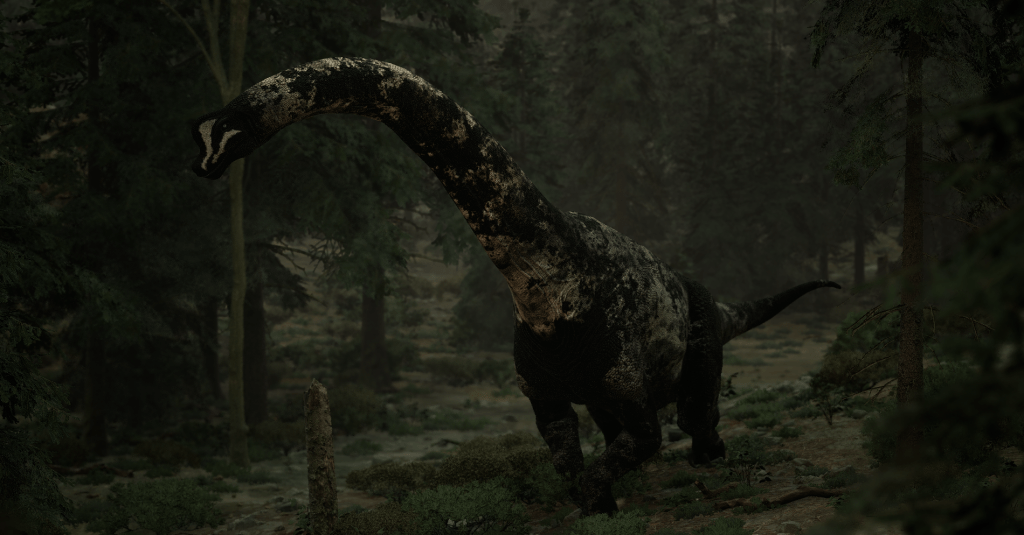
Brachiosaurus was a large, long-necked herbivorous dinosaur that lived during the Late Jurassic period, around 155 to 145 million years ago. It is notable for having longer front legs than hind legs, giving it a more upright posture than most other sauropods. Adults reached lengths of around 18 to 25 meters and were among the largest land animals known. Its long neck allowed it to reach vegetation high above the ground. Brachiosaurus had a relatively small skull with simple teeth suited for stripping plant material. Fossils have been found primarily in North America’s Morrison Formation, indicating that it lived in large, plant-rich ecosystems. Scientists infer that Brachiosaurus likely relied on its immense size to deter threats and, if necessary, used powerful body blows or kicks in physical confrontations.
Tier: 6
Dimorphism: Males, called bulls, typically have spiked bodies and necks, more so than females, known as cows.
Habitat: Cedrus Forest, Hollow Hills, Redwoods, Blackfern Hills, Dryfang Canyon
Diet: Herbivore
Active Time: Cathemeral. Brachiosaurus do not follow a strict day-night cycle, remaining active whenever needed, reflecting their constant forward movement.
Group Size: 2 Adults and their offspring during Spring only.
Defense: 1 adult
Nesting Season: Spring
Offspring: Up to 2
Adoption: ❌
Behavior
Brachiosaurus are large, nomadic sauropods with little patience for others. They spend most of their time moving in search of food, rarely staying in one place for long, and expecting space to be given rather than shared.
Most live alone, only crossing paths with others when they have to. Groups may form for a time, but they are loose and short-lived. Even when traveling near others, individuals keep their distance and act on their own.
They are known for their irritable nature. Crowding is not tolerated, and interactions can turn tense quickly. When pushed, their reactions can be sudden and forceful, making them difficult to stay around for long.
Offspring are not carefully managed and are expected to keep up. Those who fall behind are often left to fend for themselves. As they grow, they fall into the same pattern of independence.
At certain times, especially when males begin competing, this behavior becomes more aggressive. Encounters become more frequent and more dangerous, and avoiding them is often the safer choice.
Brachiosaurus is not a cooperative species. Being near one means keeping your distance, staying aware, and knowing when to move.
Courting
Toward the end of winter and into early spring, cows enter a receptive period, signaling their readiness through vocalizations that can draw bulls from across the area.
Bulls seek out and follow these sounds, traveling between cows and competing with rivals for access. When multiple bulls converge, encounters begin with posturing (? emote). Individuals size each other up and attempt to intimidate competitors. If neither yields, they may turn broadside and begin necking, swinging, and driving their necks into one another in an effort to force a rival to back down. If neither bull disengages, these clashes can escalate into direct combat, with fights intensifying until one bull withdraws by letting out a distress call or is killed.
Encounters may repeat until only one bull remains. Once rivals disperse, he may lay claim to receptive cows within the immediate area.
Cows remain in motion and do not significantly alter their routine. Receptivity is shown by allowing a bull to remain close as she moves toward her nesting ground. Bulls may align their movement with the cow, traveling alongside or slightly behind her. Brief physical contact, such as brushing or neck-to-body contact, may occur as they move. If a cow shows significant aggression toward him, the bull disengages and moves on.
A bull may take part in multiple courting interactions during this time, though each remains brief and does not form a lasting bond. Once courtship concludes, the bull separates and resumes independent movement.
Nesting & Offspring
After courtship, the cow will dig a nest and lay a clutch of eggs. If a bull has won multiple cows, they may nest nearby, increasing the overall chance of survival through numbers. Following courtship, bulls do not remain with the cows and play no role in protecting nests or guiding calves.
Once eggs are laid, the cow remains only long enough for one calf to emerge. Shortly after her calf can walk, she moves on, while any remaining eggs are typically abandoned and left vulnerable to scavengers. As a result, most cows are accompanied by a single calf, though two may occur if she lingers longer than usual.
While not overly attentive, the cow will respond aggressively to immediate threats, particularly when a calf is present.
Brachiosaurus do not actively manage multiple offspring. When more than one calf is present, the mother maintains a steady pattern of movement and feeding without adjusting pace or behavior to account for them. Calves are expected to keep up on their own, and those that fall behind may become separated as she continues forward. This frequently leads to natural separation, with slower or less aware calves becoming isolated.
Adults vocalize frequently, creating a broad acoustic presence across their surroundings. Separated calves may attempt to relocate their mother by following these calls.
After nesting, cows may form loose pods with their offspring, traveling in the same direction for safety while maintaining independent spacing and movement. These groups are uncoordinated and temporary, dissolving as calves reach sub-adulthood, though nearby cows may respond aggressively to threats that are in range of the calves.
Early life moves quickly. Hatchlings try to stay close to their mother, with instinct driving them to their feet and into motion almost immediately.
Juveniles face the highest risk, needing to remain close to their mother to survive. Distance and inattention often lead to separation at this stage.
As they grow, adolescents begin to steady out, becoming more aware of their surroundings and less dependent on constant proximity to others.
By sub-adulthood, Brachiosaurus are largely self-reliant, no longer depending on others for survival and beginning to transition into adult behavior.
Orphaned Behavior
Orphaned Brachiosaurus are vulnerable, and their survival rate on their own is low. If they are lucky enough, they may imprint on the first large sauropod they encounter, such as Ampelosaurus, Apatosaurus, or Argentinosaurus, following and behaving as a Brachiosaurus while treating the individual as a parental figure.
In these cases, the orphan will not exhibit Colossal Disdain toward larger sauropods, behaving as though it belongs among them. Despite this, it retains its own species instincts and continues to behave as a Brachiosaurus in all other respects.
These individuals may remain with their adoptive parent for extended periods, sometimes even into adulthood, only separating as instincts begin to assert themselves, particularly during maturity and breeding periods.
Brachiosaurus do not imprint on creatures that are not sauropods.
Mandatory Traits
Colossal Disdain
The presence of other large sauropods provokes agitation in Brachiosaurus. They become increasingly tense and will not tolerate staying near them for long. This may escalate into direct aggression, as Brachiosaurus will challenge other sauropods for food regardless of size or species if neither gives way. This behavior is driven by competition for resources, with Brachiosaurus viewing the other large herbivores as direct threats to available food. This disdain extends to other Brachiosaurus outside of the breeding period. While females may tolerate one another when traveling in a pod with offspring, this tolerance is limited and driven by necessity, and even within a pod, they may challenge one another for food if it becomes scarce. Argentinosaurus is the sole exception. When an adult Argentinosaurus is present, Brachiosaurus will leave the area rather than remain nearby.
Temper, Temper
Brachiosaurus is prone to irritability and unpredictable reactions. It does not tolerate closeness or cuddling for long. Overcrowding a Brachi will make it grumpy, even among those within a herd.
When agitated, Brachiosaurus will use forceful kicks to clear space around itself (using Pulverize front and rear kicks only). These outbursts are neither controlled nor selective and may result in injury to nearby creatures, including smaller herdmates. Smaller creatures are especially at risk of being maimed or killed if caught too close during these reactions. This behavior applies regardless of species, including other Brachiosaurus and its own offspring. There is little or no warning before these temperamental shifts occur. Its presence is heavy and uneasy, as it does not behave as a stable or reliable herd member.
Ancient Wanderers
Brachiosaurus is nomadic and routine. They maintain a steady, forward-driven pattern of movement and often return to familiar resting and feeding areas, rotating between them over time. It does not stop or adjust easily for others, often continuing through occupied space and expecting nearby creatures to move, even when they are grouped within a herd.
As they travel, Brachiosaurus will broadcast their presence across the area. This can reduce unexpected encounters with others of their kind and also serves as a warning to nearby creatures of the threat a Brachiosaurus may pose.
This behavior slows only during nesting, though even then it resumes shortly after a calf is born.
Solitary Bull
Adult bulls do not form herds and exist independently. Associations with other adults are limited to the breeding season and courtship and do not persist beyond it
Optional Traits
Morrison Menagerie
Brachiosaurus shows a higher level of tolerance toward certain species that share its native range, particularly Camptosaurus, Stegosaurus, Amargasaurus, and Euhelopus. These are the species it will most readily travel alongside and prioritize when grouping
Amargasaurus and Euhelopus are the only other sauropods Brachiosaurus will tolerate in this way under normal circumstances. An orphaned Brachiosaurus that imprints on another sauropod, such as Apatosaurus, may continue traveling alongside that individual into adulthood, perceiving it as part of its own social structure. This tolerance is not without limits and does not override its generally irritable nature.
Brachiosaurus may protect these herdmates at its own discretion. No more than one Brachiosaurus may be present in a mixed herd.
Gunning Period
As bull Brachiosaurus come into adulthood, they enter a phase of heightened aggression, driven by the need to prove themselves and impress nearby females. During this period, their temper shortens significantly, and they may react aggressively to almost any intrusion, treating surrounding creatures as challenges or nuisances. They will let out an aggressive call before attacking whatever has set them off, committing to driving it away (will chase three Brachi body lengths).
This behavior becomes more pronounced when multiple males gather near receptive cows, with tension rising quickly and fights between bulls becoming increasingly common as the breeding season approaches. Older, larger bulls may rely on presence and intimidation, displaying their size and scarred hides to push out younger or less confident individuals, while younger bulls are more likely to escalate into direct conflict.
This aggression fades as the breeding season passes or once a bull has driven off rivals and established himself with a receptive cow.
The Drifting Pod
Cows may travel within loose groups, sharing direction and space without forming a cohesive herd. These pods form after nesting and are made up of females and their offspring. Associations are fluid and uncoordinated, with individuals maintaining their own pace and spacing, though instinct keeps them together when calves are present. As they move, their size and feeding behavior often result in heavy disturbance, frequently stripping or flattening vegetation along their path.
Smaller species (tier 1 and/or tier 2) may group and travel alongside the pod in a scouting role. While they may move with the group, they are not considered part of the pod itself. These are not flamekin, as Brachiosaurus do not form bonds in such a way. The pod does not defend these scouts, prioritizing their own young and themselves.
Members do not remain tightly bonded, and individuals may drift ahead, fall behind, or separate entirely.
When threats arise, nearby cows will respond aggressively if they are within range, particularly when calves are present. No more than two cows may engage in defensive actions at a time, regardless of group size.
Credits: MisslilBlue and DragonRider
Sources:
https://www.britannica.com/animal/brachiosaur
Last updated 5/8/26
 Ashes of Apex Fantasy Realism