Cerataspida
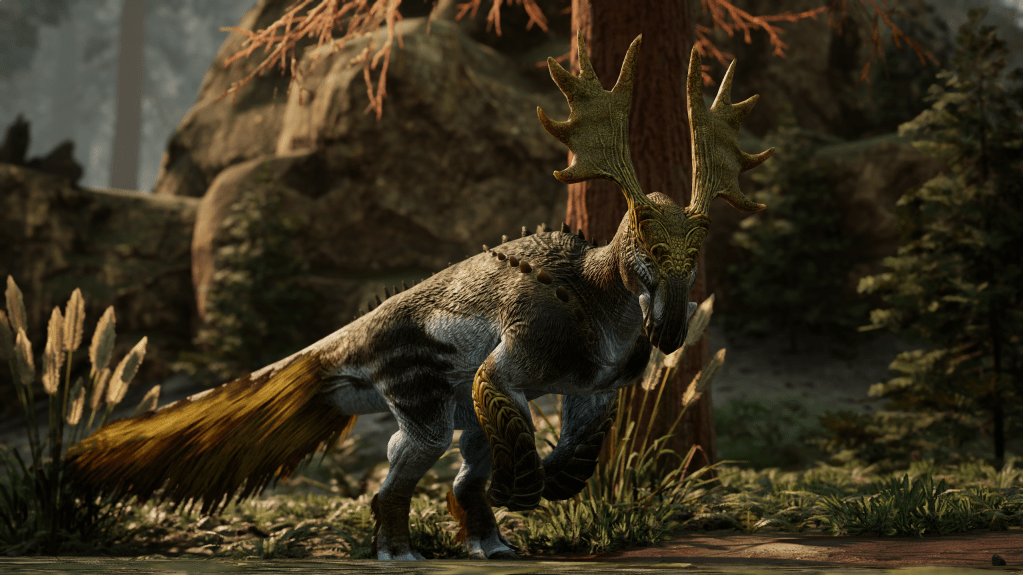
Cerataspida is a grazing herbivore and facultative biped that can be characterized by a large, robust body with armor-like scales, long wiry fur, massive antlers, and enormous forelimbs that have a padded glove appearance that is indicative of its immense strength. Its diet consists of fruit and other plant material, and its high demand for food drives it to migrate constantly. Cerataspida favor heavily forested habitats with dense vegetation where food is abundant and visibility is limited. Despite their fearsome appearance, they have a notable tolerance to smaller herbivores and allow them to remain nearby under their protection. Cerataspida possesses an intensely defensive temperament and will readily confront perceived threats before retreating.
Tier: 5
Dimorphism: Yes: Females, called “Does” have smaller antlers and lack fur on their faces and necks that are distinctive in males, called “Bulls”.
- Female subspecies include Doe
- Male subspecies include Common and Crowned
Habitat: Cerataspida prefer to nest in densely forested habitats such as Redwoods, Black Fern Hills, Cedrus Forest, Wollemi Forest, Hollow Hills, and Big Tree Island.
Diet: Herbivore, Frugivore
Active Times: Diurnal, meaning primary activity such as migrating and foraging takes place during the day, though some activity is carried out through the night.
Group Size: Unlimited
Defense: 2 individuals
Nesting Season: Spring
Offspring: Up to 5
Adoption: ✅
Behavior
Cerataspida are nomadic herbivores that rarely remain in one territory for long, constantly traveling in search of fresh vegetation. They are highly observant animals and rarely react without purpose, often relying on intimidation, positioning, and coordinated displays to control threats before engaging in direct combat.
Although fully capable of surviving alone, they will often welcome the presence of other herbivores, primarily of similar size and smaller, which commonly travel alongside them for protection. Cerataspida naturally assume a dominant role in herds and are extremely defensive of nearby herbivores once they have accepted them.
Cerataspida are notoriously intolerant of carnivores and react aggressively to their presence regardless of size. Even significantly smaller carnivores such as the Deinonychus and Compsognathus are often met with bluff charges, loud vocal calls, and forceful shoving and kicking intended to drive them away.
They are known to easily form Flamekin bonds with the herbivores they protect. Those they share this bond with experience increased affection, with Cerataspida often treating their Flamekin companions like one of their own, watching over and guarding them with notable dedication.
Courting and Nesting
During the breeding and nesting seasons, Cerataspida become much more social and territorial within their own species, often temporarily separating from their usual mixed-species herd structures to form smaller, Cerataspida-only groups focused on courtship, nesting, and raising young. Multiple bonded pairs may coexist within these herds, though older individuals tend to be more dominant, taking priority in access to food, nesting sites, and preferred resting spots.
Courtship usually consists of vocalizations, posturing, and a show of strength rather than outright combat. Bulls walk side by side and circle each other, using loud calls and beating their forelimbs together to seem as large and powerful as possible. Rarely do these competitions become combative, as bulls tend to prefer to remain in prime condition for defending the does and their young. These types of confrontations usually end with one bull backing down, and the other maintaining his status within the herd.
Bulls that are capable of asserting dominance without escalating into prolonged or injurious fights are generally favored, as unnecessary injuries can threaten the safety of the entire herd. Because of this, Cerataspida courtship tends to reward confidence, protectiveness, and stability more than outright aggression.
When a bull successfully pressures a rival into retreat or submission, nearby does often respond through subtle behaviors rather than immediate affection. A doe may remain close to a bull during travel and rest periods, mirror his movements, and respond to his vocalizations with calm body language and soft calls to signal trust and acceptance.
Does frequently nest near one another in loosely organized nursery groups located in secluded areas, hidden by shrubby or rocky terrain far from popular grazing sites and watering holes. Nearby adults instinctively assist in defending calves from predators or intruders. During this period, Cerataspida become significantly less tolerant of outsiders, and may engage in aggressive behavior to any creature roaming too closely to the nesting site
Once offspring reach adolescence and are capable of keeping pace with the migration, these family groups gradually reintegrate into the larger mixed-species herds. Cerataspida return to the same nesting grounds year after year, with older individuals often guiding younger members back toward familiar territory that is safer for raising offspring.
Mandatory Traits
Wandering Shepherds
Cerataspida are instinctively migratory and rarely remain in one territory for extended periods. Their immense appetite drives them to constantly seek fresh vegetation, often resulting in long-distance travel between feeding grounds. During migration, Cerataspida naturally gather and lead smaller herbivores, forming traveling herds that benefit from their imposing presence and defensive behavior. Cerataspida do not associate with sauropods, Paraceratherium, or Madrehorn, however, as their immense size, heavy feeding demands, and unpredictable temperaments make coexistence difficult during migration.
Get Ready to Rumble
Because of their natural tendency to assume dominance within travelling herds, multiple bulls may size each other up to establish a “Chief” or herd leader. These confrontations usually involve circling, loud vocalizations, tail whips, and pounding the ground with their forelimbs, but rarely escalate into a full-blown fight. Older and larger bulls naturally maintain authority over younger males through intimidation alone, although challenges from rival adults are not uncommon. If these interactions do become combative, bulls may spar until one competitor reaches 50% health before backing down and accepting their status within the herd.
Rival Guardians
Cerataspida see the presence of Daspletosaurus as not only a predatory threat, but also a challenge for control over their herd. Because of this, encounters between the two immediately escalate into a lethal confrontation. Cerataspida will attempt to drive off or kill any Daspletosaurus before it establishes itself among any hadrosaur herds.
Ring of Antlers
Cerataspida assume a defensive formation when their herd is directly threatened or ambushed. Does gather smaller herbivores and young toward the center of the group, forming an inner wall of antlers and mass around the more vulnerable herd members. Led by the Chief, bulls position themselves outward, creating an outer shield while behaving aggressively through threatening calls, swinging their forelimbs, and bluff charging to drive the threat away from the herd. While multiple Cerataspida may participate in this show of force, only two dominant bulls may directly engage an attacker at a time unless another individual is personally threatened.
- If no bulls are present in a herd, two does may engage with the threat.
- Cerataspida may initiate combat with carnivores that approach within two Cerataspida body lengths of any herd member after a warning call. (Threatening call)
Optional Traits
Close Companions
Cerataspida are known to share particularly close proximity to one another when traveling as a group. Usually, the Chief takes the lead, and the rest of the group takes up a close formation behind him. Each individual responds to slight changes in the Chief’s movement and the group moves smoothly and with cohesion, even in rough or narrow terrain.
Herd Lessons
Young Cerataspida are raised in tightly protected nursery groups where they learn behavior through observation and play. Calves mimic the movements and vocalizations of the adults, and they spend considerable amounts of time bonding with the herd and their siblings. Older individuals have patience with juveniles, guiding them along migration routes and instinctively placing them at the center of the herd for protection. As offspring mature, they gradually take on more responsibility within the herd and begin to participate in defensive displays.
Personal Space
Though typically docile in nature, the Chief Cerataspida may establish a small perimeter around himself in which he will only tolerate his Flamekin and other Cerataspida. Any creature that lingers within this perimeter for too long may be met with a swift headbutt or ground pound. These attacks are not intended to be lethal, but to signal that his space is to be respected, and that only those most closely bonded to him may be close for prolonged periods of time.
Mossy Beds
At night or during resting periods, Cerataspida show a strong preference for secluded and comfortable bedding sites. They lead their herd to mossy beds that are safely hidden among the trees to recover from the migration. Despite these periods of respite, one or more adults, usually bulls or older does, remain awake throughout the night to keep watch for predators and rotate in shifts with other adults until dawn.
Credits: Onlooker
Sources: from my heart
https://en.wikipedia.org/wiki/Moose
https://en.wikipedia.org/wiki/Bovini
https://www.nps.gov/articles/aps-v5-i1-c7.htm
Last updated: 5/17/2026
 Ashes of Apex Fantasy Realism