compsognathus
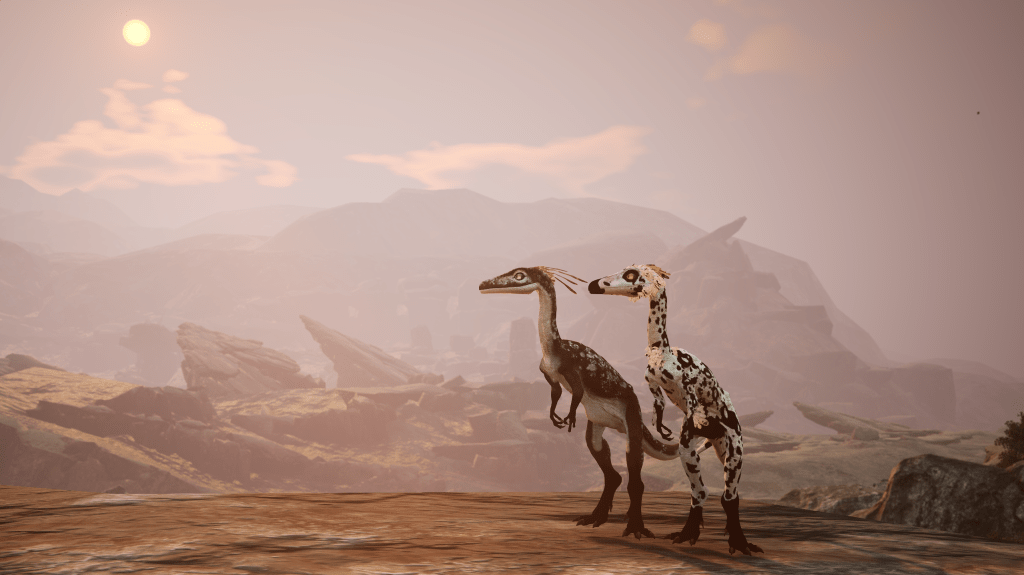
Compsognathus was a small bird-like Theropod, roughly the size of a chicken. Along with having very lightweight and hollow bones, while being a bipedal, it was also equipped with a long neck, long legs, and a long tail. Compsognathus were alive around 150.8-145 million years ago during the Tithonian age of the late Jurassic period, in what is now Europe. Some of the key physical characteristics of the Compsognathus include a slender body and three-fingered “hands” with claws. Its light weight allowed for very swift running, and its diet was preferably small prey such as lizards. They typically live in tropical forests or islands for security from certain prey.
Tier: 1
Dimorphism: Males are often slightly larger than females. (Typically more vibrant and distinct, using brighter or darker shades of green with specific markings) Females are slightly smaller than males (Are more muted or paler in color, with less distinct markings)
Habitat: Dry Fang Canyon, Steep Run, Black Fern Hills
Diet: Carnivore
Active Times: Nocturnal (Sleeps during the day and is active at night)
Group Size: Up to 20
Attackers/Defenders: 10
Nesting Season: Spring and Summer
Offspring: Up to 5
Adoption: ✅
Behavior
The Compsognathus is a very small and agile carnivore that thrives in its habitat, or Island/Tropical Archipelagos, and is unlikely to engage in long-distance migrations(Static), while it is most likely restricted to moving around its Archipelago to find food, shelter, and suitable nesting sites. The social behavior of the Compsognathus is very cooperative, living and hunting in flocks or packs(5-10) for cooperative hunting of small prey such as lizards and insects. But also potentially larger animals while in swarms(12+). With some sources pointing to them being in a “hierarchy” of sorts, being led by the older or more dominant individuals, the eldest mated pair, or their offspring. The Compsognathus is a friendly creature unless provoked, relying much on its agility and speed to retreat if necessary. Much evidence suggests that they lay eggs in communal nests, and juveniles are capable of following the pack just a matter of days after hatching. Compsognathus are also incredibly vocal, using chirps, squeaks, and whistles to communicate with each other.
Mandatory Traits
Comp Army
They form groups of unlimited size to increase their chances of taking down their prey, and because they don’t count as a BD, they are allowed to continue a hunt until their numbers fall below the required hunting threshold for that specific hunt. Group size minimums for hunts are: Tier 2: 2, Tier 3: 4, Tier 4: 6, Tier 5: 8, Tier 6: 10.
Natural Curiosity
Compsognathus have incredibly good eyesight for their size; therefore, they are very curious about anything that is in their line of sight(LOS) and will run towards it to figure out what it is while chirping or squeaking. After discovering whether friend or foe, they will stop chirping and squeaking.
Unfavored Friends
Compsognathus are not scared of many things due to their agility, speed and small structure. However, there are two creatures they are not happy to see in the slightest the Cougar and the Smilodon. This is due to the Cougar’s ability to keep pace with them and the fact that Smilodons can pick them up and thrash them violently.
Preferential Treatment
Compsognathus that are Albino or Melanistic, won’t be shunned or forced out of the pack; however, they will be easily “forgotten” in the pack and will be left behind when the pack begins to move or leave the POI it is currently in, and will be last to eat during meals.
Misfit Policy
Compsognathus that are Albino or Melanistic, can choose to leave their packs and form packs that hunt only at Night, with Albino Compsognathus acting as decoy’s to lure larger prey in while the Melanistic Compsognathus lie nearby waiting patiently and ready to pounce on unsuspecting prey that are unprepared for an onslaught of Comps they can’t even see due to the darkness of the night.
Optional Traits:
Socially unavailable
Compsognathus can be incredibly self-sufficient and solitary; however, if it finds a suitable mate, it can either choose to stay with the family or become solitary again. In doing so, it will immediately leave the nest once all the eggs have hatched because they cannot yet “chase their father,” since they are not normally involved in the pack until juvenile or if they have already been following a large carnivore for a long period of time.
Wanderer
Compsognathus, due to its incredibly nimble and swift body, was able to travel long distances since it had these features that allowed it to be very balanced. At its top speed (40mph/64kph), it could be found in many different areas, such as in HooDoo Expanse, visiting its distant relative, the Deinonychus.
Spring Bleeding
During Spring, Compsognathus famished by a long cold winter head out in search of dinosaurs who may be sparring for dominance. The Compsognathus upon seeing death scars or bleed will violently and rapidly pounce on the weaker dinosaur until it is downed. If carnivore, this does not count as a body down for Compsognathus, only for the sparring Dinosaur that wasn’t killed in battle, Compsognathus is allowed to freely scavenge as a reward for assisting in this kill. If herbivore, this will count as a body down for Compsognathus and the group of Comps must remain with the body until it despawns.
Follow the Bleeder
Compsognathus, since it loves scavenging, may follow larger carnivores for easy meals, such as the Allo or Maip. They will also follow other creatures that they know will provide bleed to creatures in order to join in on a fight for rights to scavenge after.
Credits: IveMcFallen
Sources:
https://en.wikipedia.org/wiki/Compsognathus
Last updated 10/20/2025
 Ashes of Apex Fantasy Realism