Dankanaptera
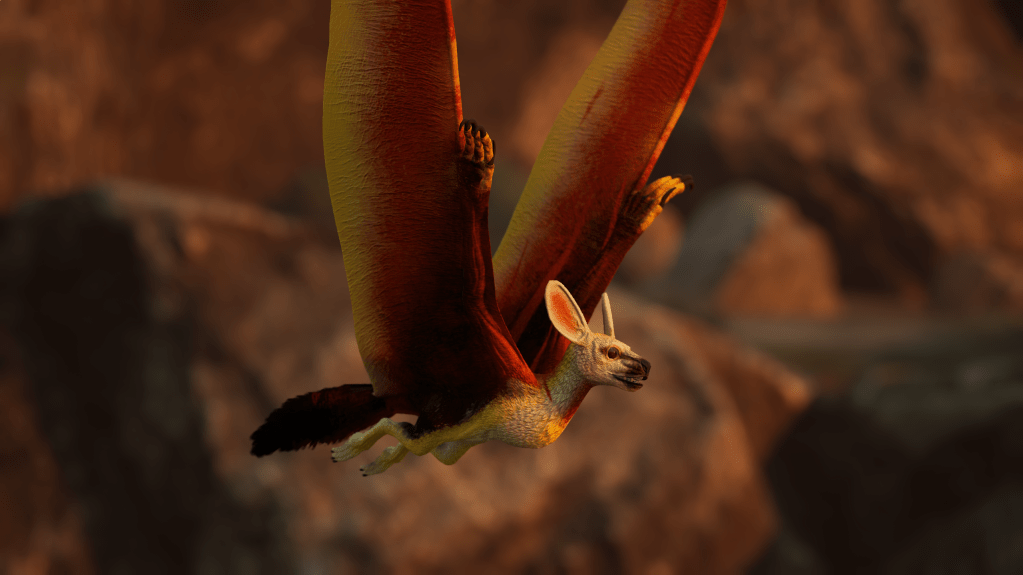
Dankanaptera is a small, bat-like mammal with a diet that consists primarily of fruit and fibrous plant material. They are semi-terrestrial, travelling on all fours when grounded, and otherwise using their impressive wingspans to glide long distances, conserving energy as they travel between feeding grounds and along migration routes. Though they are passive, they are known to harbor diseases like rabies in their saliva, which is commonly used as a defense mechanism. Dankanpatera are social and prefer to maintain tight bonds with members of their own kind, forming groups, called “colonies,” that grow to numbers in the dozens. With their powerful senses, such as acute hearing and an incredible sense of smell, they are highly adapted foragers and flyers that are able to locate food and navigate low-visibility conditions. While not built for direct confrontation, their awareness and agility make them difficult targets, allowing them to evade predation through quick escapes and coordinated group behavior.
Tier: 1
Dimorphism: Yes, males have thick collars of fur on their chin, neck, and back. This fur is called a mane, and females do not have it.
- Female subspecies includes Female and Wyvern
Habitat: Dankanaptera prefer to nest on highly elevated cliff ledges and under secure rocky overhangs near freshwater sources, though they can sometimes be found nesting in small caves as well. Dankanaptera can nest anywhere in Riparia.
Diet: Herbivore, Frugivore, Insectivore
Active Times: Cathemeral, active day and night, sleeping sporadically.
Grouping & Defense:
- A colony can contain 2 Dankanaptera per large herbivore, meaning a herd of 10 Tier 3+ herbivores can be accompanied by a colony of 20 Dankanaptera (maximum).
- Dankanaptera may not defend their herd or Flamekin host.
- Dankanaptera may only engage in combat when cornered, nearly out of stamina, or otherwise cannot fly or escape.
- Dankanaptera may scout for herds and alert to a predator’s presence.
- Colonies must disperse if their herd disperses. Dankanaptera may stay in family groups or groups of up to 7 individuals.
Nesting Season: Spring and Summer
Offspring: Up to 5
Adoption: ✅
Player Tip:
Dankanaptera may only group with a herd if a Flamekin bond has formed with a large herbivore. Server and profile Flamekin grouping rules apply. If a colony is actively forming, Dankanaptera may group with each other and stay in the same general area as the herd. Colonies are encouraged to communicate with their herd via local chat.
Behavior
Dankanaptera occupy a delicate and unusual niche within their environment. They divide their time between quiet foraging and opportunistic interactions with much larger herbivores. Though they regularly consume fruit, nuts, and plant matter, they are drawn to the presence of grazers, who harbour a secondary, highly valued food source: parasites.
With cautious movements and keen awareness, Dankanaptera quietly approaches these grazing herbivores to land lightly upon them and to begin picking away at the parasites, dead skin, and other debris on their hides. When tolerated, the Dankanaptera moves to rid their host of irritating debris before lifting off again.
These relationships exist in a balance, with some creatures remaining indifferent to their presence or simply lacking the energy to protest. Some herbivores, such as the Iguanodon, however, tend to react with agitation, snapping, or shaking in an attempt to dislodge the unwelcome visitor. For the Dankanaptera, each landing is a measured risk guided by subtle cues like posture, movement, and tension sensed in the host.
Dankanaptera are rarely solitary. Groups often gather where large herds roam, in places along migratory routes and within nesting habitats. Each individual group member maintains contact with yips, howls, and barks. A single startle can send the whole group scattering into the air, only to circle back to their hosts once calm has returned.
They are naturally wary of all carnivores, as they are not adapted for direct confrontation or combat. Their first instinct is to flee, then observe the herd interactions from afar. They only return once they can no longer see the carnivores from their vantage points, reinforcing to their herds that the territory is once again safe for roaming.
If a Danakanaptera ever finds itself cornered, it has methods of deterring predators. Its first line of defense is to make itself look as large as possible, stretching their wings and puffing out their fur in an intimidating display. Their last resort is to pounce on the threat and bite them repeatedly, transferring toxin and disease via its saliva. This does not come without great risk to the Danakanaptera, who will disengage if they still have enough stamina to escape.
Flamekin Behavior
On rare occasions, Dankanaptera form a deeper, more enduring association with a single larger creature, resulting in a relationship often referred to as a Flamekin bond. Unlike their usual fleeting visits, these individuals remain close to their host for extended periods, shadowing its movements and returning to it repeatedly throughout the day and night.
The Dankanaptera benefits from a reliable source of parasites and scraps, while the host grows accustomed to its presence, benefiting from its healing qualities and environmental awareness, reacting with little to no resistance. Over time, a quiet familiarity develops, and the Dankanaptera moves with greater confidence around the migration zone or nesting site.
Courting and Nesting
Dankanaptera form persistent pair bonds and rely almost entirely on vocalizations for courtship. As the breeding season approaches, their colonies grow louder and more animated, filling with layered calls that range from soft chirps to echoing cries. Individuals will single one another out from the crowd, engaging in repeated call and response exchanges. The pair will stay in close proximity to each other and maintain their call and response within the chorus of the colony to establish their bond.
After a pair has been established, they will split off slightly from the colony to seek out a suitable nesting site. Dankanaptera favor elevated and secure nesting locations that are impossible to access by terrestrial creatures, and hidden from sight by aerial predators. Females produce up to 5 young, and both parents take equal care in raising the offspring. The entire family exists within the wider colony, which adds an extra deterrent to predators during nesting.
As the nesting season ends, gatherings of multiple colonies move on with their respective herds. If a bond is formed between two individuals from different colonies, the male always follows the female and her herd when Summer arrives and migration resumes. Offspring will follow their mother until sub-adulthood before dispersing into the wider colony or moving on to find a herd of their own.
Mandatory Traits
Flying Flamekin
Dankanaptera are rarely found far from the presence of larger herbivores, to which they are instinctively drawn. While capable of sustaining themselves on fruit and plant matter, they habitually seek out living hosts, circling herds and settling among them in search of parasites. Prolonged isolation is uncommon, and solitary Dankanaptera will remain compelled to keep moving in search of a herd to maintain close proximity to.
- Dankanaptera may be a Flamekin for terrestrial herbivores.
Fragile Form
Light-bodied and delicate, Dankanaptera are ill-suited for confrontation of any kind. At the first sign of danger, they rely on swift retreat, taking to the air and scattering into nearby cover. They do not challenge threats, nor do they linger near active combat. Survival depends on awareness and escape, not resistance and aggression.
Hive Mind
Dankanaptera are creatures of constant connection. They form enduring bonds with the herds they frequent, and over time, a given group will be seen as “theirs” by the colony. They don’t guard these herds, and they don’t assert ownership with aggression, but they remain closely attentive to them, circling, returning, and settling among familiar individuals. They have been noted to alert “their” herd to an unknown presence should anyone wander close to the group.
Optional Traits
Naturally Gifted
Dankanaptera are born with an instinctive ability to fly. As early as their juvenile stage, offspring take their first tentative leaps from the nest, managing short gliding flights. Safely within the protection of the colony, they gradually build strength and confidence, venturing farther with each attempt. By adolescence, they travel alongside their parents to feeding grounds and move freely throughout the colony, fully at ease in the air.
Riders on the Storm
With water-repellent, membranous wings, Dankanaptera navigate rainstorms with remarkable ease. Rather than seeking shelter, entire colonies take to the skies, circling, diving, and gliding through wind and rain. Even in these moments of apparent play, they remain vigilant, constantly scanning for threats to the herd.
Forest Forager
When not cleaning parasites and debris from their hosts, Dankanaptera uses its sharp sense of smell to find ripening fruit, such as melons, to feast upon. These sugary treats are such a source of happiness that Dankanaptera may even attempt to body block others from access, “protecting” its food from even its closest relatives.
Credits: Onlooker
Last updated: 4/15/2026
 Ashes of Apex Fantasy Realism