Dimetrodon Grandis
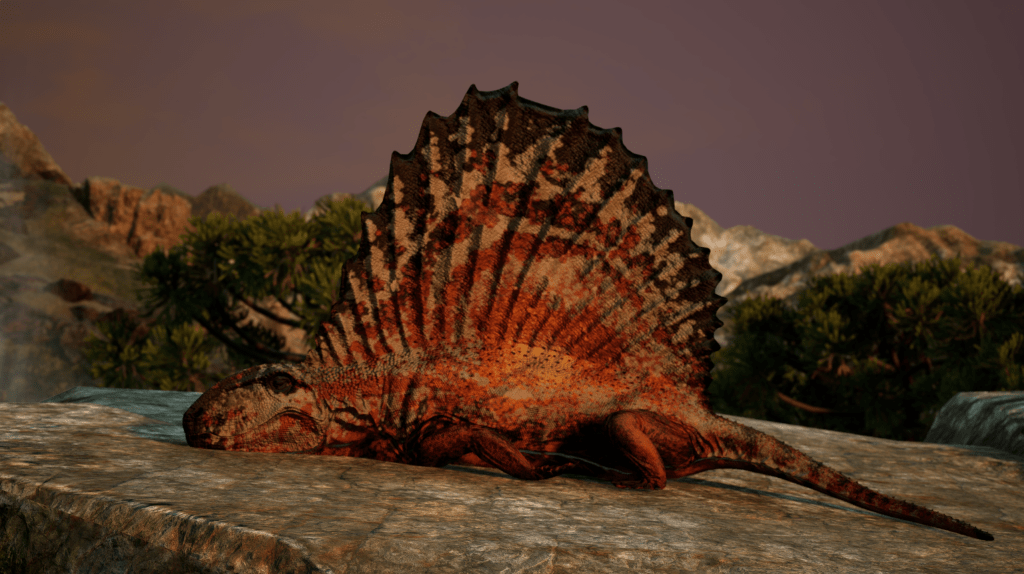
Dimetrodon grandis was a large sail-backed synapsid that lived during the Early Permian period, approximately 295 to 272 million years ago. A close relative of Dimetrodon milleri, it reached lengths of around 3 to 3.5 meters, making it nearly three times larger and one of the bigger species within the genus. Despite often being mistaken for a dinosaur, it was actually a non-mammalian synapsid and is more closely related to mammals than to reptiles or dinosaurs. Its distinctive dorsal sail, formed by elongated neural spines connected by skin, was more prominent in larger species like D. grandis and was likely used for visual display and possibly thermoregulation, though the exact function remains debated. As a terrestrial carnivore with differentiated, serrated teeth adapted for slicing flesh, D. grandis occupied a high predatory role within Early Permian ecosystems, behaving as a formidable hunter but not an indiscriminate threat outside of feeding behavior.
Tier: 2
Dimorphism: Males display their teeth and have a lower peaking crest (Subspecies: Borealis, Limbatus) with more vibrant shades as opposed to females, which display duller shades and a higher peaking crest (Subspecies: Grandis)
Habitat: Can be found nesting anywhere is Riparia and Gondwa. Suggested areas:
- Riparia: Coastland Swamp, East Passage, Volcano Islands
- Gondwa: Mudflats, Rockfall Hill, Rainbow Hills
Diet: Carnivore
Active Times: Cathemeral (Active during both day and night on an irregular basis)
Group Size: 8 Adults with 5 offspring up to subadult age (can be increased to 10 adults with 3 offspring up to subadult with certain roles)
Attackers/Defenders: 6 individuals
Nesting Season: Spring and Summer
Offspring: Up to 5
Adoption: ✅
Behavior
Despite its relatively small size, the Dimetrodon Grandis is highly social. While it readily acknowledges that, to most smaller land creatures, they are easy prey and may be hunted without hesitation, this does not diminish its tendency to interact frequently with others by sprinting past nearby creatures and using an alert call to “say hello,” though it does not stop to do so. For this reason, they are known as the “No-Context Screamers.” They can also be found basking fully in the sun to absorb as much heat as possible, and while doing this, they will often take a short nap. They may also rest in hot springs, using the warmth of the water like a heat blanket, much like the sun.
Courting
During courtship, male Dimetrodon Grandis initiate the Sunflare display by positioning themselves broadside in direct sunlight, slowly adjusting their bodies to fully illuminate their sails. The displaying male may perform short calls or low vocalizations while maintaining this posture. If multiple males are present, they may posture or attempt to out-position one another to secure the most visible display space. The female observes and signals acceptance by approaching and settling near the chosen male, often circling once before doing so. Rejection is indicated by the female walking away in clear disinterest.
Nesting and Offspring
After courtship is accepted, the pair relocates to a sun-exposed nesting site, favoring open ground near reliable heat sources such as sunlit rock beds or geothermal terrain. The female selects the final nest placement, often choosing a position with strong visibility and consistent warmth. During nest establishment, the male remains nearby, maintaining a visible perimeter rather than hovering directly over the nest. While not overtly aggressive without cause, both adults become more alert and vocal when unfamiliar creatures approach the nesting area.
Once hatchlings emerge, they remain close to the mother during early growth stages. Offspring may compete for basking space or preferred positions near a parent through brief nudging, posturing, or snapping. Minor sibling tension is considered natural and does not automatically require adult intervention unless true harm is intended. Younger offspring are expected to stay within visible proximity of at least one parent and avoid unnecessary confrontation. As they mature to adolescent, they gradually shift from tight clustering around the mother to looser proximity, learning basking locations and movement patterns through observation.
As subadults, Dimetrodon Grandis become increasingly independent and less tolerant of tight sibling clustering. They may test dominance through posture, heat-spot competition, or brief displays, but typically avoid sustained conflict. Subadults begin roaming farther from the family unit in short excursions, returning to familiar thermal areas while building confidence and self-sufficiency.
Mandatory Traits
No-Context Screaming
The Dimetrodon Grandis is known for sprinting past other creatures and using its Alert call at seemingly random times, without engaging or stopping.
“We Are The Island Bois”
The Dimetrodon Grandis does not typically remain on a single island for long periods unless its mate is present and they are nesting. While it is not known for strong swimming capabilities, it will travel by hopping from island to island rather than crossing large stretches of open water at once.
Thermal Lurker
The Dimetrodon Grandis instinctively seeks out sun-drenched stones, volcanic vents, and other heat-rich terrain, often remaining motionless for extended periods to absorb warmth through its sail. During colder hours, it prioritizes thermal refuge over roaming and rarely strays far from reliable heat sources.
Optional Traits
The Nickel and the Dime
Dimetrodon Grandis and Dimetrodon Milleri readily tolerate one another, often forming loose mixed groups for basking, travel, and shared awareness of threats. Rather than competing for dominance, the larger Grandis naturally settles into outer or forward positions, while the smaller Milleri remain closer to the center during rest or migration. When basking, they comfortably share sunlit rock beds, geothermal vents, or open clearings without territorial disputes. Minor displays, such as slow sail flares or low huffs, serve as communication rather than intimidation. True aggression between the two is rare and typically occurs only if food scarcity or direct harm creates tension, reinforcing a bond built more on shared survival than rivalry. *Max of 8 Grandis and 3 Milleri are allowed in the group.
- Milleri present in the group are unable to help in attack/defense unless there are only 2 Grandis in the group.*
- Grandis cannot flamekin for a higher-tier carnivore when grouped with a Milleri.
Sail Recognition
When encountering another sail-backed species (Spinosaurus, Concavenator, Ichthyovenator), the Dimetrodon Grandis becomes immediately alert and may use an Alert call or brief posturing display upon first sight. This reaction reflects recognition of a similar silhouette rather than automatic aggression. They may briefly shadow or observe sail-backed creatures from a measured distance before deciding whether to approach, settle nearby, or leave the area.
Shadow of the Sail
When basking near a large sail-backed species (Spinosaurus, Concavenator, Ichthyovenator), the Dimetrodon Grandis may choose to remain within visible proximity rather than relocating. They do not behave submissively, but instead position themselves confidently along the outer edge of the larger creature’s presence. This proximity is calculated using the dominant silhouette as a deterrent to possible threats. If the larger sail species displays aggression, the Grandis will leave the area without hesitation.
Credits: IveMcFallen and MissLilBlue
Sources:
https://www.museumofevolution.com/the-permian-period/dimetrodon
https://www.britannica.com/animal/Dimetrodon
https://www.britannica.com/animal/Komodo-dragon
Last updated: 2/18/26

