Dominus
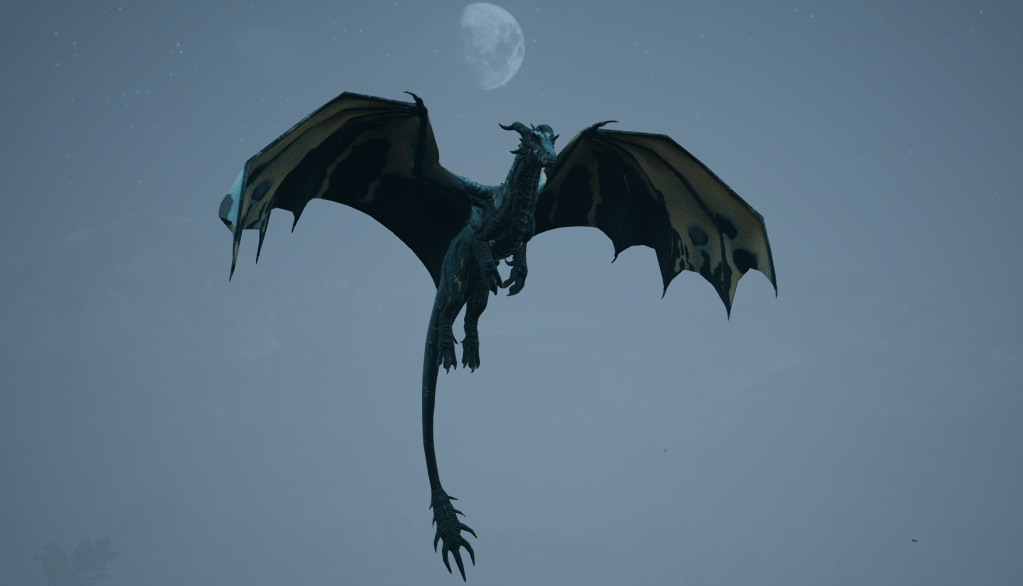
The Dominus is believed to descend from a nearly-forgotten lineage of primordial dragons whose nesting grounds once dotted ancient Gondwa, long before the asteroid that shattered their world and scattered their kind across distant lands. As legends tell, only a handful of unhatched Dominus eggs remained hidden deep within volcanic caverns when the exodus began, left behind by parents who fled the impending sky-fire. These rare survivors eventually hatched in isolation, creating the modern Dominus: a relic of a vanished era, shaped by ancient instincts and a legacy of conquest.
The Dominus is built for both power and endurance. Its body is armored in layered, volcanic-black scales interlocked like ancient stone plating, each reinforced by heat-resistant keratin and mineral deposits absorbed from its environment. A ridge of swept, jagged spikes runs from crown to tail base, with its face shielded by a dense cluster of smaller defensive spikes and curved, fortress-like horns meant to deflect claws, teeth, and projectiles alike. Its tail ends in a heavy spiked club, a bone-mace evolved for smashing threats on land or breaking armor in aerial combat.
Though stocky, the Dominus stands on four powerful, compact limbs, each ending in three hooked talons that anchor it against wind shear and allow stable landings after long glides or high-velocity dives. Its massive wings unfold from a reinforced shoulder girdle, capable of sustaining sustained soaring flight despite its bulk, much like a thermal-riding eagle or pterosaur, but magnified by draconic muscle and ancient magic-like biology.
Internally, the Dominus carries a remarkable heat organ system: a network of gas sacs and chemical reservoirs near the stomach that produce intense exothermic reactions when compressed and channeled. When provoked, this mechanism pressurizes and ignites expelled gases, unleashing a concentrated blast of fire capable of glassing sand and charring bone. Their internal warmth also serves a role in metabolism and egg incubation, echoing myths of dragons nurturing flame within.
Dominus dragons are fiercely territorial, born from a lineage that once ruled volcanic cliffs and storm-scarred peaks. They are not merely beasts of destruction, but survivors of an age-ending catastrophe. The final echoes of the original Lords of Gondwa, carrying memory and fire within their blood.
Tier: 5
Dimorphism: No gender specific dimorphism, but leaders (M or F) will be the most vivid in coloring.
Habitat:
Dominus favor cave systems, tunnel networks, cliffside dens, and shaded mountain terrain within these regions, particularly the cave maze along the mountainsides of northern East Passage. Deep stone shelter and limited sunlight are strongly preferred, allowing the Dominus to avoid excessive heat while maintaining defensible territory and elevated vantage points.
Riparia: Wind Tunnels, Dry Fang Canyon, East Passage
Gondwa: Red Island, Death Valley in Titan’s Pass, Stego Mountain
Diet: Carnivore
Active times: (Adaptive) Active during the cooler portions of the day due to overcast skies, rain, snow, and night sky.
Group Size: 3 adults/sub-adults or 2 adults and their offspring.
Attackers/Defenders: 2 adults/sub-adults
Nesting Season: Spring and Summer
Offspring: Up to 2
Adoption: ❌
Behavior
The Dominus is a highly selective apex whose behavior is shaped by distance, loyalty, and old instinct. It does not spend time around others without reason, and most interactions are brief, watchful, and controlled. Space is often preferred, but not every bond is refused.
Much of its life is spent alone or at a distance from others, yet it is not defined by solitude alone. Certain bonds are accepted and held closely, especially with mate and bloodline. These connections are few, but they run deep, and they shape how the Dominus moves through the world. The Dominus does not form bonds with creatures outside of its accepted bloodline and allied Spearcrests.
Behavior shifts with circumstance. Alone, it is cautious, observant, and slow to commit. Within accepted bonds, it becomes more direct, more protective, and far less tolerant of intrusion. What it allows near is chosen carefully. What it claims as its own is defended with intensity.
The Dominus carries an ancient predatory instinct toward dragonkind. To it, draconic creatures are not only rivals, but prey. When hungry, it will instinctively prioritize hunting other dragonkind over ordinary creatures whenever the opportunity presents itself. Within its chosen territory, the presence of unrelated dragonkind is rarely tolerated for long. Dominus defend their habitat fiercely against draconic intrusion and will attack rival dragonkind without mercy to drive them out, establish dominance, or eliminate competition entirely.
Even these instincts do not fully consume the Dominus’ nature. Closeness is not constant. Distance still has its place, and companionship does not erase what it is. The Dominus remains a creature that values space, acts with purpose, and carries both fire and memory in the way it responds to the world.
Courting
Courtship is rare and guided by instinct, and Dominus will not tolerate the presence of multiple suitors. Initial encounters between unrelated Dominus are dangerous, as instinct does not immediately separate a potential mate from a potential predator.
A Dominus takes interest in another that proves itself through action, not display alone. Clean kills, precision in flight, and the refusal to back away when space is challenged are what draw its attention. When one takes an interest, it keeps its distance, circling slowly, gliding overhead, or watching from a high vantage point. Its presence is announced through low, resonant calls and bursts of flame, as a display of power. The other does not retreat. It holds its ground under that pressure, continuing its movement or hunt without panic or avoidance. Courtship is a measured tolerance between two creatures. When neither yields, the distance between them closes. Acceptance is shown when both spread their wings and perform the (?) emote.
Once accepted, the bond is permanent. It will only remain in the company of its mate and bloodline, forming a small, fiercely loyal family circle. Any other Dominus that lingers nearby is treated as a direct threat and must be driven off or killed. To harm one of their own is to provoke an ancient fury. Their lineage remembers loss, exile, and the ancestral flight from the asteroid’s wrath, and that memory lives on in how they defend what is theirs.
If a mate is lost, the remaining Dominus will withdraw for a time, becoming more distant and less tolerant of others before eventually accepting another. However, it does not do so quickly.
Nesting and Offspring
A bonded pair will settle within secluded cave systems, cliffside dens, or winding mountain tunnels. Elevated stone terrain and deep shade are favored, where wind and rock offer both vantage and protection.
The nest is hallowed ground and defended without exception. Anything that lingers too close is treated as a potential threat, even without offspring present.
Egg incubation is a sacred act. Dominus will raise no more than two offspring from a clutch. It uses its internal heat to maintain the eggs, carefully regulating its flame to sustain life. One parent may leave to hunt while the other remains, but the nest is never left exposed for long.
When the young hatch, they are recognized as part of the Dominus’ bloodline and protected without hesitation. Dominus do not adopt unrelated offspring or raise creatures outside their own lineage. Any creature that approaches too closely, lingers with intent, or fixes attention on the brood is met with immediate aggression. Within close range of the nest, hesitation is not given, and parents will chase and bite at a threat up to three Dominus body lengths away or until the threat is out of line of sight, whichever occurs first. Fire is not used in defense around the nest when offspring are present.
The pair remains with their young, raising them within the safety of their nest until they are capable of surviving on their own. The young do not emerge strong. They are shaped by the territory and by constant exposure to their parents’ behavior.
Hatchlings remain close to the nest site under direct supervision, rarely straying, with cautious, low-to-the-ground movement. Juveniles begin exploring short distances, venturing farther from the nest while still keeping close enough to return quickly. They observe nearby parental hunts, grow bolder, and begin testing short glides from cliffs or slopes. As adolescents, they begin to follow prey without initiating combat and hunting small critters for practice. By subadult age, they begin participating in hunts under parental guidance, though they do not lead engagements.
Adult offspring will typically leave to establish themselves elsewhere. If parent and offspring encounter one another later in life, they may acknowledge each other through brief affection before moving on. However, if an adult offspring is attacked within line of sight, the parent may intervene in its defense, but only for the duration of that conflict, as their bond is never broken except in death.
Orphaned Behavior
For orphaned Dominus, survival depends on self-sufficiency from the start. As hatchlings, they hunt small critters but stay close to cover, using terrain and early flight to escape danger, taking to the air as soon as they are capable to avoid larger predators or aggressive encounters.
This early pressure shapes their development. They learn to survive in a much harsher environment and are made wiser by their isolation and stronger because of it.
By adulthood, this carries forward. Orphaned Dominus are more likely to remain solitary, slower to approach a potential mate, and more cautious when closing distance during courtship. They observe longer, commit later, and avoid unnecessary risk even when fully capable.
Mandatory Traits
Devouring Flame
The Dominus does not recognize all dragonkind as kin. To it, unrelated draconic creatures are often viewed as rivals, prey, or both.
Draconic Acrocanthrosaurus are commonly targeted due to their appearance. Noviana are also favored prey, though their speed and armor-piercing bite make them dangerous to underestimate. Unrelated Dominus are viewed as direct rivals, and violent conflict between them is common when territory, food, or dominance overlap. Lesser dragonkin, such as solitary Dracovipers, may be hunted opportunistically within shared territory, often requiring patience or stealth to catch unaware. Bristlewings and Thalasrex are also recognized as draconic prey and competitors when encountered.
If a Dominus witnesses another unrelated Dominus actively hunting or attacking another creature, it may intervene and redirect its aggression toward the hunting Dominus instead of the original prey. The passing Dominus may third-party the encounter, treating the occupied hunter as an opportunity to challenge and kill a rival Dominus while it is distracted.
This instinct does not extend toward bonded mates, offspring, its accepted bloodline, or allied Spearcrests. Those recognized as part of its fire are defended with the same intensity shown toward prey outside it.
My Partner in Crime
To a Dominus, alliance is rare and sacred. Yet the Spearcrest is an exception; its electric abilities resonate with the Dominus’ fiery nature, stirring ancient instincts of shared hunts among elemental kin. When a solo Dominus witnesses lightning crackle along the Spearcrest’s form, it does not see competition, but a kindred predator forged by storm and flame. It will hunt alongside Spearcrests willingly, defending them as trusted partners and marveling at their thunder-born power as if remembering a forgotten age when dragons and storm-beasts ruled together.
Is It Hot in Here?
Despite wielding fire, the Dominus is highly sensitive to heat. Its inner flame requires careful balance; too much external heat risks igniting internal pressures and exhausting its energy reserves. Thus, during harsh daylight, they remain hidden in caves, deep forests, or volcanic shadows, emerging only when their hunger level falls below 40% or their thirst level falls below 50%. But when night falls, the Dominus awakens fully, a silent titan gliding through moonlit skies, feeding freely at 60% hunger and drinking without restraint. Darkness is their domain; in cool air, their fire burns purest.
Pride in the Flames
Among all creatures, only the C-Rex dares mimic the sacred breath of the dragons. To the Dominus, this is an unforgivable trespass. Fire is the birthright of dragonkind, not a weapon for scaled pretenders. The Dominus will pursue a C-Rex with relentless determination, seeking to extinguish its false flame. If victorious, their pride smolders bright. But should the C-Rex escape or defeat them, the Dominus retreats into shame, withdrawing to a cave until wounds mend. Not merely to heal but to wrestle with ancestral fury and wounded honor, refusing to face the world until dignity is restored.
Optional Traits
Winter Sanctuary
Despite its fearsome presence, the Dominus remembers the ancient dragon code: fire protects life from the cold. In the frozen months or snowbound regions, its inner heat becomes a refuge instead of a weapon. During winter weather, the Dominus must allow non-apex herbivores and juveniles to rest near it if they seek warmth. The Dominus may not attack peaceful creatures sheltering nearby unless they threaten it first.
If the protected creatures leave or gather food, the Dominus may resume normal hunting to include those that once sought its protection from the cold.
“In deepest winter, even the fiercest fire may become a hearth. To warm the weak is not mercy, it is dominion.”
Eclipse of Embers
(Celestial Rage) When the sky darkens under an eclipse, ancient instincts surge. The Dominus believes the sun’s source of flame is under attack. In this omen-charged twilight, fire becomes fury.
When an eclipse occurs, the Dominus enters Rage of the Fallen Sun:
- It must aggressively roar and scorch the area around it to warn all creatures nearby of its instinctual response to an eclipse.
- Any creature in the same POI radius becomes a hostile target unless already allied or part of a brood.
- Once the eclipse ends, the Dominus must withdraw to a cave or shadowed area to recover from the frenzy.
“When the sun is swallowed, the dragon’s heart burns brightest, and none stand safe before the fury of stolen light.”
Credits: Spook & MisslilBlue
Sources: Imagination land
Last updated: 5/6/26
 Ashes of Apex Fantasy Realism