Dracoviper
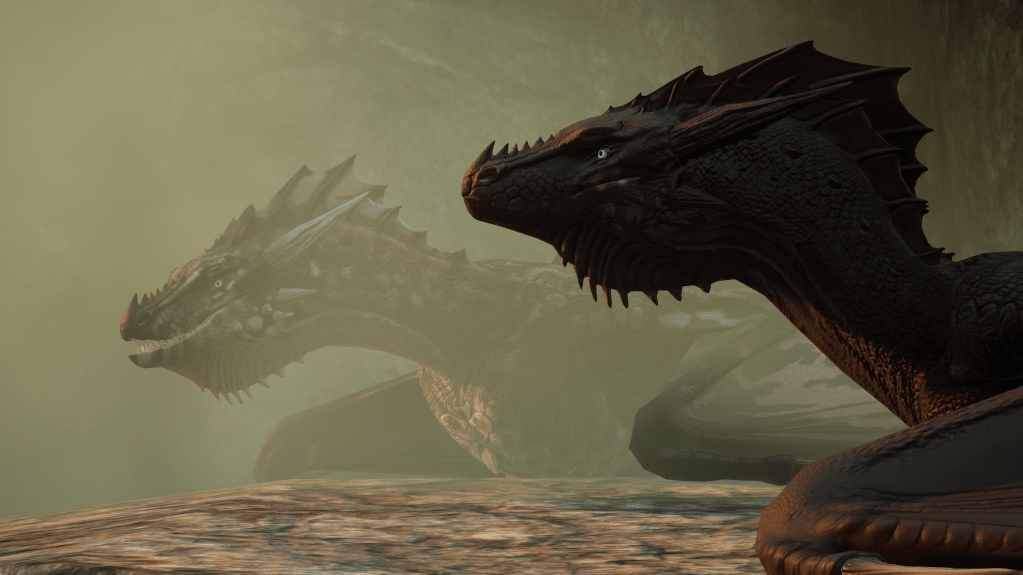
The Dracoviper, a wyvern-inspired aerial predator, is a solitary and cunning hunter that dominates the skies of its territory. Preferring to stay on elevated perches such as cliff ledges, rocky outcrops, and tall forest canopies, it used its keen eyesight and agile flight to patrol wide areas, swooping down to ambush prey with dangerous precision. Its hunting strategy mainly relies on stamina suppression, allowing it to tire out prey before finishing the kill. Though primarily solitary, Dracovipers form mating pairs during spring, with one mate often guarding the nest while the other hunts. If they successfully raise their clutch to sub-adult, the pair can stay bonded together. They thrived in regions with open skies interspersed with sheltered roosts, often near water sources or migratory routes where prey was abundant, and relied on their aerial advantage to remain both elusive and dominant within their chosen habitats.
Tier: 3
Dimorphism: Males display vivid coloration year-round. Females become noticeably brighter during spring and remain duller throughout the rest of the year. {layers are encouraged to use the /bright and /dull commands to represent this seasonal change.
Habitat: Dracovipers favor warm, elevated environments with rocky cliffs, exposed ledges, caves, crevices, and nearby forest cover. They may nest outside their primary habitats wherever suitable elevated shelter, open airspace, and access to direct sunlight are available.
Riparia: Wind Tunnels, Dry Fang Canyon
Gondwa: Red Island, Red Reef, Ocean Stacks, Azure Shore
Diet: Carnivore/Scavenger
Active Times: Diurnal, most active during daylight hours when visibility is high, and their aerial mobility can be fully utilized. During the day, they patrol their territories from elevated perches, cliff edges, treetops, or rocky outcrops using keen eyesight to spot potential prey or intruders from afar.
Base Group Size: 4 Adults 5 offspring (below sub-adult) (Can be increased to a max of 6 Adults 5 offspring with certain roles (below sub-adult))
Attackers/Defenders: 4 adults
Nesting Season: Spring
Offspring/Defenders: Up to 5
Adoption: ✅
Behavior
Dracovipers rely on instinct over intellect, guided by a drive to hunt and survive. As they mature, some develop the ability to exhale venom, a trait that makes them even more formidable predators. They primarily feed on small to medium-sized creatures and take shelter in caves or forests when resting. Many Dracovipers display vivid colors, while others possess more muted tones that allow them to blend into their surroundings when necessary. Highly nomadic, they frequently move between hunting grounds in search of new prey. Their social behavior changes with the season and circumstance, allowing them to form temporary but functional bonds.
Their instincts shift the moment offspring are involved, and they will defend their young with unmatched ferocity. Should their parents fall during migration or battle, the strongest of the young will rise to continue the lineage. To the wyvern, protecting their offspring is not just instinct, but an inherent duty to preserve their line.
Outside of spring, Dracovipers may form small social groups of four to five unrelated adults. These groups are loose and opportunistic, often forming around shared hunting grounds, migration routes, or abundant resources. Younger orphaned wyverns may also join unrelated adults and be accepted into the group, though they do not imprint upon them.
Courting
Courtship occurs during spring, when adult Dracovipers leave their current family or social group and become receptive to forming a seasonal pair bond. Males retain their vivid coloring year-round, but during this season, females also brighten noticeably, signaling that they are prepared to accept a potential partner within their territory.
Males begin courtship from a distance. He performs several short aerial passes, then positions himself upon a sunlit cliff, elevated perch, or rocky outcrop where his coloring can be seen clearly, spreading his wings and angling his body toward the light. He gives a series of sharp calls and waits to see whether the female remains nearby or drives him away.
If she is receptive, the female takes flight and initiates a demanding aerial chase through the cliffs and tunnels. She dives, climbs, turns sharply, and passes close to the terrain, forcing the male to prove that he can keep pace without colliding with her or striking out in frustration. The purpose of the chase is to demonstrate agility and endurance. The female may suddenly wheel toward the male, snap nearby, or release venom into the open air as a warning display. The male must not retaliate with a direct attack. He may evade, circle back, or answer with his own harmless spray directed away from her path. A male that strikes the female, attempts to pin her, or becomes excessively aggressive is rejected and driven away.
Courtship concludes when the female ends the chase and settles upon an exposed perch. If the male is accepted, she remains in place and allows him to land beside her. The pair spreads their wings and enters a brief Solar Lull, resting together in the sunlight. This shared stillness marks the transition from tolerance to a seasonal pair bond.
Dracovipers do not accept multiple active suitors. If another male approaches during courtship, the courting male will attempt to drive him away. If neither yields, conflict may occur, but the female does not assist either suitor and may reject both if the disturbance becomes prolonged.
Once bonded, the pair remains together throughout the nesting season. Their attachment is driven primarily by reproduction and protection of the bloodline rather than lifelong devotion. When the following spring begins, the pair bond ends, and each adult may seek a new mate. Former mates may court one another again, but the female may accept a different male. The previous bond does not guarantee renewed acceptance.
Nesting and offspring
After bonding, the pair searches for a secluded nesting site. Narrow cliffside hollows, shallow caves, elevated crevices, and ledges hidden from open flight paths are preferred. Dracovipers avoid large, obvious dens that can be easily seen or occupied by larger dragonkind.
One parent remains near the nest while the other hunts, but they may trade roles throughout the day. Both parents become increasingly alert as hatching approaches and will patrol nearby perches for predators or rival dragonkind.
Dracovipers defend their offspring with extreme aggression, but they do not blindly sacrifice the entire bloodline against an overwhelming threat. An unfamiliar creature that comes within three Dracoviper body lengths of the nest or its entrance is met with sharp threat calls, wing-spreading, and defensive positioning. If the intruder retreats, the parents do not attack or pursue it.
In cases where the intruder continues forward and comes within one Dracoviper body length of the nest, the parents may attack immediately. They may drive the intruder beyond the three-body-length boundary, but must then return to the nest rather than continue the pursuit. However, if the intruder is valid prey and the Dracoviper is within the permitted hunting threshold, the defending parents may transition the encounter into a hunt. Should a Dominus, Bristlewing, or another threat too powerful to repel discover the nest, the parents may attempt to avoid direct combat and instead attempt to draw it away through calls, low flights, false retreats, or venom sprayed from a distance.
If the nest can no longer be defended, the parents may abandon the site rather than die beside it. Mobile offspring are led to another hiding place when possible. Eggs and newly hatched young that cannot be moved may be left behind if remaining would cause the loss of the entire family. Such abandonment is an act of survival, preserving the parents and any offspring capable of continuing the bloodline.
Hatchlings remain concealed within the nest and rely entirely on their parents for food and protection. As juveniles, the young begin climbing along ledges and making short, supervised glides near the nest. They are taught through imitation, watching their parents hunt, perch, patrol, and react to threats. Weaker offspring are protected, but parents do not repeatedly risk their lives for young that consistently wander too far, fail to feed, or fail to respond to danger.
Adolescents begin accompanying their parents on short flights and scavenging trips. They may chase critters, practice venom spraying away from family members, and learn to use escape routes and maneuvers. They do not lead hunts and are expected to retreat when larger predators or dragonkind appear.
By sub-adult age, offspring are capable of joining longer hunts and defending themselves. They continue traveling and hunting as part of the family group as they mature into adults and through the remainder of the year. When spring returns and the next courting season begins, adult offspring leave the family group to seek mates and continue the lineage.
Hatchlings and juveniles do not imprint on unrelated creatures. Their familial attachment is limited to their parents and broodmates. Orphaned young may be adopted only by a bonded pair of adult Dracovipers and accepted into their family group.
If one or both parents are killed, the strongest surviving offspring takes precedence within the brood. Older young may guide smaller siblings toward cover, food, or familiar resting areas, though this is driven by bloodline instinct rather than careful leadership. Until adopted, orphaned hatchlings and juveniles survive primarily through concealment and scavenging, favoring areas that offer protection from both terrestrial and aerial predators.
Mandatory Traits
The Forsaking of Thought
Unlike their more calculating dragon kin, Dracovipers are driven primarily by instinct and immediate circumstance. They are capable of recognizing danger, learning from experience, and using deceptive survival tactics, but they do not form elaborate plans or carefully weigh distant consequences. Their choices are shaped by primal drives honed through countless generations: hunger, self-preservation, protection of offspring, and the continuation of their kind.
The Patient Mind
A Dracoviper rarely abandons its chosen prey. If its target attempts to hide, it will linger nearby, guarding the area and striking with venomous spray whenever an opening presents itself. It will only abandon the hunt if it becomes seriously injured, finds an easier meal, or simply loses interest after five minutes of waiting.
The Solar Lull
When not hunting, traveling, or defending themselves, their group, or their nest, Dracovipers seek out cliffs, elevated perches, rocky outcrops, or other areas exposed to direct sunlight. They settle into stillness with their bodies relaxed and wings partially spread, allowing the sun’s warmth to reach as much of their body as possible. During this time, they remain alert to nearby movement but are less likely to leave the perch unless disturbed, threatened, or driven by hunger. This behavior is essential to maintaining their energy and physical condition.
The Wandering Shadow
Social groups formed between unrelated Dracovipers are not permanent. Outside of spring, these individuals travel, hunt, and rest together while conditions remain favorable, but their associations are driven by convenience rather than lasting loyalty. Members may leave when resources decline, migration paths divide, or conflict disrupts the group.
Optional Traits
The Echo of Greed
Though not true treasure-hoarders like dragons, some Dracovipers display a primitive attraction to visually striking objects. Flowers, colorful vegetation, feathers, and small trophies from successful hunts are gathered and arranged around their nest.
The Winged Betrayal
The Dracoviper’s combat style is as deceptive as it is fierce. In moments of pressure, it may pull away from a fight, giving the illusion of retreat, only to use the momentum of flight to wheel around and strike from an unexpected angle.
Player Tip: Use your barrel roll and dive to disengage, then quickly re-enter combat from above or behind to mimic this behavior.
Wind Dancer
Though most Dracovipers are viewed as relentless predators, some Dracovipers display bursts of playful energy that seem to serve no purpose beyond joy itself. Females can be seen twisting through the air or chasing their own tails, while males engage in lighthearted mock duels with other flyers. These rare displays of freedom remind observers that even the fiercest hunters sometimes dance with the wind.
Venom Before Flame
Despite their distrust of larger wyverns, Dracovipers recognize the value of a Bristlewing when facing a Dominus. A pair may temporarily cooperate with a solitary Bristlewing, using their speed and venom to harass and weaken the larger dragon while the Bristlewing waits for an opportunity to strike. This cooperation is entirely opportunistic, and the Dracovipers never mistake the Bristlewing’s tolerance for friendship. No more than two Dracovipers may group with one Bristlewing, and the group must form before combat begins.
During the hunt, the Dracovipers remain alert to the Bristlewing’s movements and give it space whenever possible. Once the Dominus is killed, they keep their distance from the carcass until the Bristlewing has finished feeding, instinctively recognizing that challenging it over food is far more dangerous than going a little longer without it.
A failed hunt is particularly dangerous. Should the Dominus escape and remain out of sight for more than five minutes, the Bristlewing may quickly turn its aggression toward its smaller companions. Dracovipers do not linger to determine whether the alliance still stands; they disperse, using the surrounding terrain to put distance between themselves and their former ally.
Credits: IveMcFallen, Littlered, and MisslilBlue
Sources and what this creature is based on:
https://www.dndbeyond.com/monsters/17065-wyvern?srsltid=AfmBOoqQ4cNsTO4FqQHS-QirDpZdK772oZzzw38XI3r3NKiF2n4mQGB6
https://abookofcreatures.com/2020/06/22/quetzalcoatl/
https://www.africansnakebiteinstitute.com/snake/mozambique-spitting-cobra/?srsltid=AfmBOop-j8-EvEUfEGwB4Qbkdi9bmEfo_w9GkK3ttn24_U-x48gMrg36
https://aminoapps.com/c/dragons/page/blog/the-wyvern/Xk7b_8NtgugVxkvGE3Kr5enKxnbej0jdEG
https://mythosanthology.com/wyvern/
Last Updated: 8/8/2026
 Ashes of Apex Fantasy Realism