Eotriceratops
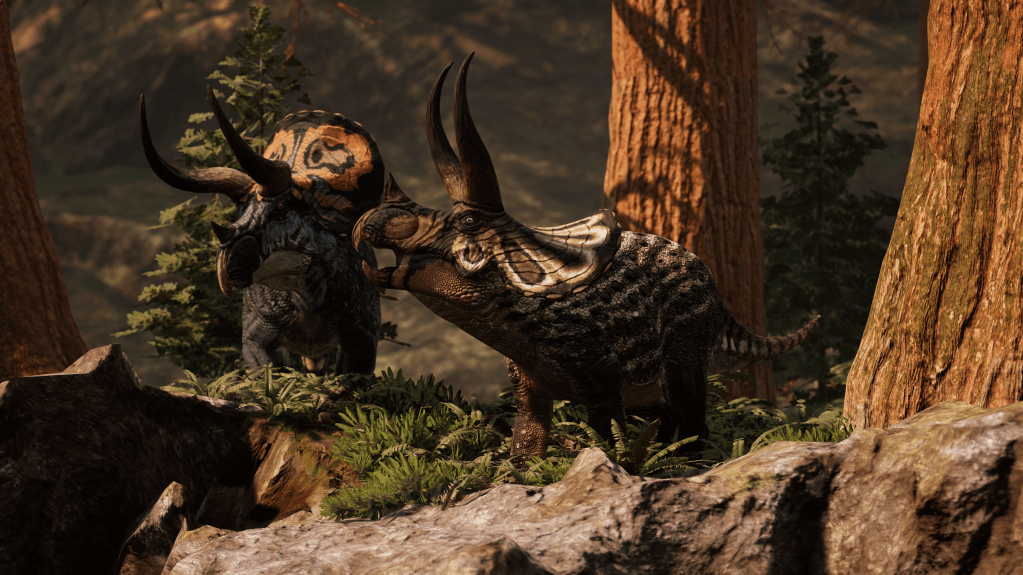
Eotriceratops lived during the Late Cretaceous period, around 68 to 66 million years ago, in what is now Alberta, Canada. Its habitat, the Horseshoe Canyon Formation, was a warm, temperate floodplain filled with rivers, wetlands, and lush forests of ferns, cycads, and conifers. This environment supported a diverse ecosystem, where Eotriceratops coexisted with hadrosaurs, ankylosaurus, and large theropods like early tyrannosaurids, navigating a world rich in vegetation for grazing while remaining vigilant against predators.
Tier: 5
Dimorphism: Females have smaller horns compared to the males.
Habitat
- Riparia: Redwoods, Black Fern Hills, and Hollow Hills
- Gondwa: Ripple Beach, Green Valley, and Broken-Tooth Canyon
Diet: Herbivore
Active Times: Eotriceratops was diurnal, meaning it was most active during the daytime.
Group Size: Unlimited
Defense: 3 adults
Nesting Season: Spring and Summer
Offspring: Up to 5
Adoption: ✅
Behavior
Eotriceratops live in family groups and use their massive horns and frills not just for defense but as key tools in social interactions. Males display their frills and horns to attract mates and assert dominance over rivals, often engaging in ritualized sparring to settle disputes without serious injury. The females build hidden nests and actively guard both the nests and their young, showing clear parental care. When threatened by predators like Tyrannosaurus rex, Eotriceratops reacts aggressively, charging, goring, or using defensive formations to protect themselves and their group. They are territorial, often marking their space with displays of horned intimidation, and their keen senses of sight and smell help them detect danger early. Overall, Eotriceratops combines social interaction, careful parental behavior, and formidable defense to survive in their environment.
Mandatory Traits
The Stillpoint
When Triceratops and Eotriceratops enter the same point of interest, their interactions are tense and cautious. The two species usually maintain distance, only coming near one another when accessing shared resources like water, and even then, approach with extreme care. Grazing from the same berry bush or straying too close to another herd often sparks dominance displays, including lowered frills and horn bracing. If these boundaries are crossed, the herds may engage in forceful ramming and charging, though most encounters end with careful retreat rather than serious injury. (Excluding juveniles too small to participate in fights.)
The Gilded Guard
When Triceratops confront predators, only a limited number of adults actively engage, regardless of herd size. Three males take the lead, or, if a brightly colored female is present, two males and that female form the active defense. These adults brace their powerful horns and lower their frills, circling and ramming predators in calculated bursts, aiming to intimidate or injure while maintaining a defensive stance. While the rest of the herd form a circle around the young or weak (sickly or injured) herd members. If a young is struck or endangered during the skirmish, the nearest female moves immediately to shield the juvenile, positioning herself between the predator and the offspring. While she can block or fend off attacks, she cannot pursue the carnivore over long distances, leaving the chase to the faster predator. Most adult clashes are intense but controlled, relying on horn strength, body mass, and precise positioning rather than prolonged combat.
The Majestic Matrons
Eotriceratops herds are distinctly female-dominated, with seasoned matriarchs directing movement, selecting grazing grounds, and maintaining order within the group. These lead females form the social core of the herd, and their decisions shape the daily rhythm of travel, feeding, and safety. Males primarily serve as defenders, stepping forward only when predators threaten, forming a disciplined frontline controlled by the matriarchs’ signals. The only females who break from leadership roles are the brightly colored, more aggressive individuals; these rare females may replace one of the males as an active defender when danger rises. This structure female leadership paired with selective male (and exceptional female) engagement creates a highly organized, protective, and efficient herd dynamic
The Defender’s Gauntlet
Male Eotriceratops frequently engage in ritual sparring when the herd is safe and no predators are nearby. These bouts full of horn clashes, frill-locking, and strength tests serve both as practice to keep their fighting skills sharp and as a way to determine which males are strong enough to earn a place among the herd’s designated defenders. Despite their size and aggression, males must follow strict social rules: any male that directs violence toward a female risks swift punishment. If a male attacks a female of the herd, the matriarch intervenes immediately, and her authority is absolute; she will chase the offender out, stripping him of herd protection and status. This balance of controlled combat, discipline, and matriarchal enforcement keeps the herd stable, skilled, and tightly bonded.
Optional TRaits
Mini-Frill Parades
Young Eotriceratops often form loose “parade lines,” trotting after one another in zig-zag patterns with their small frills held as high as they can manage. These displays aren’t serious dominance shows, just playful mimicry of the adults. The older females indulge these parades, watching with patient amusement, while the males occasionally join in by pretending to be “predators,” prompting excited calls and clumsy retreats from the youngsters.
The Night-Nuzzle Ritual
Before settling down to sleep, juveniles gather into a warm pile, gently nudging and rubbing their frills together. It’s believed this behavior strengthens their social bonds and helps calm anxious youngsters after a long day. Adult females often sleep around the pile like a living protective ring. While the males will take turns watching over the sleeping herd.
Credits: Littlered in collaboration with LeviathanMosa
Sources: https://en.wikipedia.org/wiki/Eotriceratops https://www.nps.gov/articles/bison-bellows-7-7-16.htm
Last Updated: 11/27/2025
 Ashes of Apex Fantasy Realism