Giganotosaurus
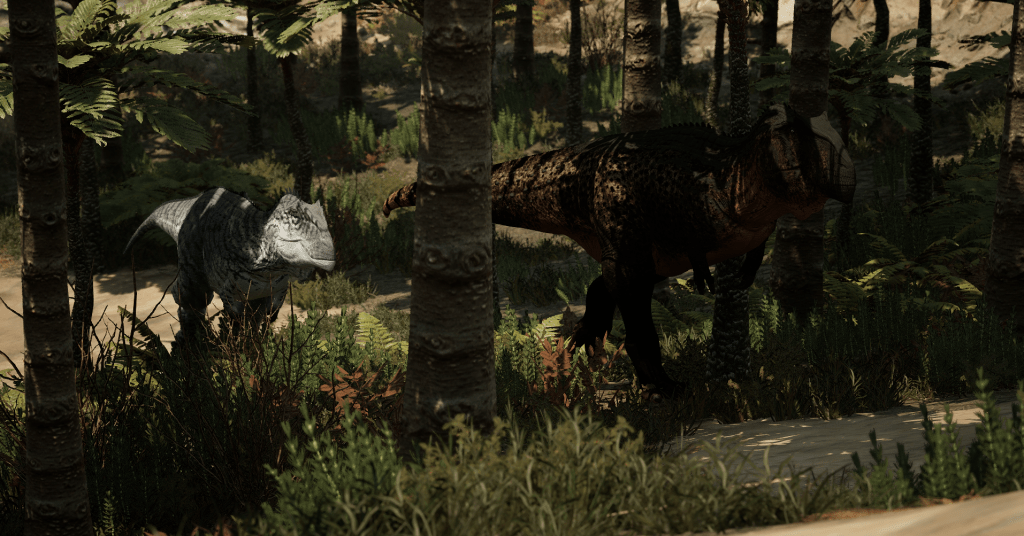
Giganotosaurus was a colossal, bipedal carnivorous theropod from South America, one of Earth’s largest land predators. It featured a massive skull, a blunted snout, and long, serrated teeth built for tearing flesh, along with powerful legs, a balancing tail, and relatively small arms. It lived during the Late Cretaceous period and was slightly larger than Tyrannosaurus rex.
Tier: 5
Dimorphism: Males display orange, blue, and white coloration, while females exhibit brown, green, or yellow tones.
Habitat:
- Riparia: Cedrus Forest and Crag Bluffs
- Gondwa: Birchwoods, Desolate Pass, Titans Pass
Diet: Carnivore
Active Times: Cathemeral. Their sleep is distributed in sporadic intervals throughout both the day and night.
Grouping:
Giganotosaurus may form a family group of up to 6 blood-related individuals. Multiple adults may coexist within the group, but only one bonded adult pair may reproduce. Offspring are included within the group limit.
- At any given time, no more than 2 members may act as primary hunters or defenders.
- Primary hunting or defensive roles must be chosen before a hunt or engagement and may not be changed during an active encounter.
- Subadults may fill one of the primary hunter or defender roles.
- Adolescents may accompany hunts in an assist-only capacity.
- Adolescents may not participate in defensive engagements.
Family hunts may consist of only one of the following configurations:
• Two adults, with up to one assisting adolescent
• One adult and one subadult, with up to one assisting adolescent - Male-only hunting coalitions of up to 4 males, regardless of blood relation, are permitted as described under the Alpha Coalition trait. These coalitions may only form for the active hunting of sauropods and are not permitted to pursue or initiate hunts against any other prey species as a coalition.
• During an active sauropod hunt, all four members may participate.
• If coalition members hunt non-sauropod prey, the coalition is considered inactive. In these cases, no more than 2 individuals may hunt together.
• If acting defensively outside of an active hunt, no more than 2 individuals may engage at a time, and these roles must be chosen before the engagement begins.
• These coalitions are not considered family groups.
Nesting Season: Spring and Summer
Offspring: Up to 5
Adoption: ✅
Behavior
Giganotosaurus carries itself with a deliberate presence, rarely acting without purpose despite its immense size. It is not a constant hunter; instead, it moves through its territory with patience and intent, allowing the world around it to settle before choosing when to intervene. Smaller carnivores often trail behind it, drawn by its hunts and its reputation, lingering at the edges rather than daring to challenge it directly.
While tolerant of this presence, Giganotosaurus is not permissive. Boundaries are unspoken but clearly enforced, and those who fail to recognize them quickly learn that leniency is not part of their nature. Its reputation is built less on frequent violence and more on the certainty that disrespect is remembered and answered decisively.
Among other apexes, Giganotosaurus shows a clear distinction in how it interacts. It holds Tyrannotitan in high regard, often prioritizing their aid during hunts or conflicts and showing a rare willingness to form cooperative bonds. In contrast, encounters with Carcharodontosaurus are defined by rivalry. Their similar builds and hunting roles place them in constant competition, and these interactions often escalate into contests of dominance rather than cooperation.
Whether hunting alone or alongside others, Giganotosaurus remains a calculated and imposing force, shaping its surroundings through presence as much as action.
Courting Behavior
Courtship among Giganotosaurus is defined by ritualized aggression and controlled confrontation. Females naturally take the dominant role and initiate the trial once a male has demonstrated interest by following her over time. This pursuit alone does not constitute acceptance. The female must actively choose to engage, signaling her willingness through a direct challenge.
Once initiated, the Trial of Strength consists of brief clashes meant to test endurance rather than inflict serious harm. Bites, charges, and physical pressure are exchanged, but neither participant may drive the other below 50% health. Crossing this threshold is considered a failure of control and immediately ends the courtship attempt.
Retreat (creating distance by disengaging or moving away to reset space) during these trials is acceptable if temporary and strategic. However, a male who disengages permanently or shows hesitation is deemed unworthy. Likewise, a male who overcommits or attempts to overpower the female through excessive force is rejected, as unchecked aggression is viewed as a liability rather than a strength.
Acceptance is signaled clearly by the female through the heart emote call. Once accepted, aggression ceases entirely. The newly bonded pair shares space without hostility, and any continued aggression between them is considered a violation of the courtship bond.
Nesting and Offspring Behavior
Female Giganotosaurus selects a secluded nesting site far from heavily trafficked areas, favoring isolation over convenience. Both parents remain fiercely protective of the nest and surrounding territory, treating any intrusion as a direct challenge.
Hatchlings are expected to remain close to the nesting area and respond immediately to parental signals. Disobedience is not tolerated. Offspring that repeatedly ignore direction, draw unnecessary attention, or disrupt the nest are corrected through aggressive displays. Continued failure to comply may result in culling, as weakness is viewed as a threat to the family’s survival.
Young that wander too far from the nest or fail to keep pace with the adults at any stage are not retrieved. Such individuals are assumed to be sickly or unfit and are left behind without hesitation.
Juveniles experience a noticeable reduction in direct protection. They are pushed to observe hunts, learning through proximity. Adults do not slow or alter behavior to accommodate them, and juveniles are expected to keep pace and remain alert.
Adolescents are permitted to assist in hunts under strict supervision. Their role is limited to flanking, harassment, or driving prey and may not include delivering killing blows. They must maintain distance, disengage immediately when signaled, and follow adult positioning and timing rather than initiating or sustaining combat. Reckless behavior during hunts that endangers the individual or compromises the hunt is met with immediate correction, and repeated behavior may result in abandonment or culling.
By subadult stages, offspring are no longer afforded special consideration. They are expected to operate with discipline, respond immediately to signals, and contribute meaningfully when present during hunts or territorial confrontations. Their place within the family is conditional on continued competence and restraint rather than age alone. Subadults that hesitate, disrupt coordination, or attempt to assert authority prematurely are met with aggression and driven off. This stage represents a proving ground where status is maintained through usefulness and discipline, reinforcing that survival and tolerance are earned, not guaranteed.
Mandatory Traits
The Passive Overseer
Giganotosaurus maintains a dominant but restrained presence within its territory, rarely acting unless necessity demands it. Rather than patrolling aggressively or asserting control through constant conflict, it relies on sheer size, awareness, and patience to deter threats. Its ability to function efficiently at low hunger allows it to remain inactive for extended periods, conserving energy while observing its surroundings. During these long intervals, Giganotosaurus often becomes a silent anchor in the ecosystem, influencing nearby predators and scavengers simply through its presence. When it finally does hunt, the decision is deliberate and calculated, reinforcing its role as an overseer rather than a relentless pursuer.
Respect Your Overlord
Giganotosaurus allows smaller carnivores, typically Tier 1 through Tier 3, to follow in its wake and benefit from its hunts. Once it has eaten its fill, the Giganotosaurus remains beside the carcass, often settling down nearby as a silent signal that feeding is permitted. This unspoken allowance establishes a clear hierarchy, with the Giganotosaurus acting as both provider and enforcer.
However, this tolerance is conditional. Any smaller carnivore that shows disrespect by attacking prematurely, lingering too long, or challenging authority breaks this fragile agreement. Such offenders earn an immediate and merciless response. The Giganotosaurus will relentlessly pursue and attack the transgressor until it either flees from its territory or perishes, and the grudge does not fade quickly.
Fellowship with Family
Giganotosaurus holds deep respect for Tyrannotitan and treats them as kin rather than competitors. When a Tyrannotitan is threatened or engaged in a hunt, a nearby Giganotosaurus will often intervene, even at the cost of ignoring other opportunities. This aid is not given lightly, as such cooperation is rooted in mutual recognition between two apex predators rather than convenience.
When bonded in this way, Giganotosaurus may group with Tyrannotitan, expanding its normal group size from two to three. A solo Giganotosaurus may group with up to two Tyrannotitans. If the Giganotosaurus is already part of a pair, only one Tyrannotitan may join the group. This balance maintains hierarchy while allowing coordinated hunts and shared protection between these powerful allies. A Giganotosaurus bonded with Tyrannotitan cannot also maintain Flamekin bonds.
The Shattered Mirror
Giganotosaurus does not act out of hatred toward Carcharodontosaurus, but frequent conflict arises due to their similar size, speed, and hunting roles. Viewing one another as direct competitors, these encounters often escalate into aggressive displays of dominance. Giganotosaurus is known to respond harshly to provocation, holding a lasting grudge against Carcharodontosaurus and returning aggression with equal force.
As a result, Giganotosaurus is often found driving Carcharodontosaurus out of points of interest, asserting territorial control through intimidation and persistence. While these clashes are rooted in rivalry rather than malice, they often begin when Carcharodontosaurus tests boundaries, only to be met with overwhelming retaliation.
The Alpha Coalition
Giganotosaurus actively seeks out others of its own kind to form temporary hunting coalitions composed entirely of males, with up to four individuals in a group. These coalitions are not social gatherings, but purpose-driven alliances forged through mutual respect and shared ambition.
Alpha Coalitions exist solely for the hunting of sauropods. These massive, high-risk prey are favored because they test strength, endurance, and coordination at the highest level. When pursuing any other prey, the coalition does not apply, and no more than two Giganotosaurus may hunt together.
Sauropod hunts serve not only as a means of sustenance but as a proving ground, allowing members to refine their hunting skills, assert status, and measure themselves against equally formidable allies. For some, the challenge itself is the reward, and the hunt becomes a deliberate demonstration of power.
Optional Traits
Lazy Hunter
Giganotosaurus occasionally supplements its diet with roots, fallen nuts, or other hardy vegetation, not for nourishment but to dull the edge of hunger. This habit allows it to delay the need for a full hunt, extending long periods of rest and observation. By quieting its stomach without expending energy, Giganotosaurus preserves strength and patience, favoring efficiency over urgency while it lounges within its territory.
Grudge Keeper
Giganotosaurus possesses an exceptional memory for conflict. Creatures that challenge, disrespect, or betray it are remembered long after the encounter ends. When these offenders are encountered again, Giganotosaurus responds with immediate hostility, showing no tolerance and offering no second chances.
Measured Mercy
Giganotosaurus occasionally spares defeated or retreating opponents, not out of kindness, but as a demonstration of dominance. When it chooses not to finish an adversary, the decision is made unmistakably clear. After driving the opponent back, Giganotosaurus deliberately disengages, holding position and issuing a low call or remaining visibly still. This pause serves as a final judgment rather than hesitation.
Those spared are expected to leave the area immediately and without hesitation. Any attempt to linger, re-engage, or return is treated as deliberate defiance and met with immediate and overwhelming aggression. Mercy is granted once, remembered always, and never repeated.
Credits: Spook and MisslilBlue
Sources:
https://www.nhm.ac.uk/discover/dino-directory/giganotosaurus.html
Last updated: 12/13/25

