Gigantoraptor
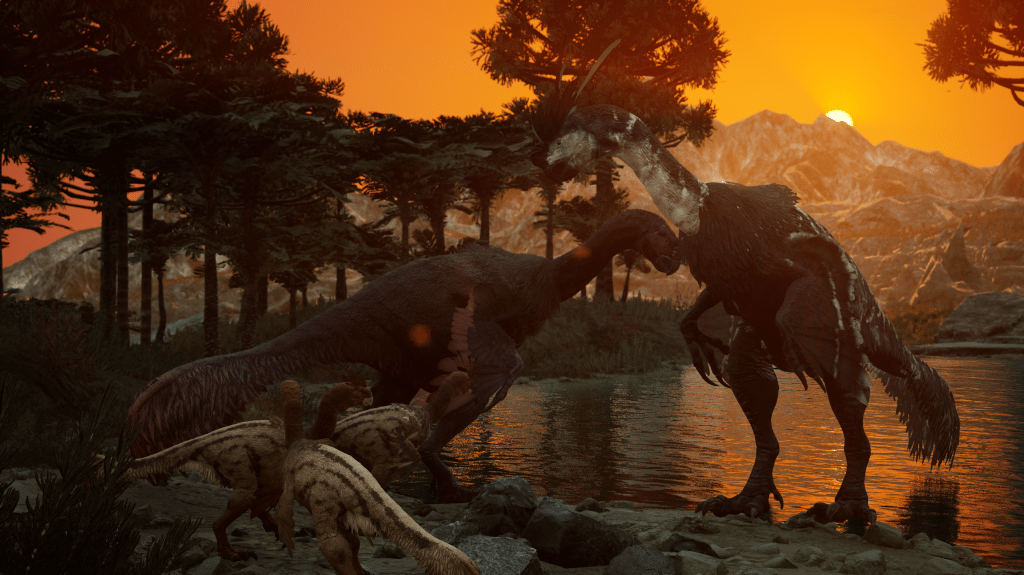
Gigantoraptor was a giant oviraptorosaurian dinosaur that lived in Asia during the Late Cretaceous period, roughly 95–80 million years ago. It is the largest known member of its group, reaching about 8 m (26–28 ft) in length and weighing over a metric ton. Unlike many smaller oviraptorosaurs, it had a long neck, elongated limbs, and a toothless beak, suggesting a generalist diet that may have included plants, small animals, and eggs. Its bones show that it grew quickly compared to other large theropods. While many relatives were feathered, its enormous size suggests it may have retained only limited feathering. The only known specimen appears to have been a young adult at the time of death.
Tier: 4
Dimorphism: Males typically display larger head feathers.
Habitat: Cedrus Forest, Wollemi Forest, Coastaland Swamp
Diet: Omnivore
Active Times: Primarily diurnal
Grouping: Typically up to 4 adults/subadults, consisting of a mated pair and two offspring, or a group of siblings. Has unlimited offspring when nesting.
Defense: 4 adults/sub-adults
Nesting Season: Spring
Offspring: Up to 5
Adoption: ✅
Behavior
Gigantoraptor establishes a moving boundary of roughly one Gigantoraptor body length in all directions wherever it travels. Dinosaurs that approach calmly may remain nearby, but those that step too close are warned once with a sharp call and a firm advance. If the warning is ignored, it may follow through with an attack.
Once distance is restored, its tension ends, and Gigantoraptor resumes what it was doing. It does not chase once its boundary has been respected.
Nearby threats are watched before action is taken. Large carnivores are not met with panic. A predator simply passing through may be ignored. One that lingers, circles, or presses closer may be met with warning calls and steady forward pressure.
When facing a lone large carnivore, Gigantoraptor does not automatically back down. A mixed group of subadult or adult Gigantoraptors will stand together and hold their ground rather than scatter. A single adult may also stand its ground, especially against other Tier 4 or smaller carnivores. However, if it becomes clear that the predator has the upper hand, Gigantoraptor may attempt to retreat. Defense ends once a threat withdraws. Long pursuits do not interest it. Once a threat retreats roughly 5 Gigantoraptor body lengths away, the confrontation ends.
When offspring are present, tolerance drops, as Gigantoraptors are very protective of their young. Brooding adults focus on ensuring their offspring are protected.
Outside of nesting periods, tolerance of other creatures increases. Other herbivores may graze nearby if distance is respected. Smaller species are often ignored, though sudden, quick movements may trigger brief overreactions before composure returns. Permanent mixed herds do not form, and crowding will result in personal space being reasserted.
Movement defines its lifestyle. It travels between berry bushes, root beds, shorelines, and bone piles, scavenging when useful and foraging steadily. Living prey is not pursued outside of brood-related conflict.
Gigantoraptors are usually solitary or found in small family units. When multiple adults travel together, they keep loose spacing rather than clustering tightly. Large flocks are uncommon and temporary. They do not form communal nesting circles; each pair selects and maintains its own nesting space.
Courting
During nesting season, males compete openly for a female’s attention through grounded, stamina-based displays. They circle with purpose, issue low resonant calls, and remain in steady motion to show endurance and strength.
Rival male displays often escalate into brief physical clashes as each attempts to intimidate the other. Light injury is common. Most contests end when one male yields by crouching or creating distance.
Lethal escalation is not the norm. However, if neither male backs down and both commit to continued aggression, the conflict may intensify into a deadly fight.
Females are not passive observers. While less common, rival females may clash over a nesting area or preferred mates. These encounters usually remain short and forceful rather than prolonged, but serious injury is possible if neither yields.
If a pairing is accepted, the female mirrors the display briefly before remaining near the chosen male. After eggs are laid, the male assumes primary incubation and also early chick-rearing duties.
Nesting & Offspring
Pairs select open, highly visible ground for nesting. Gigantoraptor prefers defensible locations where approaching threats can be seen from a distance.
Both parents share guarding duties. One adult remains within nesting range at all times while the other forages nearby. Parents typically maintain movement around the perimeter, pacing, and circling.
Gigantoraptor does not tolerate other active Gigantoraptor or Citipati nests within nesting range during the nesting season. If another pair attempts to establish a nest nearby, one pair must relocate, or conflict may occur.
Approaching dinosaurs are met with an immediate warning call and forward advance. Rival Gigantoraptors within nesting range may be driven off aggressively. Gigantoraptor does not pursue threats far from its nest. Once an intruder retreats roughly 10 gigantoraptor body lengths away, pursuit ends.
If threatened, offspring below subadult age immediately retreat toward the nearest guarding adult or seek cover that fully conceals their body. Hiding is prioritized over fighting. Young should remain still once concealed, avoiding movement that would draw further attention.
Young Gigantoraptors remain highly dependent on their parents. In early life, they must stay close to a guarding adult at all times. They do not wander and rely entirely on parental positioning for safety.
As they grow, juveniles begin moving along the nest perimeter but quickly return when called. If threatened, they retreat immediately toward the nearest adult.
Adolescents test boundaries more often, ranging slightly farther while still remaining within defensive range of the nest. They may approach nearby herbivores out of curiosity, but should not engage without adult involvement.
Adolescents and subadults who repeatedly challenge parental authority may be met with forceful correction. In rare cases, a parent may choose to kill an offspring that refuses to submit or threatens the stability of the nest.
Subadults begin to assert independence. They may travel short distances from the nesting ground and assist in driving off threats under adult direction. Upon reaching adulthood, they typically disperse in search of a mate and to establish their own nest.
Orphaned Gigantoraptor hatchlings may imprint on the first adult land dinosaur that consistently remains near them during early life. This imprint creates a temporary bond for protection and guidance. As the Gigantoraptor matures, natural species instincts strengthen, and individuals drift back toward their own kind unless raised intentionally among Citipati.
Mandatory Traits
Moving Boundary
Gigantoraptor establishes a mobile personal zone roughly equal to 3 of its own body lengths in all directions when feeding, resting, or nesting. Dinosaurs that enter this space must be warned with a call and a wing flap display, as if visually pushing the intruder away.
The warning can be reinforced with deliberate forward movement. A bite into open air may follow if the intruder continues pressing closer. Engagement is limited to enforcing space, not pursuit.
If the intruder retreats beyond 3 Gigantoraptor body lengths, pressure ends immediately. Gigantoraptor does not continue chasing once its boundary has been restored.
Brood Supremacy
When a Gigantoraptor has an active nest, it views nearby Citipati broods as direct competition. If a Citipati nest is established within sight of the Gigantoraptor nest, the Gigantoraptor may actively seek out and attempt to eliminate Citipati offspring that remain visible from its nesting area.
This hostility remains strictly localized to the area the Gigantoraptor can visibly observe from its nest. It may not pursue Citipati once they break line of sight. Once one nest relocates or the Gigantoraptor nest becomes inactive, aggression ends immediately.
If a Citipati is caught inside the Gigantoraptor nest attempting to steal a hatchling, the Gigantoraptor parents may kill the intruder without warning.
Feathered Alarm
Gigantoraptor tends to overreact to sudden, small movements. When a much smaller dinosaur unexpectedly enters its personal space, it may sidestep away before releasing a sharp hissing alert (! emote). A startled hop (? emote) may follow as it regains its balance.
It will attempt to move away as if unsettled by the intrusion of tiny, fast-moving dinosaurs, typically Tier 1 and occasionally smaller Tier 2 species. Once the smaller dinosaur retreats beyond its boundary, Gigantoraptor settles quickly, often resuming its previous activity as though the interruption never happened.
Optional Traits
Competitive Pecking
Some Gigantoraptors express dominance openly within their own kind. When grouped, individuals may snap or bite at one another to establish who holds the higher position. This behavior is most common among adolescents and subadults testing boundaries, but may also continue into adulthood.
Light damage is permitted as part of these dominance displays. Escalation into a more serious scuffle may occur if neither individual yields. Yielding is demonstrated by turning away, breaking engagement, and creating clear distance, thus establishing who is dominant within the group.
Borrowed Brood
In rare cases, a Gigantoraptor hatchling stolen and raised among Citipati may imprint on its adoptive caretakers. Having grown within a Citipati flock, it learns their calls, spacing habits, and brood tolerance.
As an adult, it may refuse to initiate aggression toward Citipati nests and will not participate in Brood Supremacy against them. It does not view Citipati offspring as competitors.
This altered upbringing does not soften its instincts toward its own species. It remains territorial toward other Gigantoraptors and may engage rival nests as normal.
The Second Hen
In rare cases, a dominant male may maintain two separate nests during a single nesting period. This is not communal nesting; the male acts as the only link between two strictly separated nesting territories.
Each female must nest far enough away that neither she nor her offspring is visible to the other family. The male travels between both sites to assist with incubation and defense from outside threats, but he does not intervene in the rivalry between the females, allowing their natural competition to unfold.
When foraging or relocating, the male must ensure the two groups do not travel together or enter visible range of one another. If a female encounters the other’s offspring, she will likely view them as direct competitors and attempt to kill them.
This high-tension arrangement is temporary and typically dissolves after a single season.
Forbidden Love
A Gigantoraptor raised entirely among Citipati may develop misplaced bonding behaviors in adulthood. It may court and attempt to form a pair bond with Citipati rather than its own species. While no viable eggs can result from this pairing, the social bond remains functional.
If mated to a Citipati that has no viable clutch, the Gigantoraptor may accept and defend adopted offspring as its own. These young are stolen hatchlings or juveniles taken from other Citipati or Gigantoraptor nests.
The Gigantoraptor will defend and raise the brood without discrimination, treating them as its own biological offspring. Its loyalty remains with its mated Citipati, though it retains nesting territorial aggression toward all other adult Gigantoraptors.
Credits: MisslilBlue and D4VYJ0N3S
Sources:
https://en.wikipedia.org/wiki/Cassowary
https://en.wikipedia.org/wiki/Gigantoraptor
https://en.wikipedia.org/wiki/Ostrich
Last updated: 2/15/26
 Ashes of Apex Fantasy Realism