Halszkaraptor
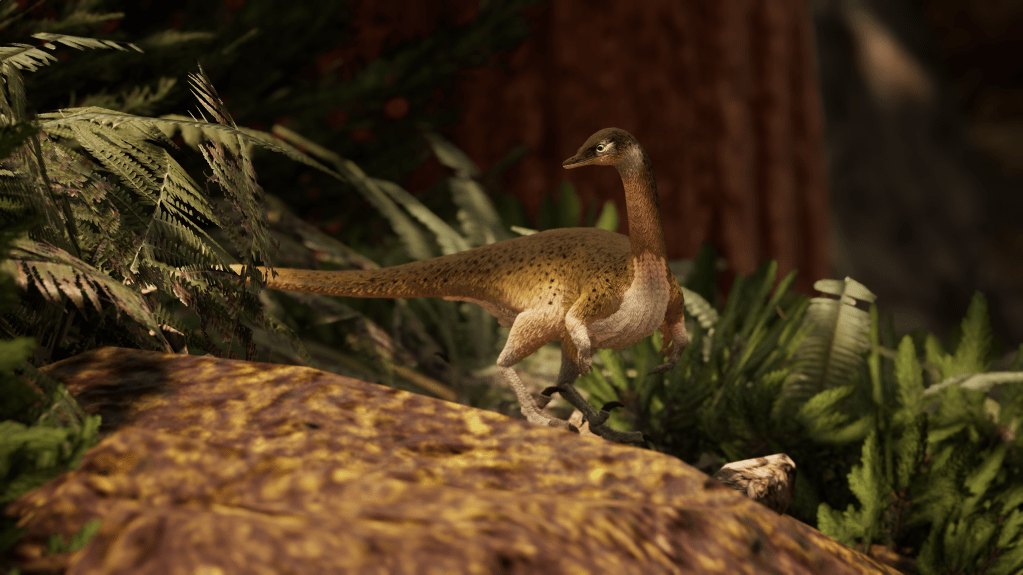
Halszkaraptor was a dromaeosaurid, similar in size to a duck, that existed during the Late Cretaceous era in present-day Mongolia. Unlike its much larger relatives, such as Velociraptor, which were mainly terrestrial hunters. Halszkaraptor evolved for a distinct way of life that involved hunting in both terrestrial and aquatic environments.
Tier: 1
Dimorphism: No
Habitat: Can be found nesting anywhere in Riparia.
Diet: Omnivore
Active Times: Crepuscular (Active at dawn or Dusk)
Group Size: 10 individuals
Defense: 8 individuals
Nesting Season: Spring & Summer
Offspring: Up to 5
Adoption: ✅
Behavior
By using its sensitive snout to locate prey and subsequently its sharp claws to capture them, the Halszkaraptor is able to capture fish and crabs in lakes and ponds. It often spends time on land and in the water, moving between ponds, rivers, and lakes as needed. Living in small flocks, Halsz might establish territorial claims over their breeding sites or a disputed body of water (a small pond).
Courting and Nesting
In the spring, courtship begins as males attempt to attract females by offering small gifts such as berries, fish, polished shells, or interesting stones; if a female accepts the offering, it signals mutual acceptance and the pair forms a bonded partnership. During this time, males also frequently display their prowess and patrol their territories, aggressively deterring unwanted rivals and maintaining dominance through constant vigilance and intimidation. Females lay eggs and rear their young until they reach adulthood, providing protection and guidance during their most vulnerable stages. Once mature, the offspring may either remain within the group or disperse to establish territories of their own.
Mandatory Traits
Fear Factor
Owing to their swiftness and nimbleness, Halszkaraptors have a very low fear factor. They can be seen getting remarkably close to large predators without putting themselves at risk. This is seen most often with Spinosaurus and Suchumimus. Although Spinosaurus and Suchumimus are highly territorial and reject other species in their claimed water areas, Halszkarapator seems to be a notable exception, likely due to the fact that these large predators rarely, if ever, manage to catch them.
Small Crocodilian Fear
Halszkaraptors have an instinctual fear of sarco’s and kapro’s due to being a big enough prey option. If one is spotted lurking in the waters within two Spino lengths of the Halsz, they will be seen moving further away from those Crocodilians or fleeing altogether.
Predator Reaction
Halszkaraptor may protect themselves or their nesting areas by mobbing, and unpredictably striking at the predator in a unified manner, but only up to a dinosaur no bigger than a tier 4.
Imprinted
After hatching, if no adult Halsz is around, a young Halszkaraptor’s “parent” would then be the first moving dinosaur it comes into contact with. This could lead to awkward or unusual situations, such as a hatchling bouncing around honking while following a rex or sauropod. A Halszkaraptor may end up remaining with its imprinted “parent” until reaching adulthood. At this time, they would leave to find another of their kind.
Optional Traits
Curious birds
Halszkaraptor are an exceptionally inquisitive species, frequently chirping and honking about the various animals they encounter as they explore their environment. Highly social and alert, they communicate constantly within their groups, using a wide range of vocalizations to share information about food sources, potential dangers, and interesting discoveries.
Their curiosity often leads them to investigate unfamiliar objects or creatures up close, carefully observing before deciding whether to approach or retreat. In situations where they feel uncertain, mildly threatened, or simply overly enthusiastic, individuals may perform a quick “display dance” intended to signal harmlessness, diffuse tension, or even encourage curiosity in return.
In some cases, especially with less predatory animals, this behavior can make them seem disarmingly non-threatening, potentially helping them avoid conflict or predation. This combination of vocal communication, inquisitiveness, and awkwardly charming display behavior helps them navigate their environment while maintaining strong social awareness and adaptability.
Little Cleaner
Halszkaraptors may approach any tier dinosaur that is sitting or lying down and cautiously initiate a “cleaning” interaction, gently shaking their heads back and forth while brushing against the larger animal with strands of lakeweed or kelp. This behavior acts as a friendly, non-threatening gesture, often interpreted as curiosity or social outreach rather than aggression.This may also serve as a secondary purpose, allowing them to get close enough to assess whether the larger dinosaur is calm, tolerant, or dangerous before committing to further interaction.
Vanity of the Down
Halszkaraptors are fiercely proud of their plumage. When they encounter another goose sporting the same pattern or coloration of down, they react with a mix of indignation and territorial pride. To them, identical markings aren’t just a coincidence; they’re a challenge to their individuality and uniqueness. They may puff themselves up, engage in exaggerated strutting, or issue sharp honks to assert dominance. Socially, this trait makes them sensitive to imitation and keenly aware of how others perceive their appearance. In groups, a Halzskaraptor may avoid or confront doppelgangers, sometimes escalating minor slights into prolonged displays of superiority or a short fight.
Credits: Littlered & IveMcFallen
Sources:
https://en.wikipedia.org/wiki/Halszkaraptor https://pmc.ncbi.nlm.nih.gov/articles/PMC9715538/ https://www.smithsonianmag.com/smart-news/newly-discovered-swimming-dinosaur-delightfully-bizarre-180967454/
Last updated: 6/24/2026
 Ashes of Apex Fantasy Realism