Kelenken
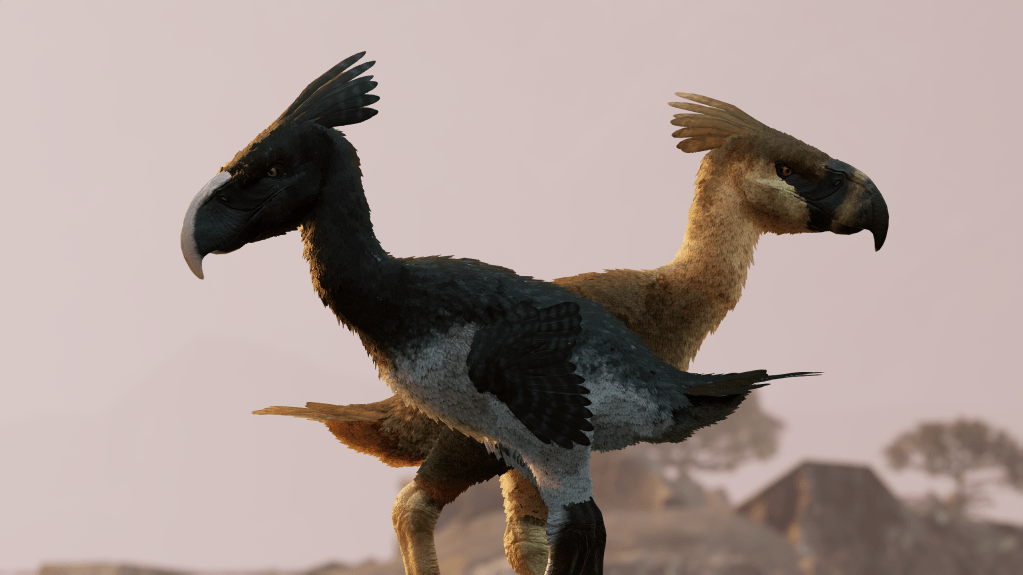
Kelenken was a massive flightless predatory bird from South America that lived about 15 million years ago during the Middle Miocene. It stood close to 10 feet tall and weighed over 220 pounds, with a skull about 28 inches long, which is the largest known skull of any bird. Built like a classic “terror bird,” it had long, powerful legs for running, small wings, and a large, hooked beak. Its anatomy suggests it was a fast ground-dwelling predator that likely hunted or scavenged across the open Patagonian plains of southern Argentina.
Tier: 1
Dimorphism: Females have larger feather crests on their heads
Habitat: Can be found nesting anywhere in Riparia and Gondwa. However, in Riparia Kelenken enjoy the rocky, elevated terrain of Hollow Hills and Dry Fang Canyon.
In Gondwa, it’s Desolate Pass, Whistling Columns, Titans Pass.
Diet: Carnivore
Active Times: Cathemeral (active during day and night, sleeping at random intervals)
Group Size: 6 individuals
Attackers/Defenders: 6 individuals or a mated pair and their offspring under sub-adult age.
Nesting Season: Spring and Summer
Offspring: Up to 5
Adoption: ✅
Behavior
Kelenken are bold, high-strung birds with sharp awareness and quick reactions. They move with purpose and rarely linger in one place for long. While individuals often travel alone or in pairs, they frequently gather in small groups of three or four during foraging or patrols. These clusters move in loose formation and share awareness of the terrain, responding to each other’s signals.
They thrive in open terrain and rocky walkways where long sightlines support their vigilant nature. Hollow Hills and Dry Fang Canyon provide the visibility they rely on and the elevated perches they use to watch for movement below. When several Kelenken share the same region, they fall into relaxed, parallel patterns. They keep a comfortable personal space but remain closely attuned to one another, reacting quickly to signals in movement and voice.
Kelenken move with surprising vertical agility for a ground bird. In rocky terrain, they perform quick, repeated leaps to reach narrow shelves, climb uneven stone, or reposition during a chase. This athletic burst allows them to clear obstacles, scale low formations, and escape through tight, elevated routes that many predators cannot follow. Their ability to chain rapid jumps is one of their key advantages on the steep walls and layered pathways of Titans Pass and Cliff Edge Falls, as well as the rocky outcrops in Dry Fang Canyon.
Kelenken are powerful for their size and rely on precise footwork, sudden bursts of speed, and well-timed strikes. They do not engage recklessly. They test the terrain, pressure a rival when conditions favor them, and disengage as soon as the advantage fades. Their strength supports a tactical fighting style rather than prolonged brawling.
They scavenge when safe, hunt opportunistically, and use sharp awareness, quick coordination, and agile movement to navigate and dominate their preferred passes.
Courting Behavior
The courting season begins in spring, and pair formation peaks through early summer. Adults select open ground of for their display rituals, choosing areas with solid footing and wide visibility.
Kelenken select partners through sparring. Adults face each other in open ground and exchange quick feints, short charges, and light-contact snaps that show accuracy without causing too much harm. Each bird watches how the other reacts. A suitable partner displays balance, timing, and calm under pressure. If both birds prove equally strong, the match becomes clear.
Temperament matters more than strength. A Kel looks for a partner who remains composed, focused, and responsive throughout the interaction. Once both acknowledge the other’s capability, they settle into a seasonal pairing and move on to select a nesting site.
Nesting and Offspring
Although Kelenken spend most of their time in open terrain, they never nest in exposed ground. During breeding season, adults retreat into secluded environments. These areas contain natural alcoves, hollowed shelves, hidden ledges, and narrow approaches that limit predator access while still giving quick routes of escape. The steep walls and stone formations create defensible nesting sites that stay out of direct sight without restricting movement.
Both parents remain attentive through the hatchling phase, guiding their young with soft calls, tapping signals, and careful direction through safe corridors. This early training teaches the chicks which paths offer cover, which routes allow escape, and how to navigate the rocky terrain of their home.
Flamekin Bond Behavior
Kelenken bond effectively with larger carnivores that value sharp senses, steady vigilance, and reliable early warnings. They act as alert partners who watch the horizon, track distant movement, and react quickly to subtle changes in the environment. Their independence makes them dependable companions, since they move with the apex they follow rather than clinging to them or disrupting their pace.
A bonded Kelenken functions as a scout, distraction runner, and sentry. Its awareness, precise footwork, and tactical instincts allow it to support a wide range of species. Faster predators gain a partner who can keep up with patrol routes and signal openings or threats. Slower or heavily armored creatures benefit from a mobile lookout that compensates for limited sightlines and delayed reaction times. They cannot initiate a hunt for an adult flamekin, but they can assist.
When the partnered apex has offspring, the Kelenken shifts into a disciplined mentor rather than a caregiver. It oversees early hunting practice, controls the movement of the chase, and selects targets that match the young apex’s stage of development. This role focuses on teaching timing, restraint, and coordinated pressure rather than providing protection or comfort. The Kelenken keeps the young from rushing in, guides their positioning, and ensures they learn the fundamentals of a clean hunt.
This partnership is practical rather than emotional. The Kelenken offers speed, vigilance, and tactical insight, while the apex provides strength, presence, and protection that the smaller bird cannot achieve alone. Their cooperation forms a balanced Flamekin bond built on mobility, awareness, and mutual advantage.
Mandatory Traits
Cleansing Wader
Kelenken maintain their feathers through frequent water bathing. When they find a shallow pool or a calm shoreline, they crouch low and immerse themselves in the cool water. Once settled, they perform a vigorous shake to clean dirt from their plumage and release excess heat. This behavior is routine and instinctive, and most Kelenken repeat it several times a day when water is available.
Rumble of Awareness
Kelenken produces a low, resonant rumble(? emote) whenever they encounter something unfamiliar in their environment. This sound is not a danger warning but a focused signal that marks the presence of something new. They rumble at unusual scents, unfamiliar tracks, changes in terrain, or creatures they have not seen before. The call helps nearby Kelenken recognize that something requires investigation. This instinctive behavior is consistent across the species and is often the first sign that a Kel has noticed a change in its surroundings.
Elevated Vigil
Kelenken instinctively seek elevated stone outcrops, ridges, or ledges during their daily movements. They pause at these vantage points to scan the landscape, listen for distant activity, and assess shifting conditions. This behavior is consistent across the species and occurs even during travel, hunting, and patrols. A Kelenken rarely crosses open terrain without first stopping at a high point to study the area ahead.
Sentinel Rotation
When Kelenken form small groups, they rotate the position of lookout. One bird takes the forward-stand role while the others forage, rest, or scan different angles of the terrain. As soon as the active sentinel steps down, another rises to take its place. This rotation keeps the group aware of distant movement and prevents any individual from tiring during shared travel or temporary gatherings.
Optional Traits
Early Departed
Some Kelenken display a strong instinct to separate from their young once they reach the adolescent stage. Instead of easing into distance, these individuals detach suddenly and without hesitation. They rise one morning, survey their adolescent chicks, and simply walk away. There is no aggression, no driving or pushing, just a quiet departure that feels almost ceremonial in its finality.
These Kelenken believe that lingering too long weakens the young. They trust the adolescents to rely on the lessons already learned: how to read terrain, how to react to danger, and how to move with confidence through their preferred passes. They assume that a clean break is a gift, freeing the young from reliance and forcing them to claim their own territory.
Adolescents left by such parents often develop stronger independence traits themselves, sometimes mirroring the precise patterns or habits of the parent that raised them. In rare cases, an adolescent may continue to shadow the departing adult for a time, but the parent never looks back or slows down. Their role is finished, and they step into the next season with no regret.
Way of the Talon
The Kelenken takes an active role in training the apex offspring it is bonded to as a Flamekin. It initiates controlled hunts only for teaching purposes and selects targets that match the young apex’s growth stage. If the offspring are juveniles, the Kel chooses Tier 1 or Tier 2 prey. If the offspring have reached the Adolescent stage, the Kel may guide them after Tier 3 prey.
The Kel teaches timing, restraint, and coordinated movement. It controls the pace of the hunt, signals when to hold, and decides when the young apex should commit. During risky moments it behaves like a strict instructor, maintaining order and preventing reckless charges. This trait ensures the young apex learns proper hunting discipline under the Kel’s tactical guidance.
Pale and Shadowed Outcasts
Kelenken occasionally hatch albino or melanistic offspring. Adults rarely accept these unusual chicks and often drive them away once they reach the early juvenile stage. The outcasts form small, elusive groups that avoid contact with typical Kelenken. They roam widely and seldom linger near others, appearing only briefly before fading back into isolation, yet they still return to their preferred habitat when it is time to court or nest.
Credits: MisslilBlue and Onlooker
Sources:
https://en.wikipedia.org/wiki/Seriema
https://en.wikipedia.org/wiki/Secretarybird
Last Updated: 11/28/25

