Lambeosaurus
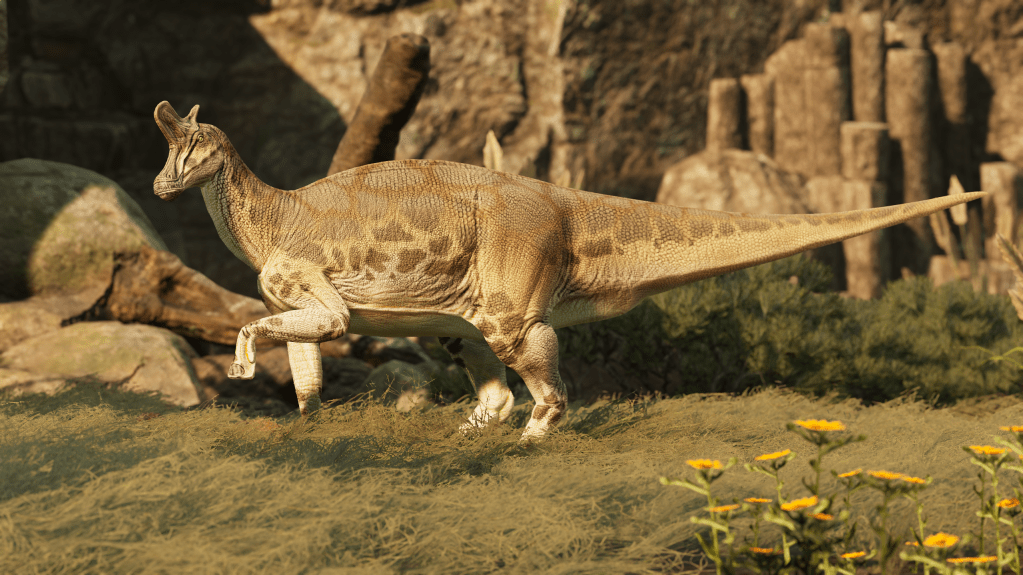
Lambeosaurus, often called “the Choir,” is renowned for its deep, resonant songs that echo through the landscape and its ornate, crown-like crest that makes it one of the most striking hadrosaurs of its kind. The crest is more than decoration; it’s an instrument of communication, identity, and dominance. By channeling air through the hollow chambers within its crest, each Lambeosaurus produces a distinct tone known as its heart song. This unique vocal signature strengthens bonds between mother and calf and allows herd members to recognize and coordinate with one another across great distances. The crest also serves as a visual display of health and strength. Brighter, more vividly colored crests often signal higher status or greater vitality, especially during courtship or rutting season. Though typically moving on all fours, Lambeosaurus is a facultative biped, able to rise onto two legs for display, combat, or swift movement.
Tier: 3
Dimorphism: Dominant males and females exhibit brightly colored crests.
Habitat: Follows migration unless pairing and nesting in East Passage or Wollemi Forest
Diet: Herbivore
Active Times: Diurnal (Meaning active during the day and resting during the night).
Group Size: 6 individuals
Defense: 4 individuals
Nesting Season: Spring and Summer
Offspring: Up to 5
Adoption: ✅
Behavior
Shortly after birth, mother Lambeosaurus, often called “lamb mothers,” carefully nurture their young and host their offspring’s very first “voice lesson.” This early ritual is instinctive and deeply emotional: together, mother and calf create a unique song that becomes their lifelong bond. The mother repeats this melody until the young one can echo it perfectly, marking the beginning of its identity within the herd.
Lambeosaurus are profoundly empathetic creatures. Highly social and attuned to one another, they don’t just hear each other’s calls; they feel them. The deep vibrations produced by their resonant crests travel through the ground and air, allowing herd members to sense one another’s emotions. When a calf cries out in fear or pain, the herd quite literally feels its distress, prompting an immediate and protective response from all members.
Fathers, or bulls, are naturally curious about the calves but are kept in check by the vigilant cows, who monitor every interaction with fierce attentiveness. Despite this, bulls play an important protective role and are often seen patrolling the perimeter of the herd, watching for danger, and standing guard while females and young remain near the center.
When traveling, the dominant bull leads from the front, while subordinate males move along the outer edges and rear, forming a living shield around the herd. Together, they remain alert for ambushes or threats.
A solitary Lambeosaurus, however, behaves much differently. They are nervous, reactive, and constantly in a state of fight-or-flight. Within the safety of the herd, their behavior transforms: they find balance through shared combat, survival, and healing calls, maintaining harmony and strength through the power of their unified voices.
Courting
Lambeosaurus breeding behavior is inseparably tied to sound, hierarchy, and communal tradition. While players are not required to breed, any Lambeosaurus that chooses to do so must return to East Passage during the rutting season. As fall arrives and cooler months set in, Lambeosaurus herds migrate back to this sacred region, where breeding, nesting, and social restructuring occur among all hadrosaurs.
Rutting season is marked by powerful vocal displays as bulls compete for dominance and the title of Lead Bull. These contests determine which bull will guard the herd and claim the majority of mating opportunities. Duels are ritualized and controlled, ending when one bull signals submission with a respectful bow or is forced to yield after reaching physical exhaustion. All remaining males within the herd take on submissive or beta roles under the Lead Bull’s authority.
Despite this structure, Lambeosaurus breeding behavior allows flexibility. Females may occasionally seek out beta males to promote genetic diversity, often when the Lead Bull is distracted or engaged elsewhere. Courtship is heavily vocal-based: males circle receptive females while producing melodic crest calls, escalating into deeper, resonant heart-songs. Mutual interest is confirmed through shared harmonized calls and close crest contact before mating occurs. (See Traits for more details)
During rutting season, lone Lambeosaurus will also travel to East Passage, seeking both protection and the opportunity to join a herd. Females are far more likely to be accepted than males, which contributes to the formation of unattached or subordinate bulls outside established herds. A Lambeosaurus requesting entry must approach respectfully, using calm movement and measured vocalizations to announce their presence.
The Lead Bull acts as the primary gatekeeper for herd acceptance. Females are often welcomed quickly, strengthening the herd’s social and reproductive structure. Males, however, are treated with suspicion; even if they attract attention from cows, the Lead Bull may respond aggressively if he perceives the newcomer as a rival or threat to herd stability.
Nesting
East Passage serves as neutral and protected territory. During nesting season, all hadrosaurs defend the nesting grounds regardless of herd affiliation. Territorial disputes are set aside in favor of collective survival, and Lambeosaurus frequently nest alongside Parasaurolophus and other hadrosaurs, often returning to the same nesting sites year after year.
Once breeding concludes, eggs are laid at East Passage and incubated communally. Mothers conduct early bonding through the calf’s first “voice lesson,” creating a unique heart-song that allows instant recognition and emotional connection. The herd remains deeply attuned to these calls, responding immediately to distress through unified protective behavior.
Through sound, ritualized dominance, and communal defense, Lambeosaurus ensure the survival of their young while preserving the harmony and strength of the Choir.
Mandatory Traits
Who’s in charge here?!
During the cooler months (Fall), Lambeosaurus herds enter the rutting season and return to East Passage, a time when bulls compete for dominance and the title of Lead Bull. These contests determine who will guard the herd and claim the majority of mating rights. (All other bulls in the herd will be beta males/submissive bulls.) During a rutting duel, combat must end when one bull signals submission with a respectful bow. If no clear yield occurs, the duel automatically concludes when one participant reaches 30% health, at which point that bull must yield. This ensures fair competition and prevents unnecessary harm, preserving strength for the challenges of the season ahead.
Sacred Lands We Return
If decided to reproduce, lambs will return to East Passage for the communal nesting among hadrosaurs provides significant benefits. Multiple herds band together to defend their sacred nesting grounds and safeguard the next generation from predators and threats. Lone lambs may also take advantage of nesting season and try to join herds during this time.
Safe Harbor
Some hadrosaurs, such as Lamb, may choose to remain in East Passage during nesting season rather than continue their migration. Their reasons can vary: some stay because many others are nesting there, some value the protection of a well-established communal nesting ground, and others may see it as an opportunity to join a new herd.
Strong Voice
The Lambeosaurus’s voice is more than a call; it’s a force of nature. Their powerful crest-generated sounds resonate across great distances, uniting the herd and stirring courage in times of need.
Through their combat, survival, and healing calls, these dinosaurs channel deep, harmonic frequencies said to strengthen the weary and restore balance within the group. Some even believe the vibrations themselves can soothe pain and rekindle vitality, proof of the Lambeosaurus’s remarkable bond between sound and spirit.
Family Reunion
“Fossils have revealed hadrosaur fossils grouped together, which scientists suggest hadrosaurs may have traveled together and nested together“ (EBSCO). In addition, paleontologists believe hadrosaurs nested in groups, as many nests were found close together. Some containing eggs from multiple seasons, suggesting they reused the same sites year after year.
So hadrosaurs (e.g., Parasaurolophus, Barsboldia, Edmontosaurus Annectens) are allowed to travel and nest together. They are additionally allowed to reuse their nests versus placing a new one.
Optional Traits
Mating Ritual
In Lambeosaurus herds, the dominant bull typically claims most mating opportunities through displays of strength and vocal power, using his impressive crest calls and physical presence to guard receptive females. However, the system isn’t entirely rigid, females sometimes seek out less dominant “beta” males within the herd to encourage genetic diversity. These discreet pairings may occur while the lead bull is distracted or focused on other rivals.
When a male locates a receptive female, either within the main herd or slightly apart from it, he begins the courtship dance. The ritual starts as he circles the female three times, producing soft, melodic calls through his crest. If the female is interested, she rises to a bipedal stance and watches him closely, signaling curiosity and engagement.
After the third circle, the male stops face-to-face with the female and issues a more resonant “visible” call (one of the vocalizations used in survival, combat, or healing contexts) to display the depth of his heart-song. If the female chooses to reciprocate, she joins him in the call, harmonizing in unison.
Finally, when a bond is accepted, the pair bring their crests together and share a synchronized love call, sealing their connection. Some pairs remain near the herd, while others briefly move to quieter ground before rejoining the group, ensuring both safety and intimacy during courtship.
Herdbound Flamekin Doctrine
(Flamekin Bond)
The Lambeosaurus may serve as a Flamekin exclusively to fellow hadrosaurs. Since the earliest embers of Riparia, Lambeosaurus’ survival has been bound to the safety of hadrosaur herds, where vigilance, coordination, and communal defense ensured its continuation. Outside of these familiar formations, the Lambeosaurus is instinctively cautious and unwilling to form Flamekin bonds.
When seeking to become a Flamekin for a hadrosaur larger than itself, the Lambeosaurus must first assist in the construction of that individual’s nest. Larger hadrosaurs, though formidable, are hindered by their mass and slower movement, making resource gathering a prolonged and vulnerable task. The Lambeosaurus, being smaller, faster, and more agile, fulfills this role naturally by scouting, gathering, and transporting nesting materials with efficiency.
Through this act of service, the Lambeosaurus earns the trust of its larger kin, solidifying the Flamekin bond as one forged through herd loyalty, labor, and shared survival rather than mere proximity.
Credits: Kamarooni
Sources:
https://www.ebsco.com/research-starters/earth-and-atmospheric-sciences/lambeosaurus
https://www.ebsco.com/research-starters/earth-and-atmospheric-sciences/lambeosaurus
Last updated: 11/2/25
 Ashes of Apex Fantasy Realism