Metriacanthosaurus
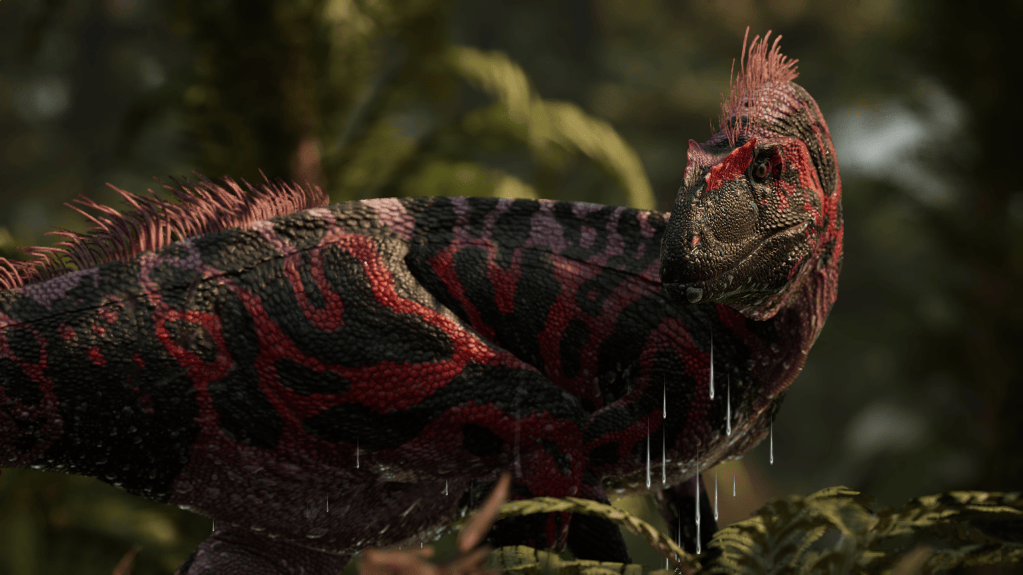
Metriacanthosaurus was a bipedal, mid-sized carnivore that stood approximately 6.5 feet tall at the hips, a measurement supported by the most reliable skeletal reconstructions, and reached lengths of roughly 23 to 26 feet from snout to tail. Its full standing height, including the head and neck, is not precisely known due to incomplete fossil remains. Fossil evidence suggests Metriacanthosaurus had laterally compressed, serrated teeth suited for slicing flesh rather than crushing bone, indicating a predator that relied on repeated slashing attacks and blood loss.
The species is easily recognized by the prominent crest along its brow and a visible dewlap, a loose fold of skin beneath the throat that may have been used for display, intimidation, or communication. Within Ashes of Apex lore, Metriacanthosaurus is known for a toxic hide that causes harm when bitten.
Tier: 3
Dimorphism: Males display brighter colors than females, who typically have dull coloring. During the autumn season, both sexes exhibit brighter coloration associated with courtship and mate attraction.
Habitat
- Riparia: Black Fern Hills, Wollemi Forest, Hollow Hills, and Craig Bluffs
- Gondwa: Rainbow Hills, Desolate Pass, Snake Gully, Burned Forest, Ocean Pillars
Diet: Hypercarnivore
Active Times: Metriacanthosaurus is primarily nocturnal, most often observed hunting or stalking under the cover of darkness. During daylight hours, individuals may be seen cautiously scavenging and tending nest sites.
Group Size:
Up to 4 adults and 5 offspring below subadult.
Maximum allowed structure: 6 adults and 2 offspring below sub-adult.
Attackers/Defenders: 4 individuals
Nesting Season: Spring and Summer
Offspring: Up to 5
Adoption: ✅
Behavior
The Metriacanthosaurus is most commonly seen in one of four social groups.
The first is a solitary individual who keeps to the shadows, staying out of sight whenever possible. These Metriacanthosaurus will often eat and drink in secluded areas where they are less likely to be found.
The second group, known as “The Grey Path Triad,” consists of three male Metriacanthosaurus. They are encountered more frequently than solitary individuals, as they migrate often and rarely stray from one another, constantly keeping watch as a unit.
The third group, known as “The Stonehush Quartet,” is made up of two family units, consisting of two males and two females. These families respect one another’s boundaries while sharing the same territory, increasing their chances of survival.
The fourth group, known as “The Anchor Pact,” consists of a single Metriacanthosaurus that aligns itself with a lone Tier 5 or Tier 6, or a matched pair of the same tier. It avoids mixed pairings, remaining close to its chosen partner and supporting them through conflict.
Courting Behavior
Metriacanthosaurus courtship is typically quiet. When a male and female encounter one another, they use the “?” emote to initiate courtship.
Courtship relies on close-range interaction over the course of a full in-game day (30 minutes), including circling, mirroring movement, traveling, and hunting together. Individuals assess one another through these interactions, and disruption or aggression during this period may result in separation.
Each individual performs a single heart call, followed by one shared call together once both have acknowledged the pairing.
Nesting & Offspring
Nesting occurs in as concealed a location as possible within their preferred habitats, as Metri offspring have a low survival rate. Parents remain cautious and avoid drawing attention, responding quickly to nearby threats. If a threat comes within two Metri body lengths of the nest, they will defend it, but once the danger has passed, they abandon the site and relocate to a new nesting area within their preferred habitat.
A Metriacanthosaurus that has established a nest may adopt one lone Metri of hatchling or juvenile age. The adopted individual is treated as part of the nest and remains under the same protections and expectations as existing offspring.
Hatchlings are dependent on their parents and don’t leave the immediate nesting site. They are more vocal at this stage, often calling out unintentionally, having not yet learned the quietness of their parents. Movement is minimal, and survival depends on staying close and protected.
As they grow into juveniles, they remain within close proximity of their parents and begin following when it is time to leave the nesting area. Vocalizations become less frequent as they learn restraint. They observe their parents’ hunts and retreat immediately when danger is present.
With adolescence comes greater control and awareness, with increased patience and reduced vocalization. They trail slightly behind adults, beginning short periods of independence as they hunt small prey, but return quickly if threatened.
By the subadult stage, they are largely quiet and controlled, mirroring adult behavior. They move with greater independence, often operating at the edges of the group or slightly apart from it. Participation in hunts increases, though they avoid leading engagements and may separate fully as they approach adulthood.
Orphaned Metriacanthosaurus do not imprint, and survival without parental guidance is difficult. Without direction, they struggle to regulate vocalizations and movement, often drawing unwanted attention. They only begin to learn restraint after being hunted or attacked, with experience forcing them into quieter, more cautious behavior.
Mandatory Traits
The War of Unrotting Scale
Metriacanthosaurus and Megalania are bound by an irreconcilable, instinct-driven hatred. The presence of one is treated as an immediate threat; there is no warning, posturing, or tolerance. Encounters result in instant combat with lethal intent.
Megalania sees Metriacanthosaurus as rivals that cannot be driven away, while Metriacanthosaurus recognizes Megalania as ambush predators too dangerous to evade. Both species will fight to kill regardless of injury, numbers, or terrain.
The Librarian
A solitary Metriacanthosaurus known for its silence. It is rarely heard beyond the sound of its footsteps, as it does not vocalize, choosing instead to listen to the peace and quiet of its surroundings.
The One Who Walks With Strays
A solitary Metriacanthosaurus that travels without a permanent group, yet is rarely alone for long. Smaller or displaced Metris encountered along its path are tolerated, then protected, and eventually allowed to move within its shadow.
It does not claim territory or assert dominance, acting instead out of responsibility and survival. Its role is not to lead, but to ensure that those who follow survive the road ahead. (Maximum of 2 “strays”)
Optional Traits
The Grey March Compact
A trio of Metriacanthosaurus that travels established migration routes between apex territories. They avoid contested areas and do not challenge dominant predators. Conflict is avoided whenever possible and only met when retreat is no longer viable. When forced to fight, the trio acts as a single, coordinated unit.
The Stonehush Quartet
Two bonded pairs, two males and two females, can form two distinct family units that share space without asserting dominance. They remain close together, favoring terrain such as forests, ravines, and broken ground. Hunts are coordinated, and internal conflict is rare. Together, they present a unified presence while avoiding unnecessary confrontation.
The Anchor Pact
A single Metriacanthosaurus acts as a battlefield medic to a lone or paired Tier 5 or Tier 6 apex. It will not integrate into an already established mixed Tier 5 and Tier 6 group. Through its calls, Hussle, Rejuvenating Roar, and Healing Call, it provides steady recovery and stabilization during and after engagements, prioritizing its partner’s longevity while only assisting offensively when it is safe to do so.
Mobbing Mercenary
A lone Metriacanthosaurus can be sought out by carnivores of all tiers to assist in a hunt. As solitary Metris reside in remote areas and are relatively silent, they are not easily found. Their value in a hunt makes the effort to locate one worthwhile for those seeking a temporary ally.
Mushrooms may be offered to please and persuade the Metri before a hunt, with the amount depending on the individual. In exchange for its assistance, the Metri will feed from the body after a successful kill.
Once the body is gone, both the Metri and those it assisted go their separate ways and enter a 30-minute truce. After separating, the Metri may not assist the same individual or group again for two in-game days (1 hour).
- Additional Conditions: A Metriacanthosaurus adopting the mercenary role forfeits its ability to form or join groups with other Metris. Interactions between Metris are limited to brief tolerance and do not extend into cooperative behavior or nesting. Additionally, a Metri acting as a mercenary will adopt a cathemeral activity pattern, remaining broadly available to be sought out for hunts at any hour.
Ancient Accord
Metriacanthosaurus rarely remain alongside larger predators for extended periods. Yangchuanosaurus are a rare exception. Due to their distant relationship and long history of coexistence, a Metriacanthosaurus may choose to form an Ancient Accord with a lone Yangchuanosaurus, allowing the larger predator to travel and hunt at its side. These partnerships are uncommon and seldom witnessed among Metriacanthosaurus.
- A Metriacanthosaurus may only form an Ancient Accord with a single Yangchuanosaurus.
Credits : IveMcFallen, with special thanks to ItsAce
Sources:
https://path-of-titans.fandom.com/wiki/Metriacanthosaurus
https://en.wikipedia.org/wiki/Metriacanthosaurus
Last updated: 4/28/26

