Miragia
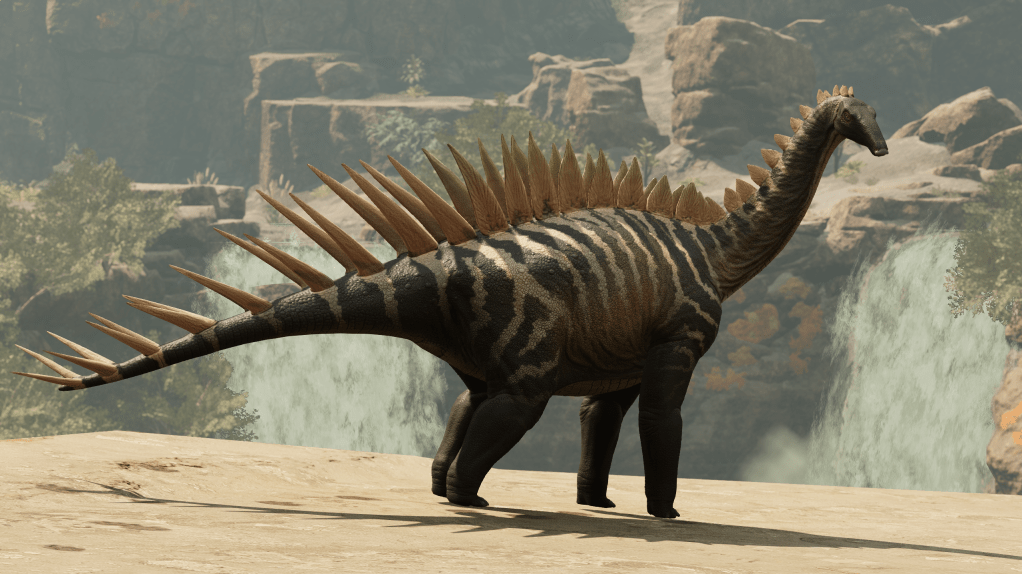
Miragaia was a long-necked herbivorous stegosaurid dinosaur that lived during the Late Jurassic period, roughly 154–145 million years ago. Its fossils have been discovered in the Lourinhã Formation of Portugal, a region that during the Late Jurassic consisted of coastal plains, river valleys, and floodplains, supporting a rich diversity of dinosaurs, crocodilians, and early mammals. Miragaia is notable for its exceptionally long neck, which likely allowed it to browse vegetation at heights other stegosaurs could not reach, giving it a feeding advantage. It coexisted with other herbivores and predators, navigating a complex ecosystem of competition and occasional predation, and its environment provided both abundant plant food and water sources for survival.
Tier: 3
Dimorphism: No
Habitat: Dry Fang Canyon, Cedrus Forest
Diet: Herbivore
Active Time: Diurnal, most active during the daytime.
Group Size: 5 individuals
Defense: 2 individuals
Nesting Season: Spring and Summer
Offspring: Up to 5
Adoption: ✅
Behavior
Miragaia is a mostly peaceful herbivore that spends its days foraging for plants. It lives in small groups or loosely associated herds and often engages in playful interactions with other herbivores. While generally non-aggressive, Miragaia becomes highly defensive when predators are nearby, especially around its young. Adults use tail swings, body displays, and posturing to intimidate threats, forming a protective barrier around nests or calves. Courtship involves visual displays such as head movements and tail gestures to attract mates. Nesting occurs in concealed areas near water or vegetation, with adults maintaining vigilance and often coordinating with nearby herd members to guard eggs from predators. Their behavior balances calm social interactions with strategic defensive responses whenever danger approaches.
Mandatory Behavior
Herbivore Harmonies
Miragaia must engage in gentle, non-aggressive interactions with other herbivores when not threatened. This includes behaviors like mock-chasing, water splashing, or harmless posturing. They tolerate other herbivores within their territory and may even form loose bonds or follow smaller species while foraging, but playful interactions must never escalate into real aggression.
Peace of the Plains
Miragaia should refrain from engaging in conflict unless defending themselves, their young, or their nest. They do not initiate fights with predators, other herbivores, or conspecifics outside of territorial or protective situations. Displaying warnings like tail swings or vocalizations is encouraged before direct confrontation.
Herd Guardianship
When in a herd or loose group, Miragaia must demonstrate cooperative behavior in defensive situations. Adults should form protective barriers around the young, coordinate movements to deter predators, and maintain awareness of other herd members. Group coordination includes signaling danger, positioning to shield vulnerable individuals, and retreating strategically if outmatched.
Optional Behavior
Leafreach Duels
Miragaia may engage in friendly competitions with herd members to see who can reach the tallest or most difficult-to-access vegetation. This playful behavior often involves mimicking each other’s movements, stretching their long necks side by side, and occasionally nudging one another gently. These challenges help reinforce social bonds and demonstrate dexterity and strength without causing harm.
Swinging Shadows
A social game where Miragaia lightly swats or taps each other with their tails. The goal is playful interaction rather than aggression, often involving chasing, mock “tagging,” or coordinated movements between herd members. Tail Tag strengthens social cohesion, allows younger individuals to practice defensive movements, and provides entertainment during periods of low stress or downtime.
Riverbed Revels
Miragaia may roll or rub themselves in mud or dust near water sources to cool down, protect their skin, or simply enjoy tactile stimulation. This behavior can be individual or social, with multiple herd members participating together. Mud Wallowing also serves as a playful interaction, occasionally leading to mock splashes, gentle nudges, or sliding competitions among friends.
Credits: Littlered
Sources:
https://en.wikipedia.org/wiki/Miragaia_longicollum https://pmc.ncbi.nlm.nih.gov/articles/PMC6853308/ https://encyclopedia.pub/entry/34426
Last updated: 10/28/2025

