Moraquile
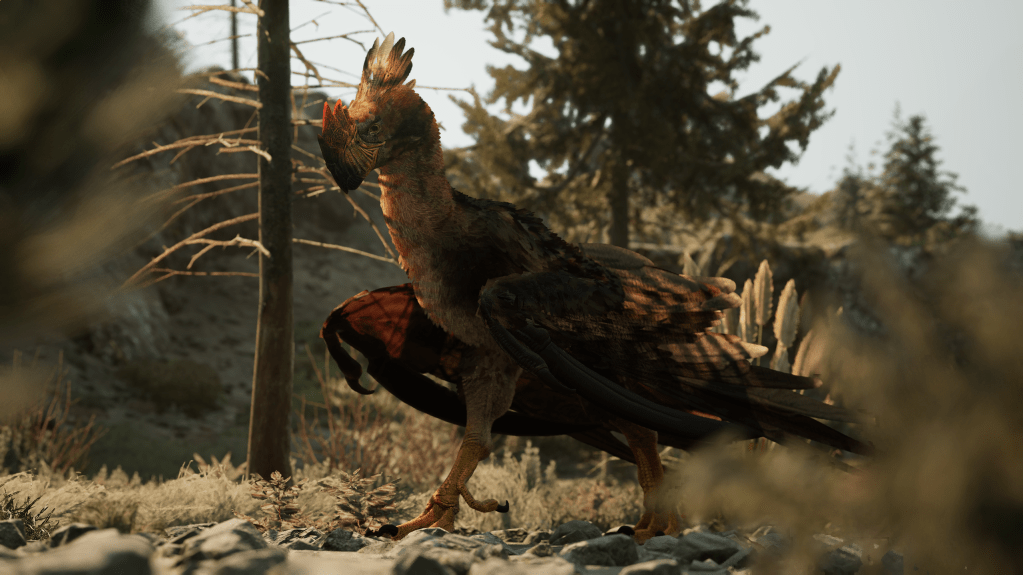
Moraquile is a gigantic predatory bird that is hyper-evolved to dominate both open ground and the skies, and possesses an immense wingspan supported by powerful flight muscles and broad, armored feathers that provide both lift and stability during slow circling flights over its territory. Its long, hooked beak and sharply curved talons suggest a predator specialized for inflicting deep tearing wounds, causing heavy bleeding that gradually weakens its prey. On land, its long legs and raptorial claws allow it to pursue prey with slashing strikes, while its tremendous beak’s grip strength enables it to seize smaller animals and carry them aloft before dropping them from great heights onto rocks or hard ground to kill them. The dramatic feathered crest atop its head may function as a visual signal for intimidation or mating displays, making Moraquile not only a capable aerial hunter but also a highly territorial and imposing species of prehistoric megafauna.
Tier: 3
Dimorphism: none
Habitat:
Riparia: East Passage, Wollemi Forest, Dry Fang Canyon, Tallbrush Coasts, Big Tree Overlook
Gondwa: Hoodoo Expanse, Flyer’s Bluff, Broken-Tooth Canyon
Diet: carnivore
Active Times: Diurnal, with activity taking place from dawn to dusk, and sleeping at night
Group Size: 6 adults/sub-adults, or 2 adults and up to 3 offspring below sub-adult age.
Attackers/Defenders: 4 adults/sub-adults
Nesting Season: Spring
Offspring: Up to 3
Adoption: ❌
Behavior
Moraquile is a large and dominant aerial predator. Despite its size, it remains highly adapted for flight-based hunting, relying on altitude and visibility rather than solely terrestrial pursuit. Observations suggest Moraquile typically patrols broad stretches of open sky, using high perches such as cliffs and rock outcrops to survey potential prey. Although capable of traveling on land, Moraquile tends to remain near terrain that allows for rapid takeoff. Social behavior appears largely solitary, with individuals maintaining expansive territories and driving away other large flying predators from preferred hunting and nesting grounds.
Courting and Nesting
Moraquile pair bonds form through an elaborate courtship ritual centered on display and skill. When seeking a mate, the male first secures a prey item, often something freshly killed or still struggling, to demonstrate his strength and hunting ability. Carrying the offering in his beak, he approaches the female’s perch cautiously before setting the prey down within her reach. He then performs a striking visual display, spreading his broad wings to their full span while raising and fanning the crest of feathers atop his head, creating a dramatic silhouette meant to emphasize both size and vitality. (Use combonation of ❓and ❤️ emotes) Throughout the display he remains grounded while allowing the female to inspect both him and the offering. If she accepts the prey and does not drive him away, the exchange marks the beginning of a pair bond. Over time, repeated hunts, shared feeding, and cooperative territory defense reinforce this partnership, eventually resulting in the establishment of a shared nesting site.
Mating behavior is most commonly monogamous, with bonded pairs forming long-term partnerships that may persist for life. These pairs often share territory, nesting grounds, and hunting responsibilities, reinforcing their bond through repeated seasonal breeding. If the Moraquile struggle to reproduce or care for young cooperatively, however, these bonds may fail leading a pair to move on from one another in search of a more compatible mate.
Moraquile nest exclusively in high elevation habitats, such as atop towering mountain peaks and high ridges, as well as in tall trees on secluded islands. They select nesting sites for their security, not necessarily proximity to resources. This is because the survival of their young is of utmost importance to them, and so they choose locations that are impossible to access by any terrestrial threat. They are known to fiercely enforce their territory boundaries, pushing out any flying carnivore that could pose a threat to their chicks.
Offspring Behavior
Moraquile lay up to three eggs each season, and hatchlings display intense early competition, particularly during periods of food scarcity. Chicks hatch underdeveloped but grow rapidly, and their demand for food can place significant strain on their parents. In nests where prey deliveries are insufficient, aggressive behavior between siblings becomes increasingly common. Larger or earlier-hatched chicks may dominate feeding opportunities and, in severe shortages, attacks can escalate into lethal confrontations. This form of brood competition, while brutal, ensures that the strongest individuals survive when resources cannot sustain the entire clutch.
Chicks stay in the nest for a prolonged period of time, and are mostly immobile during the hatchling stage. When they become juveniles, they begin to strengthen their long, muscular legs and powerful wings by moving around the nesting site. They exercise their wings by flapping and jumping around the nest, repeating these movements until they are able to hover in place. By adolescence, their confidence and curiosity has grown, compelling them to leap from the nest into their first flight.
The parents, tied to their young, will hunt for them until they reach sub-adulthood, wherever they travel to within the territory after they fledge from the nest. After being dispersed at sub-adulthood, the young Moraquile then travel many miles on a grand journey of their own, to find a mate and establish territory.
Mandatory Traits
Emberfall Ambush
Hunts often begin with circling behavior followed by rapid diving strikes against isolated or weakened creatures. When targeting those smaller creatures, Moraquile has been noted to grasp prey in its beak and carry them aloft, releasing them from great heights to inflict fatal or debilitating fall injuries.
Solitary Flame
Moraquile are often observed patrolling vast expanses of the sky over large territories, sometimes flying over an entire POI. They travel alone or with their mate for most of the year, other than nesting season when they can be seen with their young in the same territory, or in times of scarcity. Moraquile do not form Flamekin bonds, as they prefer to eat creatures of a lower tier than themselves.
Bleeding Cinders
Moraquile is an opportunistic predator that favors young, injured, or distracted prey, often singling out individuals that have been attacked or strayed too far from the safety of their group. From above, Moraquile may shadow its target, patiently allowing blood loss and exhaustion to weaken the animal before swooping in for the kill. This strategy allows the great bird to conserve energy while turning even brief strikes into deadly encounters.
- Moraquile may target hatchlings and juveniles.
- Moraquile may 3rd party only when 30% hunger or lower
Warden of the Pyre
Moraquile are fiercely defensive of their nesting territory, especially after eggs have been laid or chicks have hatched. They have been observed engaging with and driving away other large aerial predators, such as other Moraquile, Dracoviper, Griffin, Hatzegopteryx, and Quetzacoatlus, only ending their pursuit when the intruder leaves their line of sight. These chases can sometimes last for miles, or until the intruder has left the Moraquile’s territory entirely.
- Moraquile may engage in combat with any terrestrial creature that comes within 2 Moraquile body lengths of the nest, regardless of hunger percentage.
- Moraquile may engage with any flyer that comes into line of sight of the nest, ONLY if offspring (hatchling -> adolescent) are present.
The Shadow’s Toll
While most Moraquile occasionally feed on carcasses, the Vultra subspecies is known to feed on them as a primary food source. This bald-headed subspecies has been seen following large apex predators and packs of smaller carnivores alike, soaring high above them in the sky, watching and waiting for them to make a kill. After prey is brought down, a Vultra Moraquile will attempt to drive away the hunting party to claim the carcass as its own. They are highly aggressive in these claims, and will only surrender the corpse if they have reached 25% health.
- Kill claim rules apply to this behavior.
Optional Traits
Truce of Talons
While Moraquile are typically solitary and territorial, there are rare instances where multiple individuals tolerate one another within overlapping territories, particularly in areas with abundant prey or ideal nesting terrain. In these situations, Moraquile maintains a tense, unspoken truce, keeping distance while sharing access to the same skies rather than immediately driving each other away. Mated pairs and individuals maintain distance with threatening calls and displays, warning others instead of engaging in direct conflict. This truce is fragile, and Moraquile will respond aggressively if approached within close range or if direct competition for prey occurs. The presence of a nesting Moraquile with offspring nullifies the truce, as defense of young takes top priority.
- Moraquile may not cooperate in hunting or share food outside of mated pairs or Congress behavior.
- Any direct contest over prey, nesting space, or intrusion of another Moraquile’s personal space voids the truce.
- Moraquile with overlapping territories may not group or spend time in close proximity, unless courting to become a mated pair.
Perch of the Shadow
Possessing keen eyesight, Moraquile tend to prefer to perch atop high cliff ledges, trees, and rock formations where they can overlook their territory between aerial patrols. This positioning allows them to spot prey and launch into flight from safe and advantageous view points. They may also use these perches as resting sites, where they will preen themselves and their mate to reinforce their pair bond. They always remain watchful while perched, scanning the skies for intruding threats or the terrain below for a hunting opportunity.
Congressional Session
Moraquile tend to gather in the harsher seasons such as Winter and Fall, forming temporary, loosely bonded social groups called Congresses. A Congress may contain up to 6 unrelated adults and/or subadults, 4 of which may work together to bring down large prey or contest a corpse. Members of a Congress benefit from shared proximity to one another, sharing food and water sources, and hunting cooperatively in times of scarcity. The members disperse during nesting season, when mated pairs resume patrols in their territory, pushing out individuals seeking to secure a nesting site or prey on offspring.
- Members of a Congress must disperse to nest.
- No offspring under subadult age may be present in a Congress.
Player Tip: Moraquile are primarily solitary. Outside of seasonal Congress formation, they may only associate with a bonded mate and their offspring. Family units do not exceed 5 individuals and persist until offspring reach sub-adulthood, after which young are dispersed and adults return to solitary or paired behavior.
Credits: Onlooker
Sources: https://www.allaboutbirds.org/guide/Golden_Eagle/overview
https://en.wikipedia.org/wiki/Golden_eagle
Last updated: 3/19/2026
 Ashes of Apex Fantasy Realism