Mosasaurus
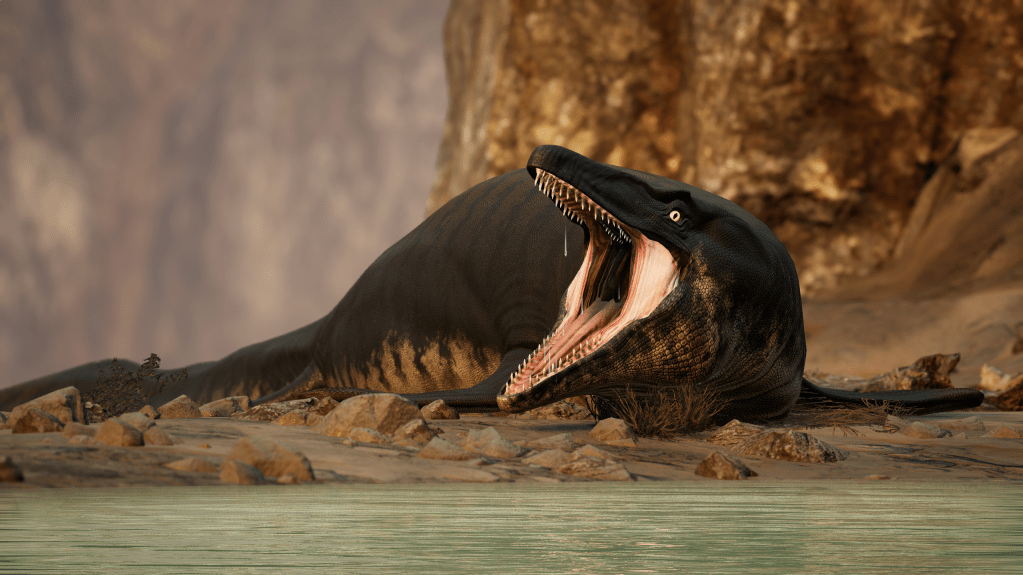
Mosasaurus was a massive aquatic carnivorous reptile that lived during the Late Cretaceous period, over 66 million years ago. It had a streamlined body, an elongated tail with a two-lobed fin, and two pairs of flippers. With robust, conical teeth, Mosasaurus had a widely varied diet that likely consisted of fish, bony sharks, sea turtles, and even other mosasaurs. They were a prolific and widespread marine apex predator, with fossils having been found in North and South America, Europe, western Asia, as well as Antarctica. They were adaptable, and inhabited a wide range of climates- from tropical to subpolar. Mosasarurus faced competition with other large predatory marine reptiles, such as Prognathodon and Tylosaurus, which were known to have a similar diet.
Tier: 5
Dimorphism: None
Habitat:
Riparia: Palm Islands, Wollemi Forest Lake
Gondwa: Volcano Bay, Sweetwater Shallows, Kelp Forest, Lonely Isle
Diet: Carnivore, Piscivore
Active Times: Cathemeral; active during day or night depending on environmental conditions and competitor presence.
Group Size: Maximum of 7 during Spring only
Attackers/Defenders: Self defense only
Nesting Season: Spring
Offspring: Up to 5
Adoption: ❌
Hunting and Combat:
-Mosasaurus are solitary predators. Outside of a brief nesting period, sub-adults/adults do not group, nor do they take Flamekin companions.
-If a nesting group is attacked, individuals may only act in self defense, not defense of the group.
-Mother Mosasaurus may only protect their hatchlings.
Behavior
Mosasaurus are solitary, opportunistic apex predators that prey on a wide variety of marine vertebrates. Individuals patrol vast oceanic territories alone and defend them with extreme aggression. Because they are highly territorial, most individuals only stray from their home ranges to reproduce. They are hostile to other large marine predators, such as Prognathodon and Tylosaurus, and will react violently to their presence.
Mosasaurus are indiscriminate generalists, and they will eat anything they can catch, even consuming their own young when the opportunity presents itself. Their hunting strategy involves hiding in plain sight, with individuals moving slowly through the open sea and locking onto prey the moment it is sighted. Once engaged, Mosasaurus pursue their prey relentlessly and attack with devastating ferocity, turning their immense size against other marine vertebrates and rival mosasaurs alike.
Courting and Nesting
Mating season for Mosasaurus is a brutal, highly competitive period marked by bloodshed and lasting wounds. From Spring to Summer, individuals migrate to the familiar coastlines and deep waters of Palm Islands and Wollemi Forest, returning to these secluded breeding grounds to court and nest.
Males engage in ferocious displays of strength; battling rivals, often to the death, for access to receptive females. A successful male may defeat multiple challengers in a single breeding season, earning numerous scars that serve as evidence of his dominance.
Once the fighting has concluded, females carefully inspect the surviving males. Preference is given to individuals bearing the heaviest scarring, as these wounds signal proven combat ability and the strength to overcome rivals. Only during this brief period do females tolerate a male within their immediate space, allowing momentary closeness before returning to their solitary and aggressive nature.
Females give birth to up to 5 offspring at one time, and their father leaves the nesting area immediately after their emergence, taking absolutely no parental role. Maternal care is brief and lasts only through the hatchling stage, with the mother abandoning her offspring once they reach the juvenile stage.
Should the mother reach hunting hunger at any point after giving birth, she may consume her own hatchlings, making the earliest stages of life the most dangerous for young Mosasaurus.
Offspring Behavior
For young Mosasaurus, life is a brutal and unforgiving test of survival. Because they are abandoned at a young age, juveniles are highly vulnerable and must adopt entirely different strategies to avoid becoming prey to their own kind. Driven by instinct, young Mosasaurus seek refuge in shallow coastal waters, estuaries, and river channels where massive adults cannot easily maneuver.
Relying on their agility and camouflage rather than raw power, they feed on small fish and crab while remaining hidden in the marine vegetation. They are flighty and skittish, fleeing for dense plant cover or crevices to hide in at the sight of any larger marine predator. They lead secretive, guarded lives that they may only share with their siblings.
As they grow into adolescence, their territorial instincts begin to develop, and these young mosasaurs begin expanding their range in search of their own territory. They become bolder in their choice of prey and much more aggressive in nature. Adolescents may wander out of their sheltered estuaries and shallows, but they do not begin to roam the open ocean until they reach sub-adulthood.
Mandatory Traits
Defensive Diver
Mosasaurus is highly territorial and may aggressively defend up to one POI from other large marine predators. Tylosaurus, Prognathadon, Mosasaurus, Lyvitan, and Orca may be aggressed immediately upon entering the line of sight of a patrolling Mosasaurus. These clashes usually last until the intruder has left the territory or died, with Mosasaurus fighting to defend its territory with its life.
-Mosasaurus must broadcast 3 times before engaging with a rival over territory. This action is not required when initiating a hunt.
-Mosasaurus may engage with any of the aforementioned rivals once they enter LOS, regardless of hunger level.
Brief Devotion
Mosasaurus mothers often retreat to highly secluded locations to nest. Once offspring are juveniles, the mothering Mosasaurus must abandon them. Upon abandonment, she leaves the nesting territory and does not look back. If she encounters her young after her departure, and she is at hunting hunger (60%), she may consume them.
Friend or Feast?
Mosasaurus are generalist predators that do not discriminate when it comes to prey. Though they mostly overlook much smaller, faster marine animals when they are not hungry or at rest, they will actively hunt them when they reach the appropriate hunger levels. Any creature lingering too closely to a resting Mosasaurus risks becoming its next meal, regardless of size.
-Mosasaurus may hunt Tier 1 and Tier 2 creatures when at 60% hunger.
-Mosasaurus do not take Flamekins.
Sibling Bond
Young Mosasaurus spend the most vulnerable period of their lives relying on one another rather than their parents. After being abandoned by their mother, siblings remain together within their sheltered birthplaces where they benefit from the safety of the group while learning to survive. As they mature, their territorial instincts begin to outweigh their tolerance, and their bond gradually dissolves.
-Juvenile Mosasaurus from the same nest may remain grouped until they reach sub-adult. Individual members must disperse after reaching the sub-adult stage.
-Siblings do not defend each other if attacked.
Optional Traits
Sunbathing Monarch
During periods of rest, such as after a hunt, Mosasaurus have been known to find secluded archipelagos to recover among. They have been seen beaching themselves on these tiny islands to bask in the sun and warm their massive bodies.
Scars of the King
Every scar on a Mosasaurus tells the story of a battle survived. Older individuals often patrol with confidence, boldly investigating unfamiliar movements, broadcasts, and disturbances within their waters. Rather than avoiding conflict, experienced individuals are drawn to it, eager to reaffirm their dominance over intruders.
Ocean Bully
As one of the ocean’s dominant predators, Mosasaurus rarely passes up an opportunity to assert its superiority over other predators. Rather than expending energy pursuing its own prey, it may instead target predators that have already secured a meal, attempting to drive them away and claim the carcass for itself.
-A Mosasaurus may contest a claimed kill regardless of hunger
-The Mosasaurus must broadcast call 3 times before engaging in combat.
-The Mosasaurus must not leave the claimed kill under any circumstances before the body despawns.
-Mosasaurus may only contest claimed kills from tier 4 or higher predators.
Credits: Onlooker
Sources:
https://en.wikipedia.org/wiki/Mosasaurus
https://www.nhm.ac.uk/discover/what-is-a-mosasaur.html
Last updated; 07/05/2026
 Ashes of Apex Fantasy Realism