Muttaburrasaurus
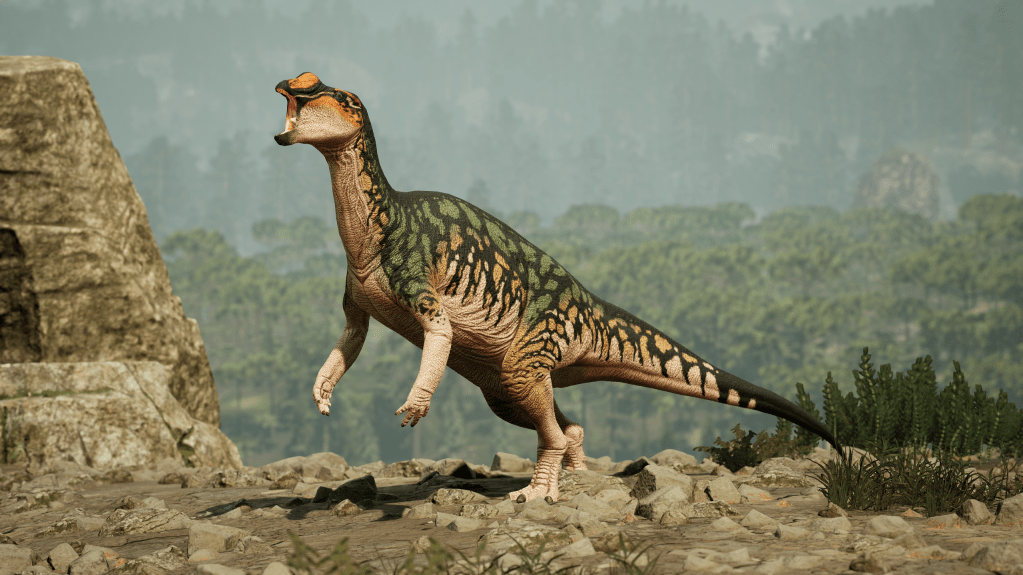
Muttaburrasaurus (“Lizard from Muttaburra”) was a stocky, powerfully built ornithopod native to Early Cretaceous Australia. It possessed a deep torso, thick hind limbs, and strong forelimbs, allowing it to move efficiently both bipedally and quadrupedally depending on speed and terrain.
One of the most debated features of Muttaburrasaurus is the thumb spike. While the only mounted skeleton depicts a spike similar in size to Iguanodon, some paleontologists question this reconstruction due to the original fossil being only partially preserved. As a result, the spike’s true size and function remain uncertain, possibly defensive, possibly vestigial, or used for display.
Another defining trait is its enlarged nasal region. Unlike hadrosaurs, whose nasal crests are positioned farther back on the skull, Muttaburrasaurus’s nasal expansion sits closer to the tip of the snout. While its exact function is unknown, many scientists believe it may have played a role in low-frequency vocalization, resonance, or visual display.
This nasal structure would have limited forward stereoscopic vision. Unlike predators, who rely on overlapping vision fields for depth perception. Muttaburrasaurus had wide, non-overlapping fields of vision, prioritizing predator detection over depth accuracy, a common trait among prey species.
Tier: 3
Dimorphism: There are no permanent physical differences between males and females. However:
- Courting individuals (typically males, but not exclusively) often display brighter coloration
- Herd leaders, regardless of gender, also exhibit brighter or more pronounced coloration as a sign of dominance and confidence
Diet: Herbivore
Habitat: Black Fern Hills, Volcano Islands, Cedrus Forest, Redwoods
Active Times: (Diurnal) Active during daylight hours, resting at night.
Group Size: 6 individuals
Defense: 4 individuals
Nesting Season: Spring and Summer
Offspring: Up to 5
Adoption: ✅
Behavior
Muttaburrasaurus was a highly social, herd-oriented herbivore that relies on group awareness, speed, and coordinated movement for survival. Herds use loud nasal calls to communicate danger, coordinate movement, and reinforce hierarchy. Primarily a browser, Muttaburrasaurus feeds on tough vegetation such as Ferns, Cycads, Club mosses, and Conifers. It uses its beak to crop vegetation and specialized shearing teeth in the rear of its jaws to process fibrous plant matter.
Courting
A courting male will present a flower to the chosen mate, placing it directly in front of them. The male then performs a dance accompanied by a male voice emote. Acceptance is shown when the female performs a wiggle and a female voice emote. Once accepted, the male assumes responsibility for nest construction, after which the female lays her eggs.
Nesting
Muttaburrasaurus typically migrates toward regions with temperate climates and nearby water sources when nesting. Common nesting grounds include the Volcano Islands, Cedrus Forest, Redwoods, and Black Fern Hills. Mutta herds have also been observed shadowing Hadrosaur migrations, nesting nearby to take advantage of the increased safety provided by larger ornithopod populations.
Mandatory Traits
She’ll be Right
Muttaburrasaurus possesses a deeply ingrained sense of calm optimism. When faced with uncertainty, danger, or environmental hardship, a Mutta assumes survival is possible, as long as they’re prepared and stick together. Mutts will not panic at the first sign of danger.
Herds favor early preparation over reactive chaos, such as stocking food nearby, positioning lookouts, and staying close to escape routes and water. Even when threatened, Mutts maintain cohesion, trusting that planning, stamina, and awareness will see them through.
This optimism is not recklessness. A Mutta that says “She’ll be right” has already chosen terrain carefully, ensured stamina is available, and positioned the herd to flee if necessary. If the situation turns dire, the herd executes a calm, coordinated retreat rather than scattering. Muttaburrasaurus believes things will work out because they’ve quietly made sure they will.
“She’ll be right”, is an Australian slang term used to infer everything will be okay. In this case, “she” isn’t a person, but a situation.
Run Now, Die Never
Required: Family Endurance (Sense) & Herd Lookout (Voice)
Muttaburrasaurus are smaller and less armored than many ornithopods and rely heavily on speed, stamina, efficiency, and early warning to survive. When properly equipped and grouped, they consume less stamina while fleeing threats.
- Mutts will always prioritize escape over extended combat, tail slaps are used defensively to create space, not to pursue kills, and once distance is gained, the Mutta must disengage and flee.
Head First
When sparring or defending the herd, Muttaburrasaurus instinctively lead with their heads. Leadership disputes occur through non-lethal sparring. Spars end when one individual reaches 25% health, the loser forfeits leadership without resentment, and gender is irrelevant; strength and competence determine leadership.
Against predators, a Mutta will strike with its head, use tail slaps to create distance, and flee immediately once space is achieved. If escape is impossible, kicks and thumb spike (claw attack) may be used defensively until space can be made again.
Not a Hadro, but I’ll Pretend
Muttaburrasaurus are often mistaken for hadrosaurs, and they know it. Players must occasionally mimic hadrosaur behavior, including grazing near hadrosaur herds, standing watch alongside them, and copying idle movements or calls (without disrupting RP). Mutts may seek safety by blending in, but must not attempt to lead hadrosaur herds.
Optional Traits
The Old Debate
Though modern science confirms Muttaburrasaurus as a herbivore, whispers of an older belief remain. Mutts may display aggressive or unsettling interest in fresh carcasses, bloodied battlefields and fallen predators or herbivores. This behavior is purely instinctual or investigatory, meaning no meat may be consumed, and aggression must end once the curiosity is satisfied or danger appears.
Lone Survivor
Required: Lone Survivor (Sense)
A Lone Survivor gains increased armor and maneuverability but operates without herd protection. Lone Mutts will seek to join an existing herd or form a new one when possible. Lone Mutts may temporarily group with up to 6 hadrosaurs and/or ornithopods.
Imprinting
Parentless hatchlings or juveniles may imprint on the first bipedal dinosaur they encounter, provided the meeting occurs near food, water, or nesting grounds and the dinosaur remains within known Mutta habitats. Mutts that imprint must adopt the mannerisms and behaviors (follow the profile of the new parent dinosaur) of their imprinted dinosaur, with the exception of diets.
Credits: D4VYJ0N3S
Sources:
https://en.wikipedia.org/wiki/Muttaburrasaurus
https://australian.museum/learn/dinosaurs/fact-sheets/muttaburrasaurus-langdoni/
https://www.nhm.ac.uk/discover/dino-directory/muttaburrasaurus.html
Last Updated: 1/27/2026
 Ashes of Apex Fantasy Realism