Paraceratherium
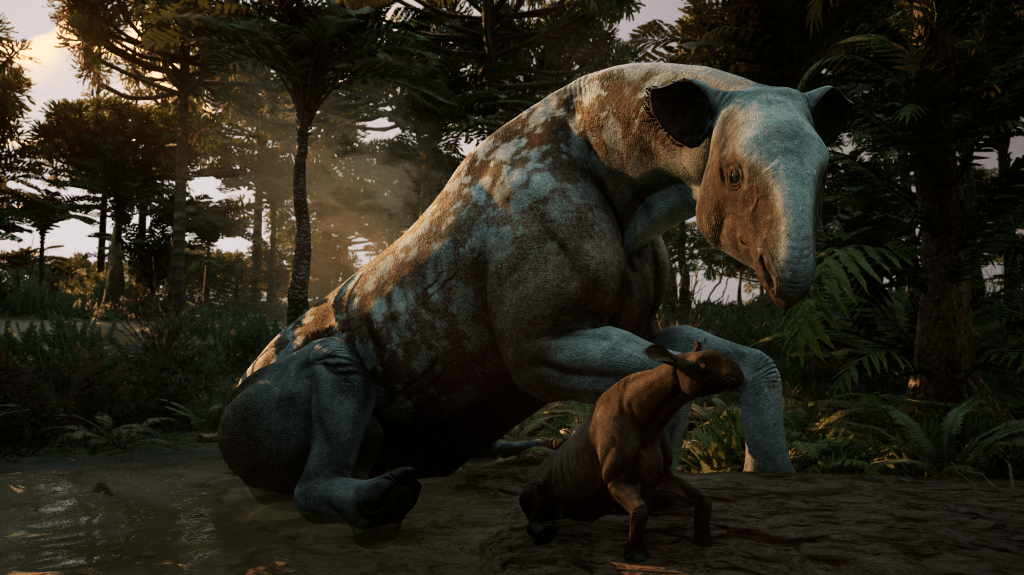
Tier: 6
ᴅɪᴍᴏʀᴘʜɪꜱᴍ: ɴᴏɴᴇ
ʜᴀʙɪᴛᴀᴛ: ʙʟᴀᴄᴋ ꜰᴇʀɴ ʜɪʟʟꜱ, ʀᴇᴅᴡᴏᴏᴅꜱ, ᴅʀʏ ꜰᴀɴɢ ᴄᴀɴʏᴏɴ, ʙɪɢ ᴛʀᴇᴇ ᴏᴠᴇʀʟᴏᴏᴋ
ᴅɪᴇᴛ: ʜᴇʀʙɪᴠᴏʀᴇ
ᴀᴄᴛɪᴠᴇ ᴛɪᴍᴇꜱ: ᴄʀᴇᴘᴜꜱᴄᴜʟᴀʀ. ᴇᴀʀʟʏ ᴍᴏʀɴɪɴɢ, ʟᴀᴛᴇ ᴀꜰᴛᴇʀɴᴏᴏɴ ɪɴᴛᴏ ᴇᴀʀʟʏ ᴇᴠᴇɴɪɴɢ
ɢʀᴏᴜᴘ ʟɪᴍɪᴛ: ɴᴏ ʟɪᴍɪᴛ, ʙᴜᴛ ʙᴀᴛᴄʜᴇʟᴏʀ ɢʀᴏᴜᴘꜱ 6
ᴅᴇꜰᴇɴᴅᴇʀꜱ: 2
ɴᴇꜱᴛɪɴɢ ꜱᴇᴀꜱᴏɴ: ꜱᴘʀɪɴɢ ᴏʀ ꜱᴜᴍᴍᴇʀ
ᴏꜰꜰꜱᴘʀɪɴɢ: 5
ᴀᴅᴏᴘᴛɪᴏɴ: ✅
Behavior
Herds are female-led, made up mostly of females and offspring. Calves instinctively stay close to a chosen adult, frequently walking behind or beside them. Adults prioritize babies over territory or food, and attacks near the calves trigger immediate defensive behavior. Herds have loosely defined territories, with frequently used wallows, feeding areas, or resting spots becoming subtly “claimed.” Female Paraceratherium are naturally docile unless provoked or a juvenile is threatened. Intruders lingering for too long may trigger warning displays. Male Paraceratherium are naturally aggressive and do not remain in the herd past the sub-adult stage. Males remain for courting, and depart once the calves are born.
Courting Behavior
Courtship in Paraceratherium reflects size, strength, and dominance. When multiple males encounter a receptive female, they may engage in brief combat to establish dominance. These contests involve pushing, shoving, head swings, and stomps, stopping when one male reaches roughly 30% health. After asserting dominance, the male performs a short display for the female (shake/throw it back emote, rearing emote), including slow head swings, signaling fitness and suitability as a mate.
Females respond through subtle body language, soft vocalizations (heart emotes or low volume calls). The “Throw It Back” emote may also be used during this display, primarily by the dominant male and rarely by the female, as a visual cue of courtship or dominance recognition. Physical combat beyond the initial contest is rare; most courtship relies on these controlled displays.
Nesting Behavior
The Paraceratherium shows care in selecting nesting and resting locations. Adults commonly gather in flattened clearings, shaded groves, or mud wallows, which provide both comfort and natural protection.
Young Paraceratherium almost always rest in the center of the herd, often tucked between the legs or beneath the broad shoulders of adults for added security. This positioning protects the young while allowing them to observe and learn adult behaviours, such as foraging techniques, herd movement patterns, and wallowing habits. Adult females frequently position themselves along the perimeter, forming a protective buffer while maintaining herd cohesion.
Nesting behavior is highly strategic, with adults maintaining constant visual contact and close physical proximity to their offspring. Any sign of distress or threat is addressed immediately, reinforcing the protective and socially aware nature of the species and maximizing herd safety and stability.
Mandatory Traits
Colossus Provocation
Paraceratherium instinctively reacts aggressively toward Novi, maintaining distance or escalating conflict quickly. It recognizes Novi as a serious threat and responds with immediate defensive aggression. Forceful displays are used to create space, but if a Novi advances or lingers, Paraceratherium responds with force.
Roaming Bull, Guarded Matriarch
Bulls are naturally aggressive toward anything they perceive as a threat, especially creatures of comparable size or larger. Bulls that have left a herd become noticeably more aggressive than those that have never belonged to one. Bulls rarely show aggression toward members of their own species outside of courtship disputes.
Cows are naturally composed and protective, serving as the steady foundation of the herd. They remain attentive to the movements of calves and other vulnerable members, often placing themselves between danger and their offspring before confronting the threat. Although they rarely seek confrontation, any credible threat to their young is met with extreme aggression.
Off to Get the Milk
Male Paraceratherium leave the herd permanently once calves are born, and enter a solitary phase. They do not assist in raising the young and avoid competing with females. Interactions with female-led herds become rare, usually limited to the mating season with receptive females. If a male approaches a herd with offspring present, adult females will use alert and aggressive calls to drive him away, but only if there are offspring present.
Colossus Kinbond
Young Paraceratherium instinctively bond with a chosen adult in the herd and remain close at nearly all times. They walk just behind or beside this adult, picking up herd behavior by closely watching its actions. The chosen adult is constantly aware of the calf’s position, and any threat near a calf triggers immediate defensive responses.
Crown of the Matrons
Paraceratherium herds consist of adult females and offspring, forming matriarchal groups. Males leave the herd upon reaching the sub-adult stage, living solitary or in loose bachelor groups. Adult males only rejoin herds briefly for breeding before departing again, leaving all care and leadership to the females.
Optional Traits
Thunder Rump Sway
The “Throw It Back” emote may be used by adult Paraceratherium during courtship displays and after killing a hostile creature or player, serving as an expression of dominance and confidence.
Offspring may perform a tiny “Throw It Back” practice, featuring clumsy, exaggerated movements that mimic adult displays.
The Resting Waters
Paraceratherium regularly seek out mud pits, riverbanks, and wet ground to wallow, a behavior essential for skin health, cooling, and parasite control. Frequently used wallows become loosely claimed spaces. While these areas are not aggressively territorial, intruders that linger for extended periods may provoke warning displays such as stomping, head swings, or vocalizations, and repeated disregard may escalate into combat. Mud wallowing occurs most often after long-distance movement, combat encounters, or during hot conditions.
Gentle Giants
Some Paraceratherium have an undeniable fondness for the smallest herbivores, readily welcoming Tier 1 and Tier 2 species. These tiny companions often accompany the herd as trusted followers and scouts, and Paraceratherium may become surprisingly protective of them. If they are attacked, Paraceratherium may defend it as though it were one of their own.
Credits: Onyxmoon and MisslilBlue
Sources:
https://en.wikipedia.org/wiki/Paraceratherium
Paraceratherium – The Rhino That Grew Bigger Than Dinosaurs
Last updated: 6/24/2026
 Ashes of Apex Fantasy Realism