Parasaurolophus
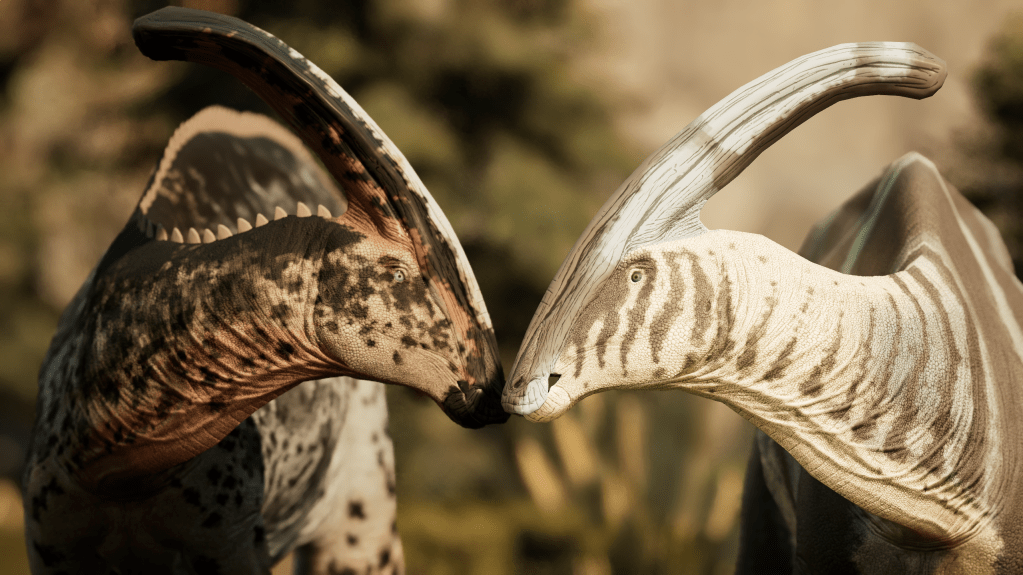
This dinosaur lived during the Late Cretaceous period, with fossil evidence primarily found in what is now western Canada and the United States. Hadrosaurs belong to the Ornithischian group, one of the two major dinosaur divisions, distinguished by their bird-like hip structure. Within this group, hadrosaurs are divided into two subfamilies: Lambeosaurinae and Saurolophinae (also known as Hadrosaurinae).
Members of the Lambeosaurinae are best known for their elaborate, hollow crests, with notable examples including Parasaurolophus and Lambeosaurus. In contrast, Saurolophinae lack these crests and are represented by genera such as Edmontosaurus and Barsboldia.
Hadrosaurs are migratory, herd-forming herbivores whose survival is rooted in numbers. Their lifestyle is often compared to modern wildebeest, forming massive migratory herds for protection. They are considered among the most successful dinosaurs, largely due to their highly specialized dentition. Hundreds of tightly packed teeth line their cheeks, allowing them to efficiently process thick, fibrous vegetation.
Tier: 5
Dimorphism: Males display brighter colors, especially on their crest. The brighter the color, the more dominant. Females are typically duller in comparison; however, Lead Mares may develop brighter colors to highlight their crest as well.
Habitat: Follows migration unless pairing and nesting in East Passage, or Wollemi Forest
Diet: Herbivore
Active Times: (Diurnal) Active during the daylight hours and can often be found resting through the night.
Group: Up to 20 individuals
Defense: 2 adults/sub-adults
Nesting Season: Spring
Offspring: Up to 5
Adoption:✅
Behavior
Like most hadrosaurs, Parasaurolophus (referred to as mares and stallions) are highly gregarious and operate under a female-led hierarchy. The oldest and most dominant female becomes the Lead Mare, guiding the herd during migration using her accumulated knowledge to locate food and water. Fiercely protective of her family, the Lead Mare also understands when to delegate. Stallions are positioned toward the rear of the traveling herd, serving as living shields and acting as the first line of defense during ambushes. While stallions engage threats, the Lead Mare leads the herd to safety.
The Harem Stallion is a sexually mature male responsible for a group of mares, typically ranging from one to twenty individuals. His primary roles are to deter rival stallions during breeding season and to breed accepted mares. He holds no authority over migration, feeding, or herd direction; all decisions remain with the Lead Mare.
As stallions reach sub-adulthood, they are driven from the herd and form bachelor bands. These all-male groups consist of inexperienced adolescents—rowdy, competitive, and constantly testing boundaries while seeking opportunities to prove themselves.
The harshest fate for a Parasaurolophus is a solitary life. These deeply social creatures thrive in herds, yet lone individuals do exist. Elder stallions who grow too weak to compete for rank or mates often withdraw from herd life. Once isolated, their life expectancy sharply declines, with stress believed to be the primary cause of death due to prolonged solitude.
Like other hadrosaurs, Parasaurolophus often migrates alongside compatible species for protection. While grouping is limited to their own species, Parasaurolophus commonly travel and nest alongside Lambeosaurus, Edmontosaurus, Iguanodon, and other hadrosaurs. Lambeosaurus and Parasaurolophus share particularly close familial ties and may mistake one another as kin. It is common to see both crested species nesting together at White Cliffs, raising offspring under shared protection.
Much like Lambeosaurus, Parasaurolophus possesses a hollow cranial crest. While its exact function is debated, it is widely believed to have been used for communication.
Courting and Nesting
Parasaurolophus breeding is closely tied to seasonal migration, rigid social hierarchy, and sacred communal nesting traditions. Breeding is optional, but any individual or herd choosing to participate must return to East Passage during the rutting season. As cooler winds signal the onset of fall, herds, bachelor bands, and lone Parasaurolophus converge on this region, which serves as the primary breeding and nesting ground for all hadrosaurs.
East Passage is neutral, protected territory. During nesting season, territorial disputes are set aside as all hadrosaurs collectively defend the grounds. The safety of eggs and hatchlings supersedes all social divisions. Parasaurolophus frequently nests alongside Lambeosaurus, forming strong inter-species alliances and jointly guarding their young.
Rutting season draws bachelor bands to the outskirts of established herds. Breeding rights are contested through ritualized, one-on-one combat between stallions, initiated by bipedal broadcasting displays. These duels follow strict rules to prevent unnecessary injury. Victory earns the right to seek herd integration, but combat alone does not guarantee acceptance.
Ultimate authority rests with the Lead Mare. Even a victorious stallion must earn her approval through a trial period that tests intelligence, patience, and attentiveness rather than brute strength. Only after her acceptance may he breed and fully assume his role.
Lone Parasaurolophus also journey to East Passage during this time, seeking safety or herd inclusion. Females are far more likely to be accepted, while unattached males typically remain in bachelor bands. Any Para seeking entry must approach carefully, using quick love calls and brief pawing gestures to gain attention. A sharp sneeze from the Lead Mare is a polite dismissal and must be respected. Acceptance is signaled through a friendly grouping call.
Males must exercise extreme caution. During rutting season, the Lead Stallion is highly territorial and will attack any male that lingers too close to his mares.
Once bonded, mares lay eggs in the fall. The eggs incubate through winter, with hatchlings emerging in spring. Survival rates are high due to cooperative defense, multi-herd presence, and unified protection by all hadrosaurs within the nesting grounds.
Mandatory Traits
Off You Go!
To prevent inbreeding, the dominant stallion will typically drive out male offspring (colts) once they reach maturity. These young males then form bachelor groups. Young females (fillies) may also leave on their own terms or be “stolen” by other stallions to join new bands.
Rutting Season
When the cool winds signal the start of fall, the mares come into season. During the fall season, all herds and lone Parasaurolophus are on their migration to East Passage, which serves as a communal nesting ground for all hadrosaurs, a sacred place of gathering and protection during the most vulnerable time of year.
Throughout rutting season, unattached bachelor bands prowl the outskirts of herds in search of mares. The Lead Stallion must defend his title or risk losing his mares. Violent clashes between rival stallions erupt as they battle for the right to breed.
When a bachelor approaches the band, the Lead Stallion must immediately confront him, ready for combat. Rutting combat must remain strictly one-on-one, with no third-party interference. To initiate a duel, each stallion must broadcast three times while standing bipedally. Combat ends when one stallion signals submission with a full-body shake. If no clear submission occurs, the duel automatically concludes when one participant reaches 30% health, at which point that stallion must yield. This system ensures fair competition and prevents unnecessary harm, preserving strength for the challenges of the season ahead.
Offspring Survival
Parasaurolophus lay their eggs in the fall, with hatchlings emerging in the spring, provided the parents successfully protect the nest throughout the entire incubation period. Parasaurolophus mares generally achieve higher offspring survival rates than many other hadrosaurs due to strong cooperative defense within their herds.
Mares are fiercely protective and will boldly nip at lingering males or any unwelcome intruder that approaches the nesting young. Lambeosaurus (“Lambs”) are often an exception to this aggression. Lambs and Parasaurolophus work exceptionally well together, acting as devoted guardians for each other’s offspring. Regardless of species, communal nesting among hadrosaurs offers significant advantages, as multiple herds unite to defend their sacred nesting grounds and safeguard the next generation from predators and threats.
Take a Knee Before the Queen
Just when you think you have won the battle, the war is not yet over. A new successor, after a successful one-on-one duel during rutting season, must still be accepted by the Lead Mare before being welcomed into the herd. While she may be impressed by the victory, Parasaurolophus are highly intelligent creatures and are not easily swayed by brute strength alone.
The Lead Mare places the new Lead Stallion through a trial period. During this time, most mares may give him the cold shoulder, and it is not uncommon for them to nip or swat at him. As it is breeding season, the stallion must act quickly. He must locate the Lead Mare’s favorite food and present it to her. The choice of food is entirely up to the Lead Mare but is typically one of the following: Pinecone, Roots, Flowers, or Berries.
Once the stallion successfully presents her chosen food, all hostility must cease. At this point, he is formally accepted by the Lead Mare and, by extension, the herd. If the stallion fails this trial, he may be attacked by the mares until chased away. However, he may linger nearby, continuing attempts to earn the Lead Mare’s approval.
I’ve Got Little Legs
When young colts and fillies are born, the herd slows its pace dramatically to allow the offspring to keep up. Rest periods become longer, and stops occur more frequently to accommodate the needs of the growing foals.
Optional Traits
Safe Harbor
Some hadrosaurs, such as Parasaurolophus, may choose to remain at East Passage during nesting season rather than continue migrating. Reasons vary: some stay due to the presence of many nesting herds, others value the protection of a well-established communal nesting ground, and some see it as an opportunity to join a new herd.
Crest Clash
Leadership positions may be challenged at any time, not solely during rutting season. Both the Lead Mare and Lead Stallion are subject to change. To formally issue a challenge, the challenger must circle the leader they wish to oppose. Mares may only challenge the Lead Mare, and stallions may only challenge the Lead Stallion while making aggressive calls. At least three aggressive calls are required, accompanied by tail sweeping or biting at the air to clearly signal intent.
Once challenged, the current leader may accept the duel or willingly step down. Submission is shown by lowering the head, issuing an alert call, and backing away. If the challenge is accepted, the defender rises into a bipedal stance and responds with aggressive calls, signaling the start of combat. All leadership challenges are strictly one-on-one and conclude upon submission or when one participant reaches 30% health. These rules ensure fair competition, minimize unnecessary injury, and preserve the herd’s strength.
Young Beast
Bachelor bands are rowdy groups of adolescents with energy to spare. It is common to see young stallions sparring, showing off their combat skills, or simply causing chaos. Like jokesters, they play, gallop, and act out not only for fun but also to draw the attention of any nearby mares, hoping to catch a wandering eye.
Safe Travels
Although Parasaurolophus cannot formally group with other herbivores, migratory dinosaurs such as hadrosaurs likely traveled together in search of food. Traveling alongside other plant-eating, herding species is therefore allowed, though not mandatory.
My Tummy Hurts
Most hadrosaurs, excluding Edmontosaurus and Lambeosaurus, experience digestive sensitivity when consuming lilies. While they may resort to eating lilies during periods of food scarcity, doing so causes significant abdominal discomfort until Red Ginger is found to soothe the ache. During this time, grunting, groaning, and increased aggression are common signs of distress.
Credits: Kamarooni
Sources:
https://www.ebsco.com/research-starters/anthropology/parasaurolophus
Last Updated: 12/13/2025
 Ashes of Apex Fantasy Realism