Pentaceratops
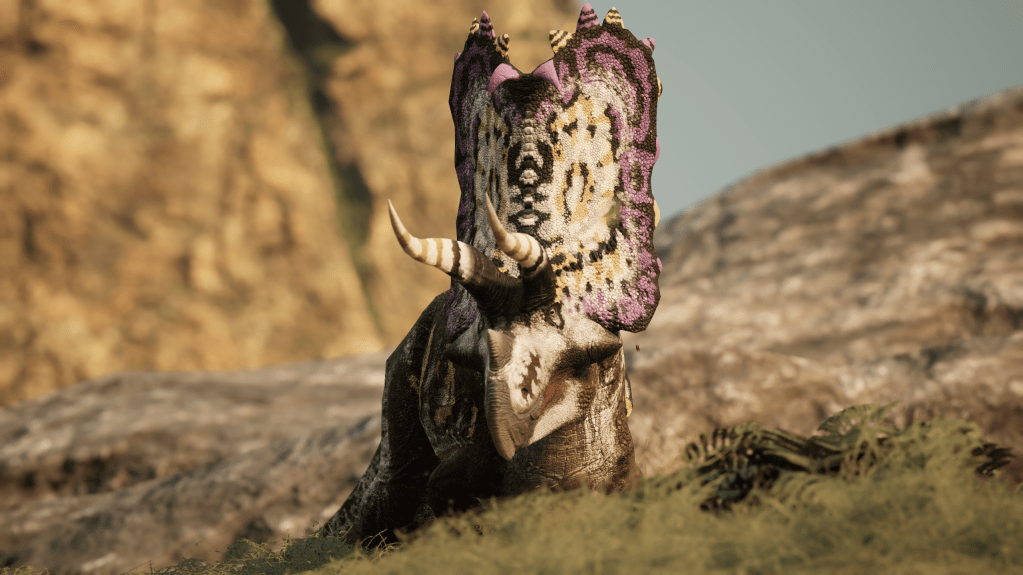
Pentaceratops, meaning “five-horned face,” was a large herbivorous ceratopsian from the Late Cretaceous period of what is now New Mexico. It measured roughly 18–20 feet (5.5–6 meters) in length and weighed an estimated 2.5–3 tons. Pentaceratops is best known for its massive skull, large open frill, prominent brow horns, and elongated cheekbones that contributed to its distinctive appearance.
Tier: 3
Dimorphism: Male Pentaceratops display brighter coloration, more pronounced patterning, and visible quill-like display structures along portions of the body and neck frill. Females lack these quills and generally possess duller coloration with less distinct patterning.
Habitat: Redwoods, Black Fern Hills, Hollow Hills
Diet: Herbivore
Active Time: Adaptable (will follow the activity of the ceratopsian herd it follows, otherwise they are)
Group size: 10 adults, 4 offspring
Defense: 4 adults/sub-adults
Nesting Season: Spring
Offspring: Up to 5
Adoption:✅
Behavior
Pentaceratops are social, emotionally driven ceratopsians that thrive in structured herd environments. They prefer stable family groups and develop strong attachments to both mates and herd members, often becoming distressed when isolated for long periods of time. Within herds, Pentaceratops are observant and adaptable, naturally shifting their behavior depending on the personalities and size of the group around them. They are attentive parents and highly aware of the safety of juveniles, maintaining a watchful presence during travel and rest periods. Although generally calm and tolerant, Pentaceratops are stubborn animals that stand their ground when challenged and are slow to forgive perceived threats or losses. They are most comfortable in familiar territories with dependable access to water and often settle into routines centered around established grazing and resting areas.
Courting
Pentaceratops courtship is a lengthy and deliberate process, as pairs form strong lifelong bonds. Once bonded, Pentaceratops do not seek another mate, even if their partner dies.
Females come into season near the end of winter and during early spring. To signal their readiness, they position themselves on elevated terrain where their calls can travel long distances. Males searching for a mate follow these calls and may encounter rival males along the way. These encounters often involve shoving contests and displays of dominance, though they can escalate into full physical confrontations.
When a male reaches the female, she performs a sequence of calls and body motions that he must correctly mimic. If the female is unimpressed, she dismisses him with a distinct three-part call and waits for another suitor. This process repeats until she accepts a suitable mate.
Once the initial courtship is complete, the female follows the male back to his territory or the ceratopsian herd he normally travels with. From there, the pair begins strengthening their bond through cooperative behaviors such as bringing food to one another and working together to prepare nesting sites. Raising and protecting their young further reinforces the bond between the pair.
Nesting and Offspring
When nesting, Pentaceratops pairs remain highly alert. While one parent guards the nest directly, the other patrols the surrounding area for potential threats. The pair will regularly switch roles as needed to eat, drink, and rest.
As the eggs begin to hatch, the parent tending the nest will call their mate back to meet the hatchlings. A strong bond quickly forms between the parents and their brood.
Young Pentaceratops are naturally curious, especially around larger ceratopsians. Calves will often attempt to mimic behaviors they observe from older herd members and may engage in playful interactions with trusted adults.
When multiple calves are present within a ceratopsian herd, adult Pentaceratops instinctively position juveniles toward the center of the group during travel or moments of danger.
If a Pentaceratops calf becomes orphaned, it will instinctively seek out other ceratopsians and attempt to integrate into an existing herd. Alone and vulnerable, orphaned calves are fearful of most unfamiliar situations and will typically rely on hiding or fleeing from perceived threats.
Mandatory Traits
Natural Stalking
Pentaceratops are driven by a strong instinct to seek out other ceratopsians and integrate into existing herds, regardless of herd size. If a Pentaceratops is met with aggression or denied entry into the group, it will often continue following the herd from a distance while still behaving as though it is part of the group. This distant trailing behavior continues until it is either accepted into the herd or encounters another ceratopsian or a different herd to attempt integration with.
Crest and Horns
Pentaceratops are highly intelligent and adjust their behavior depending on the ceratopsians they travel with. When grouped with larger ceratopsians, Pentaceratops often take on a protective support role, staying near the rear of the herd to help guard vulnerable members and watch over juveniles. When traveling with smaller ceratopsians, they commonly act as herd leaders and primary defenders, often being the first to confront or drive away carnivores that approach too closely.
Horn of Mourning
If a Pentaceratops loses its mate, it will mourn deeply. The surviving Pentaceratops will attempt to recover and keep one of its mate’s horns (the trophy) as a final reminder of their bond. If a carnivore prevents this or claims the horn first, the Pentaceratops may develop an intense grudge toward that individual. If the same carnivore is encountered again, the Pentaceratops may react with reckless aggression, attacking fearlessly until either it or the carnivore is killed. A 30-minute wait period is required before retaliatory aggression may begin.
Hydrotherapy
When alone, Pentaceratops are often anxious or uneasy and tend to remain near rivers, ponds, or lakes. These areas provide a calming environment, and Pentaceratops will frequently rest near water to soothe their nerves.
Home Field Advantage
Pentaceratops living within their family groups often settle in a single area for extended periods of time. They become highly familiar with the surrounding terrain, memorizing important paths, resources, and hiding spots within the region they claim as home. They typically remain there until local food or water sources begin to run low.
Water Cow Annoyance
When interacting with Agathaumas near water sources, Pentaceratops are unwilling to back down while drinking and will often stand their ground against Agathaumas’ territorial behavior. These encounters frequently escalate into fights between the two species. Pentaceratops also refuses to group with Agathaumas and may leave a herd entirely if one is accepted into the group.
Optional Traits
Herb-a-Friend
Pentaceratops are generally friendly toward herbivores that do not greatly exceed their comfort level in size. They avoid traveling with extremely large herbivores such as sauropods and Madrehorn, as species of that size fall outside what Pentaceratops are naturally comfortable associating with.
When accompanying mixed herbivore groups, Pentaceratops remain social and tolerant but do not perform the behaviors described in the “Crest and Horns” trait. They will not take on leadership or active defensive roles for non-ceratopsian groups. Their behavior is instead limited to vocal warnings, alert calls, and occasionally positioning themselves near vulnerable individuals as a visual deterrent during dangerous situations. Direct defensive behavior is reserved for members of their own ceratopsian herd or family group.
Bone Appétit
Pentaceratops are able to chew bones and will often dip them in water before gnawing on them. This behavior helps clean debris from the bone and provides additional resistance that gradually wears and sharpens their beaks, functioning similarly to a natural whetstone.
Profile written by: Spook , with assistance from DragonRider
Source:
https://en.wikipedia.org/wiki/Pentaceratops
Last updated: 05/15/26
 Ashes of Apex Fantasy Realism