Psittacosaurus
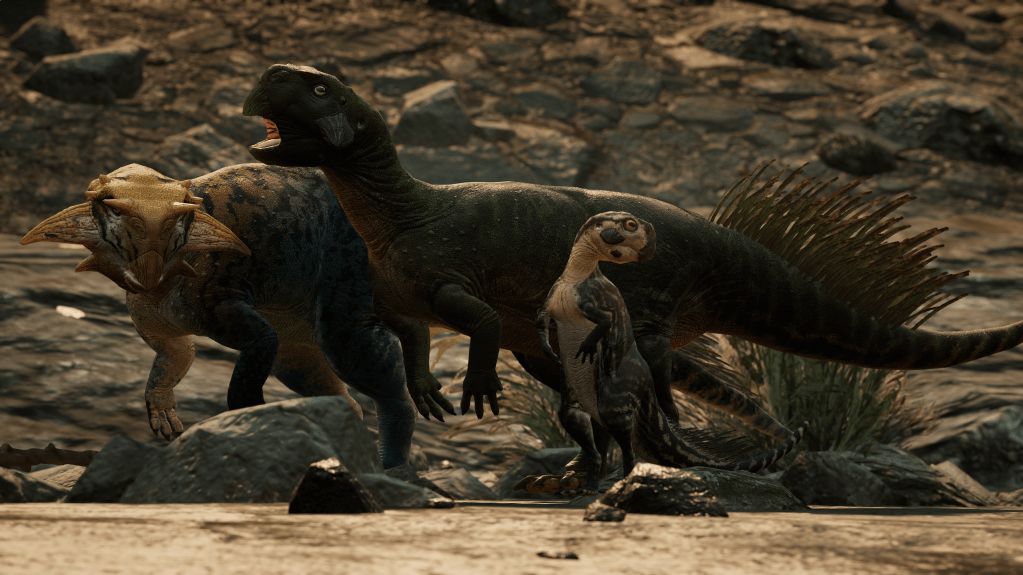
Psittacosaurus was a small, herbivorous dinosaur that lived during the Early Cretaceous period in what is now Asia. About the size of a large dog, it had a parrot-like beak that it used to crop ferns, leaves, and seeds. It lived in small groups or family units, running quickly on its strong hind legs to escape predators and communicating with simple vocalizations and visual signals. Its long tail, often equipped with bristle-like structures, served for display, balance, and signaling to other members of its species.
Tier : 1
Dimorphism: No
Habitat: Redwoods, Black Fern Hills, Hollow Hills
Diet: Omnivore
Active Times: Psittacosaurus was diurnal, meaning it was active during the day. It spent daylight hours foraging for plants, moving in small groups or family units, and staying alert for predators. Its activity peaked in the morning and late afternoon, when it used the light to navigate, communicate with other members, and safely feed in open areas.
Group Size: 10 individuals
Defense: 8 individuals
Nesting Season: Spring and Summer
Offspring: Up to 5
Adoption: ✅
Behavior
Psittacosaurus lives in small groups or family units (10 total unless a special role is equipped), defending itself from predators by running swiftly on its strong hind legs and using distress calls or its tail to signal alarm to others. During the mating season, males perform courtship displays by posturing, moving their tails, and possibly using vocalizations to attract females. Once mates are chosen they then nest in shallow scrapes or burrows, carefully laying and guarding its eggs until they are ready to hatch. Juveniles stay close to adults, learning to forage and avoid predators while practicing stealth and quick escapes, ensuring their survival in a world full of larger carnivorous dinosaurs.
Mandatory TRaits
Shadowstep Escape
Psittacosaurus runs swiftly on its strong hind legs whenever a predator approaches. It weaves through vegetation, uses sudden bursts of speed, and employs tail flicks and body posture to alert nearby group members. This strategy allows both juveniles and adults to survive in areas patrolled by larger carnivores.
Tailwave Courtship
Males perform courtship displays by waving their tails, posturing, and using vocal calls to signal fitness to females. These displays occur in daylight, often accompanied by circling and head movements, helping females assess strength and health before mating.
Group Vigil
Psittacosaurus moves in small family groups or herds, keeping constant visual and auditory contact. Members coordinate foraging, alert each other of danger with vocal calls or tail signals, and collectively make decisions about when to flee or hide.
Alarm Chorus
When a predator is spotted, Psittacosaurus vocalizes in unison with group members, creating a coordinated warning signal that enhances survival chances.
Optional Behavior
Little Leaf Prowl
Juveniles take turns exploring and nibbling on vegetation under adult supervision, learning safe foraging techniques while others keep watch for predators.
Sproutstrike
Hatchlings practice chasing, pouncing on small objects, and mock tail flicks to build coordination, agility, and predator-avoidance skills for adulthood.
Verdant Watcher
Psittacosaurus often joins mixed-species herds of herbivores for safety. Acting as a vigilant scout, it uses keen eyesight, tail signals, and vocal alerts to warn both its own kind and other herbivores of approaching predators, increasing survival for the entire group while they were all foraging or migrating.
Credits: Littlered
Sources: https://en.wikipedia.org/wiki/Psittacosaurus https://www.britannica.com/animal/Psittacosaurus https://www.ebsco.com/research-starters/anatomy-and-physiology/psittacosaurus
Last updated: 11/21/2025
 Ashes of Apex Fantasy Realism