Saurophaganax
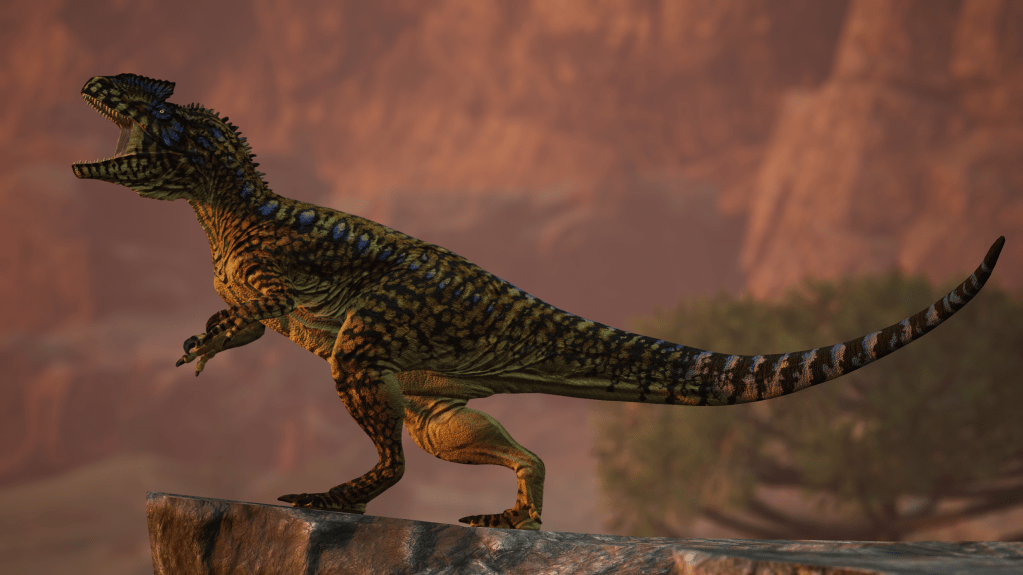
Saurophaganax maximus was one of the largest terrestrial predators of the Late Jurassic, reaching lengths of nearly 12 meters within the ecosystems of the Morrison Formation. It is generally considered a giant allosaurid closely related to Allosaurus, though its exact classification remains debated due to incomplete and possibly mixed fossil material. Distinctive features of its vertebrae suggest strong musculature along the back and neck, supporting a powerful and mobile head.
As part of the broader allosauroid lineage, it shares distant evolutionary ties with later giant predators such as carcharodontosaurians, though it represents an earlier and separate branch. Its anatomy indicates a hunting strategy based on repeated, forceful slicing bites and downward strikes, rather than the bone-crushing bite seen in later theropods like tyrannosaurids. As one of the largest carnivores in its environment, it likely occupied an apex role, preying on large herbivores and exploiting its size and strength.
Tier: 4
Dimorphism: none
Habitat:
Riparia: Tallbrush Coasts, Volcano Islands, Crag bluffs
Gondwa: Rainbow Hills, Desolate Pass, Snake Gully, Burned Forest, Ocean Pillars, Hunter’s Thicket
Diet: Carnivore
Active Times: Cathemeral – active at various times throughout the day, regardless of whether it is light or dark.
Group Size: 4 adults/sub-adults; up to 5 offspring below sub-adult
Attackers/Defenders: 3 adults/sub-adults
Nesting Season: Spring
Offspring: up to 5
Adoption: ❌
Behavior
The Saurophaganax is a patient and smart hunter that prefers to wait for the right moment to strike. Instead of rushing into every fight, it watches from the sidelines and waits for a target to get distracted, tired, or hurt. It is a very practical predator that would rather take over an existing carcass from a smaller hunter than waste energy on a difficult chase. They often act like shadows, following large herds and carefully deciding if a hunt is worth the risk before they move in.
In their social lives, these dinosaurs follow a very strict chain of command. Whether they’re traveling with others of their kind or with a tolerated companion (see Phaganax Entourage trait below), the Saurophaganax is always the boss and will use quick nips to keep others in line. This “tough love” style carries over to how they raise their young, where offspring must be strong and obedient to survive. From the way they protect their food to the way they lead their families, the Saurophaganax is a gritty survivor that doesn’t give up its ground easily.
Courting
During the mating season, Saurophaganax courtship begins when a sire takes interest in a dame and follows her at a respectful distance. He signals his presence through low vocalizations and the hug emote, while avoiding immediate physical contact.
The dame may acknowledge the sire’s presence without accepting his advances right away. During this period, the pair may travel near one another for a time, allowing the dame to assess the sire’s behavior and suitability. In some cases, the sire hunts while remaining in the dame’s vicinity, offering food or successful hunting as an indirect display, hoping for a sign of acceptance.
Acceptance is indicated when the dame initiates the love call, followed by the shake emote. Sauro pairs are typically long-lasting, but a new partner will be chosen if one is lost or absent for an extended period.
Nesting and Offspring
Saurophaganax parents are fiercely protective when nesting and raising their clutch. Any creature within line of sight of the nest or hatchlings is treated as a potential threat. Parents will give a warning threat call, and also by biting at the air. If a creature comes within two Saurophaganax body lengths, they will attack until the intruder is fully driven out of line of sight. This protective behavior continues until the young reach sub-adult and are more independent.
Saurophaganax raises its young harshly. Only the strongest survive. Violence against a parent is the ultimate transgression; it is more often answered with an ending than a lesson.
Hatchlings must stay close to the nest until they reach their second growth stage. Wandering too far may result in being corrected by their parents. Sauro will not protect offspring who have wandered too far. Continued disobedience may result in offspring being culled.
Upon reaching the juvenile stage, offspring are expected to stay within range of their parents and begin following more actively during travel and hunts. They remain under full parental authority and are expected to keep up. Those who lag or fail to follow will be left behind. Parents will correct continued disobedience with physical discipline, including nipping. Repeated disobedience or lack of discipline may result in severe punishment, including death.
As they continue to grow, younger individuals are expected to begin practicing their skills. Juveniles and adolescents will attempt to kill critters they encounter while traveling with their parents as a way to build strength and learn.
As they reach adolescence, they will challenge one another to establish dominance. These fights must be mutually agreed upon and may go to 50%, but no lower than 25% health. Killing a sibling is not allowed under any circumstances.
Once they reach sub-adult, they are capable of assisting in hunts and surviving on their own. Parental protection is no longer automatic, but any sub-adult that chooses to remain with their parents is still subject to their authority.
Orphaned Behavior
An orphaned Saruo hatchling or juvenile must adapt quickly to survive. Orphaned Saurophaganax are more cautious and opportunistic, avoiding direct conflict with larger creatures and relying on smaller prey and unattended carcasses.
They use the underbrush to hide when threats are near and linger at the edges of interactions, watching and waiting for opportunity. Direct challenges against larger predators are avoided until they reach sub-adult.
They do not imprint. Adults do not take in offspring outside of their own clutch. If an orphan encounters a nest, it might attempt to blend in and go unnoticed. In most cases, the parents will recognize the intruder and kill it.
Mandatory traits
Carving Space
Saurophaganax prioritizes taking nearby carcasses over securing its own kill when the opportunity is low risk. When approaching a carcass claimed by another creature, it must give two clear threat calls before engaging. If the current holder does not leave the body after the warning, Saurophaganax will attack and attempt to drive them off. Once the carcass is theirs, they will defend it from other creatures.
Carcass Tenure
Once a kill is made or a body is claimed, the Saurophaganax will not simply eat and leave. It stays with the food until the meat is gone or a larger threat forces it away, but Sauro will fight to keep its claim. To show other predators that the food is claimed, the Sauro will stand over the body and use frequent low calls and ground-sniffing emotes. If another carnivore gets too close, they will bite at the air as a warning. They do not share their kill with scavengers.
If a Sauro is alone, it will only leave the carcass to find water when it is direly thirsty (10% water or lower). If it has to walk too far to find water and loses sight of the body, it loses its claim. When hunting in a group, at least one member must stay behind to watch the food while the others go to drink. This ensures the group never leaves a good meal unprotected.
Goliath’s Bane
Saurophaganax will target vulnerable sauropods when no suitable carcass is available or when contesting one is not worth the risk. When alone, it hunts smaller sauropods such as Euhelopus or Amargasaurus. When grouped, they engage larger sauropods such as Apatosaurus or Ampelosaurus. Argentinosaurus is typically avoided and will only be engaged if fully grouped and at least one member is in a critical hunger state (10% or lower).
Optional Traits
Phaganax Entourage
Saurophaganax forms opportunistic alliances when it benefits them. A single Saurophaganax may pair with one Allosaurus. A solo Sauro or group of two Saurophaganax may include one Concavenator.
These alliances last as long as they remain useful, often forming around access to food or favorable hunting conditions. Concavenator’s tendency to stay near water can create additional opportunities that Saurophaganax will take advantage of.
Saurophaganax maintains dominance within the group. If an Allosaurus or Concavenator becomes too assertive, the Saurophaganax will correct the behavior with warning bites to reinforce its place.
Testing the Crown
Saurophaganax groups sometimes test the patience of larger apex predators (tier 5 and above) only. This includes approaching, threat calling, short advances, and pulling back to gauge reactions. This behavior may continue for up to 30 seconds before Saurophaganax must either commit to the fight or disengage. Biting and dealing damage is allowed during this time. Killing the apex is not required, but might occur if the group commits to the fight. A lone Saurophaganax does not behave this way, as it knows it is outmatched.
- This behavior can only be used once per individual apex creature every 30 minutes. After engaging a specific apex, it cannot be repeated on that same creature until the cooldown has passed, but it can use it on a different apex during that time.
Feral Prudence
Orphaned Saurophaganax that manage to reach adulthood often develop a more ambush-focused approach to survival. Without early guidance, they learn to rely on caution and timing, which can carry into adulthood. They are often more hesitant to group and may be slower to pair or nest.
When hunting, they favor stealth over direct pressure. They move carefully, stay hidden when possible, and keep quiet as they close the distance, striking when the moment feels right rather than forcing an engagement.
Credits: MisslilBlue
Sources:
https://en.wikipedia.org/wiki/Saurophaganax
https://www.nationalgeographic.com/animals/mammals/facts/spotted-hyena
https://www.britannica.com/animal/grizzly-bear
Last updated: 4/1/26
 Ashes of Apex Fantasy Realism