Tenontosaurus
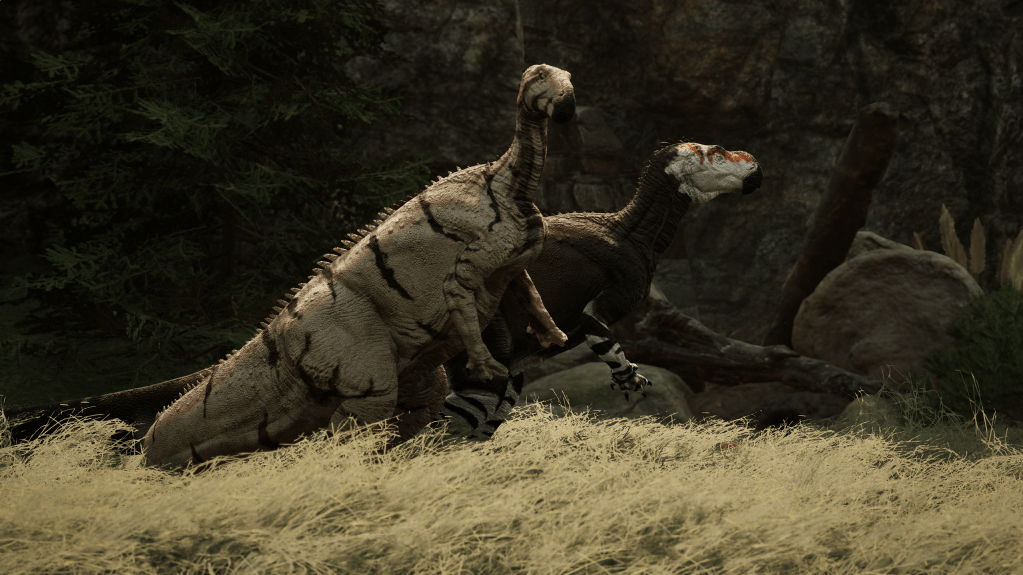
Tenontosaurus was a medium-sized herbivorous dinosaur that lived during the Early Cretaceous period, around 115 to 108 million years ago. Fossils of this species have been found primarily in North America, including what is now Montana, Wyoming, and Oklahoma in the United States. Tenontosaurus likely inhabited floodplains and lightly forested areas, feeding on a variety of plants, and it may have lived in herds for protection against predators like Deinonychus. Its fossils often show evidence of predation, suggesting it played an important role in the Early Cretaceous ecosystem.
Tier: 2
Dimorphism: Males have spines down its neck and back while females will not.
Habitat East Passage, Wollemi Forest
Diet: Herbivore
Active Times: Tenontosaurus was mostly diurnal, meaning it was active during the daytime.
Group Size: 8 adults and 4-8 young below sub-adult age
Defense: 6 adults
Nesting Season: Spring and Summer
Offspring: 1 Offspring
Adoption: ❌
Behavior
Tenontosaurus is a diurnal herbivore that forages during the day in open floodplains and lightly forested areas. During the breeding season, it gathers in small herds (4-8 young included) near nesting sites, laying eggs in shallow nests and providing protection for them. When threatened by predators such as Deinonychus, Tenontosaurus relies on herding, vigilance, and rapid flight, using its strong tail and agility to escape attacks. Evidence shows that individuals frequently survive predator encounters, demonstrating that social defense and alertness are essential to their survival. Tenontosaurus balances daytime foraging, social interactions, and predator awareness as a key part of surviving in its ecosystem.
Mandatory TRaits
Defenders Pact
Tenontosaurus adults always defend in coordinated groups. A herd of four adults has four active defenders, and when the herd reaches eight adults, it can have up to six defenders actively protecting the group from predators.
Tail Guard Tactics
Tenontosaurus uses a combination of coordinated group defense and flight. When threatened, adults form a defensive perimeter, with up to four defenders in small herds and up to six in larger herds. They use strong tails to deter attackers, while the rest of the herd flee quickly together, maximizing safety for juveniles and weaker members.
Tail Tango
Tenontosaurus engages in coordinated herd courting displays during the breeding season. Males show off size and strength by swinging tails, posturing, and nudging rivals, while females circle, vocalize, and signal readiness to mate. Adult defenders guard the area to deter predators, allowing courting and nesting to proceed safely. Displays blend tail strikes, body posturing, and vocal calls into a ritualized, coordinated performance that reinforces herd bonds and ensures successful mating.
Protectors Heart
When predators approach the young or weakest (injured) in the herd instinctively move to the center or heart of the herd. Relying on the strong defenders for protection.
Optional Traits
Fern Sprints
Juveniles often engage in playful chasing and gentle mock combat, darting through ferns and nudging siblings with their snouts. While moving through their environment, they frequently adopt alert postures, raising their heads to scan for potential threats. These behaviors together help them develop agility, social awareness, and predator vigilance, forming essential skills for survival within the herd.
Pond pals
Adults are often observed wading into shallow ponds, splashing water over themselves to regulate body temperature and remove parasites. They also frequently engage in light, ritualized play-fighting, gently pushing or nudging one another to test strength and reinforce social bonds without causing injury. These behaviors support both physical well-being and herd cohesion, maintaining a balanced social structure.
Credits: Littlered
Sources: https://en.wikipedia.org/wiki/Tenontosaurus
Last Updated: 11/25/2025
 Ashes of Apex Fantasy Realism