Therizinosaurus
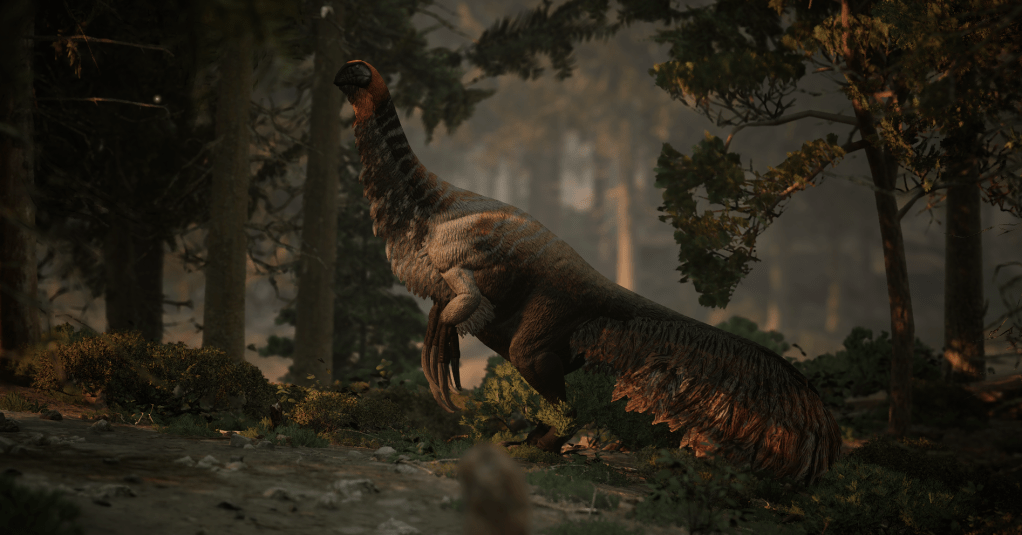
Therizinosaurus was a massive therizinosaurid theropod from the Late Cretaceous of Mongolia and is widely interpreted as a primarily herbivorous browser. Like Suzhousaurus, it belongs to the therizinosaurid family, sharing the deep-bodied build, elongated forelimbs, and browsing adaptations typical of the lineage. It is known for its long neck, deep-bodied frame, extremely long forelimbs, and enormous scythe-like hand claws, which were likely used to pull vegetation within reach and may also have served defensive or display functions. Although direct feather evidence is not known from Therizinosaurus itself, it is commonly reconstructed with a feathered or filament-covered body based on its close therizinosaur relatives. Its size, long neck, and forelimbs likely allowed it to browse on taller vegetation than many other herbivores. Fossils come from the Nemegt Formation, a fluvial environment with river channels, floodplains, lakes, and vegetation-rich woodland and wetland habitats, indicating that it lived in a relatively well-watered ecosystem.
Tier: 5
Dimorphism: Little to no obvious dimorphism, though some males, known as cobs, may display brighter orange or blue plumage. Occasionally, cobs display orange or blue in deeper, richer shades. Females are referred to as pens. Offspring below sub-adult age are referred to as cygnets.
Habitat: Wollemi Forest, Cedrus Forest, and Coastland Swamp.
Diet: Herbivore
Active Time:s Cathemeral
Group Size: 2 adults and their offspring. Once offspring reach adulthood, they typically disperse, though 1 adult offspring may occasionally remain with the parents for a limited time.
Defense: 2 adults; 1 sub-adult offspring may assist
Nesting Season: Spring & Early Summer
Offspring: 2-4
Adoption: ⚠️Conditional
Behavior
Therizinosaurus carries itself with a quiet, measured presence. Movement is often silent, and vocalizations are infrequent outside of dawn and dusk, typically reserved for locating others of its kind, maintaining contact with a mate or offspring, or responding to nearby disturbances. They do not posture unnecessarily and rarely react without cause.
They favor dense, well-watered environments rich in vegetation, particularly forests, wet woodlands, and swampy forest edges where shrubs, ferns, saplings, and low branches are abundant. They are not herd-oriented animals and instead tend to form close family units centered around a bonded pair and their offspring. Though generally quiet, they do not passively tolerate predators within their vicinity and prefer to make their awareness known through watchful posture, warning displays, and visible deterrence before escalating further if a threat continues to press closer. A bonded pair is more willing to stand its ground and present a united front to predatory intruders than a solitary individual. This cooperative behavior continues into nesting and the raising of offspring.
Therizinosaurus generally tolerate other herbivores as long as those creatures do not interfere with food, nesting areas, or offspring. If another herbivore behaves in a way the Therizinosaurus perceives as threatening, they respond with warning displays and may drive it off by force if it does not retreat.
They are slow to abandon productive areas. If resources are abundant, they spend extended periods browsing the same area before moving on. As seasons shift and local resources or nesting conditions become less favorable, bonded pairs and family groups gradually relocate together to more suitable areas. However, they may be less mobile while actively nesting or caring for very young cygnets.
Courting
Courtship for Therizinosaurus typically begins in the fall. They form close-mated pairs and court through quiet displays rather than constant vocal or physical spectacle. Because the species frequently lacks obvious dimorphism, courtship is recognized through behavior rather than appearance. A Theri seeking a mate repeatedly returns to the same individual of interest, remains nearby without tension, and feeds beside them while gauging their reaction. Loud broadcast vocalizations at dawn and dusk become more frequent during this period, expressing contentment between the pair as they remain within sight of one another.
As interest becomes mutual, courtship becomes more visibly ritualized. The Therizinosaurus initiating the display lowers and curves its neck downward, slowly swaying or swinging its head from side to side while remaining close to the intended partner. Soft vocalizations or heart emotes may accompany this display to make their intentions clear. If the interest is returned, the second Therizinosaurus mirrors the display, answers with its own quiet vocalizations, or begins shadowing the other more closely while feeding, resting, or moving together. Gentle feather grooming, brushing against one another, and brief nipping or nudging may also occur as the pair becomes more comfortable with one another.
Once bonded, a cob and pen remain within close reach while traveling, resting, and feeding side by side, and they respond more quickly to unfamiliar Therizinosaurus that approach too closely.
Bonded pairs are protective of one another and less tolerant of a potential rival lingering too close to their mate. If another adult of the same sex approaches the pair too closely, the cob or pen will begin watching their rival more intently, staying close to their mate and, if needed, placing themselves between them. Warning displays include threat-calling, air-swiping, and stepping forward to pressure the rival away. If the rival continues to linger or press closer, it will be driven off with bites and claw rakes.
Nesting and OFfspring
When ready to nest, the cob and pen choose and prepare the nesting site together in the spring or early summer, favoring secluded, heavily vegetated areas with easy access to food and water. Nests are typically placed beneath dense foliage, along forest edges, within thick undergrowth, or in other sheltered locations that keep the eggs and cygnets concealed without limiting the parents’ ability to defend the area. Therizinosaurus lay up to 5 eggs, though typically only 2–4 will hatch, with full clutches hatching only occasionally. Throughout incubation and early growth, the parents remain highly attentive and fiercely protective of the nest and young.
The cob and pen will drive away threats that approach within two Spino lengths of the nest. They position themselves between the threat and the nest, posturing, threat-calling, and air-swiping in an attempt to drive the intruder away. One parent typically remains near the nest while the other confronts the threat more directly. Once cygnets hatch, that protectiveness becomes more intense. If the threat continues to press too close and comes within one Spino length of the cygnets, the adults may escalate beyond warning displays and physically attack to drive it away, with both parents readily engaging if necessary. At the approach of danger, the parents work to gather and shield the young, while the cygnets instinctively hurry into nearby cover or press in beneath a parent’s tail for protection.
Cygnets stay close to their parents into adolescence, instinctively following where they walk, stopping when they do, huddling beneath a parent’s tail feathers for shelter and security, and vocalizing frequently to maintain contact with the adults and one another.
Parents move more slowly when cygnets are present, allowing them to keep pace and remain close, whether at their heels or tucked beneath the tail. If the family must travel while the offspring are still younger than adolescent, the parents will frequently guide them through dense groundcover, undergrowth, and other sheltered routes to help keep the young concealed as they move. As the cygnets grow, they begin to explore more independently, but rarely stray far from their parent’s shadow before reaching adolescence.
As offspring mature, they gradually become more independent and typically disperse once they reach adulthood. In some families, however, one adult offspring may remain with their parents longer than their siblings, lingering for a time before eventually establishing themselves elsewhere. This does not continue indefinitely, and if the cob and pen produce another clutch while the lingering adult offspring is still present, it must disperse or be driven off by the breeding pair.
Some Therizinosaurus display brief, social corrections toward mates, offspring, or familiar family members, including nipping when irritated. These interactions are not true aggression and rarely escalate beyond a moment of agitation or discipline.
Adult offspring that later reencounter their parents may be tolerated more readily than unrelated adults, particularly outside of nesting season, but this does not reestablish the original family unit. If the parents are actively courting, nesting, or raising young, they are more likely to drive the adult offspring away.
If a parent is lost due to predation, hatchlings and juvenile cygnets will often cling even more closely to the surviving parent or close to older siblings. If both parents are lost while the cygnets are still younger than sub-adult age, they linger near the bodies or the nesting area for a time, hiding nearby, vocalizing frequently, and hesitating to travel far on their own. Adolescent offspring are more likely to survive independently, though they remain close to surviving siblings or familiar cover before fully moving on.
Cygnets that begin life without parents are orphans. When at the hatchling and juvenile stages, they remain cautious and heavily reliant on cover, favoring dense undergrowth and other sheltered routes while avoiding unnecessary time in the open. They vocalize frequently in hopes of drawing a response. While they do not imprint on unfamiliar creatures, they might shadow a friendly herbivore or herbivore herd from a cautious distance, drawn to the safety, structure, and vigilance a larger group provides, even though it does not replace the protection of a true family unit.
Bonded pairs or parents with offspring occasionally accept orphaned cygnet hatchlings or juveniles that are not their own. Once accepted, the orphan is treated as part of the family unit and remains close to the adults and any existing offspring, following them as though it had been born into the group. Not all Therizinosaurus pairs tolerate the unfamiliar, however, and some instead drive orphaned young away. A lone cob or pen will not adopt unfamiliar young and will drive a cygnet away if they continue to follow or linger too closely.
Mandatory Traits
Refuge of the Small
Cobs and pens are often tolerant of smaller herbivores (T3 and below) lingering nearby and allow them to remain in close proximity with little interference. Their presence provides additional awareness of approaching threats, creating a natural overlap of interests that benefits both parties. Smaller herbivores may take advantage of the adults’ size, vigilance, and intimidating threat displays, sometimes sheltering near them or their young in the hope that predators will be discouraged from approaching. This does not mean Theri actively defend those smaller herbivores as members of the group. However, if a predator enters close enough to provoke a Theri’s normal defensive behavior, the smaller herbivore may still benefit from that response. A predator attempting to attack a smaller herbivore near a Therizinosaurus risks provoking its defensive response if it comes too close, even if the smaller herbivore was the intended target.
The Stillness After
When a mate or offspring is killed, Theri do not immediately abandon the body. While the predator remains to feed, they will pace at a distance, keeping watch from at least two Spinosaurus body lengths away until the threat leaves or the remains are no longer safely accessible. Once the area is safe, they will return to the body and attempt to rouse their fallen mate or offspring, nudging, vocalizing, or lingering beside them as though trying to encourage them to rise and move again. After a time, they settle beside the body and remain with it until the body is gone. Afterward, they leave the area quietly, remaining subdued and withholding the dawn and dusk broadcast vocalizations they would normally give for the next few days.
A Line in the Bush
Therizinosaurus does not ignore predators within its vicinity. Its presence alone acts as a deterrent, but individuals will actively respond to drive threats away rather than passively tolerate them. When a non-apex predator is spotted nearby, they will keep it under close watch, reorienting to keep the threat in sight and making their awareness obvious with two alert calls. If a predator comes within three spinosaurus body lengths, the Therizinosaurus will threat-call and swipe at the air with its talons to deter the predator from coming any closer. Once the threat begins to withdraw, they do not follow after it, instead remaining alert until it has visibly retreated from the immediate area. They don’t waste energy pursuing a threat that has already chosen to leave.
The Tempered Claw
Therizinosaurus reacts differently when faced with apex predators. A lone cob or pen remains wary, keeping a close watch on the apex, its distance, and its apparent intentions. If the apex remains farther away and does not close the distance, they typically respond with watchful restraint, keeping the threat in sight but remaining quiet rather than immediately advertising their presence. If the apex continues to approach and comes within two Spinosaurus body lengths, that restraint gives way to open warning behavior, including aggressive calling, air-swiping, and making their awareness obvious. A lone adult might be less likely to survive an apex attack; however, they will usually avoid escalating further unless the threat presses the issue.
In the presence of another adult, this restraint diminishes. A pair or family group is more likely to assert itself early, alert calling (!) twice, aggressive calling once, air-swiping, and presenting a united front to discourage the apex from pushing closer. If the apex continues to approach and comes within two Spinosaurus body lengths, the adults may work together to drive it back from their vicinity with this behavior. Once the apex has visibly retreated and is no longer pressing closer, they do not continue to pressure the apex, remaining alert so long as it remains in their sight.
Optional TRaits
Old Wounds, Long Claws
Therizinosaurus do not easily forget those who threaten, harm, or kill their mate or offspring. The loss of a mate or cygnet provokes a grudge lasting two full season cycles. If the cygnet survives, the cob and pen instead continue to hold that grudge until the offspring reaches sub-adult age. During that time, if the surviving mate or parents naturally reencounter the individual responsible, they respond with the full force of their aggression and continue the attack until the threat is killed or escapes. This grudge does not allow them to stalk, track, or deliberately pursue that individual across the map; the encounter must occur naturally. If the grudge target retreats and reaches six Therizinosaurus body lengths away, the pursuit must end.
Stray Among Giants
A lone cob or pen may travel alongside a mixed herd of large herbivores for a time, loosely attaching itself to the group without fully becoming part of it. These Therizinosaurus benefit from the herd’s extra vigilance, movement, and safety in numbers while traveling, while the herd may in turn benefit from the presence of a large, intimidating creature that is reactionary if a predator comes too close. Even so, the Therizinosaurus remains an independent outsider rather than a true herd member. It does not treat unrelated herd animals as family, does not defend them as such, and may separate from the herd whenever it chooses.
- Under this trait, a lone cob or pen can group with a mixed herd of large herbivores.
- While grouped with a mixed herd, the Therizinosaurus still reacts to predators according to its mandatory traits. Any benefit the herd receives comes from the Therizinosaurus responding to threats as it normally would, not from taking on a responsibility to defend the herd as a whole.
Credits: @𝔐𝔦𝔰𝔰𝔩𝔦𝔩𝔅𝔩𝔲𝔢
Sources:
https://www.britannica.com/animal/therizinosaur
https://en.wikipedia.org/wiki/Therizinosaurus
https://www.britannica.com/animal/swan
https://www.britannica.com/animal/hoatzin
https://www.britannica.com/animal/Megatherium
Last Updated: 7/9/26
 Ashes of Apex Fantasy Realism