Tylosaurus
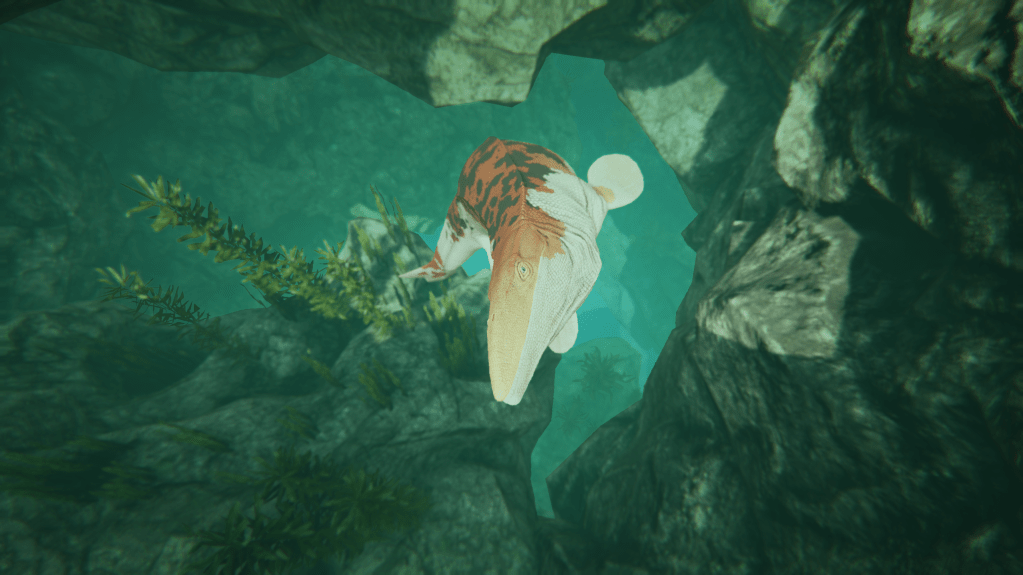
Tylosaurus was a genus of mosasaur, living as predatory ocean dwelling reptiles from about 92 to 66 million years ago, during the Late Cretaceous period. Its fossils have mostly been found in North America, Europe, and Africa, concentrated in areas around the North Atlantic Ocean. This large and streamlined marine predator had advanced evolutionary traits for its time, and was similar in build to other large marine vertebrates such as ichthyosaurs and marine crocodylomorphs. Tylosaurus was among the largest mosasaurs, with Tylosaurus proriger having an estimated length of 39-52ft. Tylosaurus had many species, and each species was specially adapted to a different hunting style for predating upon marine vertebrates.
Tier: 5
Dimorphism: None
Habitat:
Riparia: Volcano Islands, Tallbrush Coasts.
Gondwa: Volcano Bay, The Teeth, Seagrass Bay
Diet: Carnivore, Piscivore
Active Times: Cathemeral, with hunting primarily taking place at night.
Group Limit: 3 adults
Attackers/Defenders: 2 adults
Nesting Season: Spring
Offspring: Up to 2
Adoption: ❌
Behavior
Tylosaurus is an apex predator that exploits the wide variety of marine animals in its ecosystem, with a diet consisting mainly of fish, whales and other marine reptiles, as well as the occasional land-dwelling dinosaur that has approached the water without caution. Tylosaurus hunts near ocean shorelines, as well as from within deep lakes and river systems. It is a solitary predator, relying on its ability to stalk its prey from within the water, before ambushing them in a display of overwhelming force, dragging them back into the depths to consume them. They are home ranging and semi-nomadic, moving through preferred hunting grounds and defending their territory from other marine apexes such as the Prognathadon and Mosasaurus.
Courting and Nesting
Tylosarus are solitary apex predators, only seeking out one another during the breeding season. Courtship is cautious and deliberate, often initiated by males trailing females at a distance. Females will only tolerate nearby males that prove their worth, typically those capable of securing large fish or successfully bringing down terrestrial prey along shorelines. These offerings serve as both a display of strength and a sign of persistence.
Males that are not met with aggression may linger at the edges of a female’s territory, patiently shadowing her movements. In time, a receptive female may allow the male to get closer, eventually leading him to her chosen nesting site in warmer, sheltered waters. During this period, the female maintains dominance, keeping herself and her nest guarded from the male at all times.
Females produce one or two young at a time. Known as “calves,” they are highly vulnerable and underdeveloped at the time of emergence. From the moment her calves are born, the female’s behavior shifts dramatically. She becomes intensely territorial and highly aggressive to any perceived threat. At this stage, the male is often driven away and plays no direct role in raising the young.
In some cases, the male is not forcibly expelled by the female and is allowed to remain in the territory. These individuals keep their distance, avoiding direct interaction with the female and her calves, likely recognizing her heightened aggression. Such males play a passive defensive role, deterring intruders like orca, rival mosasaurs, or other Tylosaurs simply through their presence.
The female alone is responsible for the protection and early development of her young, guiding them through the dangers of their environment until they are capable of surviving independently.
Offspring Behavior
Calves are born small, vulnerable, and entirely dependent on their mother for survival. In their earliest stages, they rarely stray far from her side, relying on her for protection, guidance, and access to food. At the hatchling-juvenile stage, their behavior is quick and reactive, taking cover behind their mother at the first sign of danger. The presence of other large marine predators is met with instinctive fear, and their mother’s proximity is their only true sense of safety.
As they grow into adolescence, their behavior begins to shift. Curiosity replaces their fear, and calves become more playful and exploratory, often testing their speed and agility in short bursts or playful chases. During this stage, they begin to shadow their mother more actively during hunts, learning through observation and eventually assisting in smaller pursuits. Despite this growing confidence, they remain wary of unfamiliar adults and other threats, only shedding this caution once they reach full maturity (sub-adult) and can claim independence.
Mandatory Traits
Shadow of the Depths
The hunting strategy of the Tylosaurus depends heavily on their ability to ambush their prey. Some have been observed stalking their prey from deep water, trailing behind them until the cover of nightfall allows them to launch their attack. Others have been noted to rest at the bottom of riverbeds and in sections of the seabed between small islands, waiting for unsuspecting prey to wander too close to the shoreline, then striking and dragging them below the waves.
Marine Motherhood
Mothering Tylosaurus are hyper-aggressive with virtually all other marine life. No threat is too great to fend off, and she will protect her calf with her life. When a female Tylosaurus has a baby, she may attack any creature that comes within 2 body-lengths. She may continue to attack until her opponent either dies or leaves her line of sight.
Titan’s Territory
Tylosaurus is known to patrol broad stretches of sea and vast sections of river deltas. They push out competing mosasaurs such as Mosasaurus and Prognathadon, as well as entire pods of orca. They mainly only tolerate Shonisaurus and Kaiwhekea, as they make effective Flamekin partners, hunting and patrolling with Tylosaurus as they maintain their expansive territories.
Optional Traits
Thief of the Tender
Tylosaurus are opportunistic predators, and so they seek out easy prey. With their large bottle-nosed snout, they chase down pods of orcas and mosasaur mothers with young, ramming into them at incredible speeds to stun them. It is when the mother is incapacitated, the Tylosaurus will locate and clamp down on the young, taking it as a meal of its own.
Blood in the Water
Tylosaurus are not always swift killers. After initially striking its prey, it may prolong the battle by creating space, seemingly allowing its prey to begin escaping. They then circle back around, striking again and again, wearing their target down with each pass. Once their prey has become too weak to escape, Tylosaurus will surge forward and clamp tightly onto its victim to deliver the killing blow.
Unsteady Alliance
Though typically solitary, Tylosaurus may sometimes tolerate one another to increase their chances of survival. When populations of pod animals such as orca or Livyatan become high, Tylosaurus gather and maintain loose groups of no more than 3 individuals. These alliances, while short lived, pose a formidable threat to marine vertebrates in the territory.
Credits: Onlooker & IveMcFallen
Sources: https://en.wikipedia.org/wiki/Tylosaurus
https://youtu.be/My59VAnOiW8?si=aWXa6imr3y7UHUEB
Last updated: 03/23/2026
 Ashes of Apex Fantasy Realism