Tyrannosaurus Rex
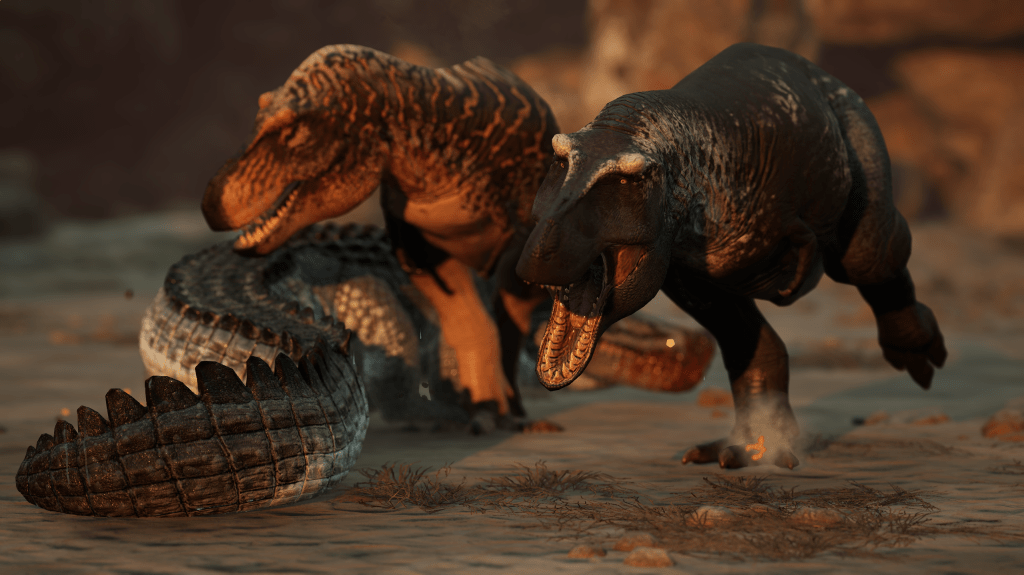
Tyrannosaurus rex (“tyrant lizard king”) was a massive, bipedal carnivore that ruled North America during the Late Cretaceous (68–66 million years ago). Reaching up to 40–43 feet in length, 12–13 feet at the hip, and weighing 7–9 tons, it was one of the largest land predators ever, featuring a 5-foot skull with 60 serrated, bone-crushing teeth, a keen sense of smell, and famously tiny two-fingered arms. Despite its immense size, evidence suggests Tyrannosaurus was capable of swimming, using its powerful hind legs to paddle across rivers and other waterways when necessary.
Fossil evidence also indicates that Tyrannosaurus changed dramatically as it grew. Younger individuals were lighter, faster, and built for speed, with longer legs and narrower skulls suited for chasing smaller prey. Adults, by contrast, became slower but immensely powerful hunters capable of delivering crushing bites strong enough to shatter bone. This shift allowed different age groups to fill different hunting roles within their ecosystem, reducing competition between young and fully grown Tyrannosaurs. These differences in growth and behavior helped make Tyrannosaurus one of the most successful apex predators of its time.
Tier: 5
Dimorphism: Male Tyrannosaurus rex, referred to as Tyrants, display colors such as red, yellow, cyan, white, and tan. Females, known as Tyrantesses, showcase green, black, blue, and orange.
Habitat:
Riparia: Redwoods, Hollow hills, Wind Tunnels, Big Tree Overlook
Gondwa: Impact Crater, Dark Woods, Broken Tooth, Big Quill Lake, Stego Mountain
Diet: Carnivore
Active times: Cathemeral – active at varying intervals throughout the day and night as conditions allow. Its activity peaks during cooler, low-light periods such as dawn and dusk, though it may move or hunt whenever opportunity presents itself.
Group Size: 2 adults, 1 sub-adult, 4 offspring up to adolescent age.
Attackers/Defenders: 2 Adults
Nesting Season: Spring and Summer
Offspring: Up to 4
Adoption: ❌
Behavior
Tyrannosaurus rex lives as a dominant and territorial apex predator, carrying itself with confidence and authority wherever it roams. While often solitary, Tyrants and Tyrantesses may form bonds during courtship and nesting, working together to defend territory and raise their brood before eventually returning to more independent lives. Young Rex grows within the protection of their parents, gradually learning to hunt, compete, and survive until they are ready to wander out and claim territory of their own. Encounters with rivals can be tense and dangerous, with dominance, reputation, and stubborn pride shaping how Tyrannosaurus interacts with others of its kind. Despite its immense power, this predator remains cautious of certain formidable prey and adapts to the terrain around it, whether crossing waterways, defending kills, or resting watchfully within its domain.
Courting
When a Tyrant seeks a mate, he may approach a Tyrantess and display his strength and presence through posture, vocalizations, and slow circling movements. A Tyrantess will often respond with displays of her own, observing the Tyrant while presenting her confidence and dominance. Either may demonstrate their strength through hunting or other displays of dominance while the other watches. When both Tyrant and Tyrantess acknowledge and reciprocate these displays, the pair may form a bond and remain together as a bound pair. Some may choose to remain together for life, though more commonly, Tyrants and Tyrantesses form seasonal bonds for nesting and raising heirs. If one does not accept the other, the courtship ends, and both will seek mates elsewhere. However, a Tyrantess who is scorned may remember the slight and react with hostility if they meet again (see Optional Trait: A Spurned Crown).
Nesting & Offspring
When a Tyrant and Tyrantess form a bound pair, they will seek a secure location to raise their brood. Nests are typically built where visibility and terrain provide protection from intruders. While either parent may construct the nest, the Tyrantess often determines where it will be placed. Once established, both parents defend the nest and surrounding territory fiercely while raising their young.
Hatchlings stay close to the nest and rely on their parents for protection and food. At this stage, they are vulnerable to nearly everything. When threats are present, hatchlings remain hidden within vegetation or terrain near the nest and avoid drawing attention to themselves. As they grow into juveniles and adolescents, they begin following their parents on hunts, observing and learning the behaviors necessary to survive.
Juveniles and adolescents may occasionally pursue smaller prey as part of this learning process, sometimes attempting hunts on Tier 1 or Tier 2 creatures or critters while the parents observe. These hunts are risky, and young Rex may be injured or even killed during their attempts. The parents can do little more than watch as their young test themselves against faster prey. At most, they may attempt to pick up their offspring and carry them away if the situation becomes too dangerous, as many of these small creatures are far too quick for an adult Tyrannosaurus to catch. Through these experiences, the brood gradually develops the skills needed to survive on their own and eventually claim their own territory.
As subadults approach their full strength, they begin asserting themselves more confidently. They spend more time wandering beyond the range of their parents and brood, testing their independence. If two parents are present, only one subadult offspring may remain with them until they reach full adulthood. If two offspring reach subadulthood at the same time and both wish to remain, they must spar to determine which one stays with the family, while the other becomes an outcast and moves on. These sparring matches never end in the death of a sibling.
If only one parent remains, up to two subadult offspring may stay with the remaining parent. As they continue their wanderings and grow into adulthood, they eventually separate from their family and establish lives and territories of their own.
Even after separating, members of the brood may recognize one another later in life. When siblings encounter each other again, they may acknowledge their shared lineage with a ♥️ call before continuing on their separate paths, though this recognition does not prevent territorial disputes.
Mandatory Traits
Pride as a King
Tyrannosaurus rex carries itself with the confidence of a true apex. Prideful and stubborn by nature, a Rex rarely backs down once a fight has begun and will hold its ground even under heavy pressure. Retreat is seen as a last resort, and a Rex will continue to push the confrontation until it is severely injured (down to 30% health). Even when challenged, it maintains a commanding presence, standing firm and expecting others to yield before it does.
Greed of a Tyrant
Tyrannosaurus rex is possessive over its kills and does not abandon food easily. After making a kill, it remains with the body until it fully decays. A Rex may rest, feed, or linger nearby, but it does not abandon its meal early and does not willingly leave its prize until nothing remains. Only after the body is gone does it continue roaming. Critter bodies do not count toward this behavior.
A Royal Take Over
A bonded pair of Rexes or a grouped pair of adult siblings may claim territory by entering a POI and broadcasting. While claiming the territory, they must sweep the entire POI of other apexes and force them out using threatening calls or faint bites in their direction. If the other apexes refuse to leave, they may be hunted down with fierce attacks until they either exit the POI or are killed. Once the other apexes exit the POI, the Rexes must stop their pursuit. If one of the claiming Rexes is killed during the takeover, the claim immediately fails, and the remaining Rex must leave the POI.
Tyrant’s Veto
Tyrantesses are aggressive toward other Tyrantesses that are outside of their family line. Encounters often begin with tense standoffs, staring one another down as if their presence is an insult. These confrontations may escalate into fights, with both Tyrantesses threat calling and challenging one another. Such conflicts may end in death, or when one Tyrantess submits by using the alert call (!) and leaving the sight of the victorious Tyrantess. Once the submitting Tyrantess leaves line of sight, the fight ends.
The Crownkiller
Tyrannosaurus rex has a few non-carnivorous rivals, members of a herbivorous group known as ceratopsians. Large species such as Eotriceratops, Triceratops, and Agathaumas are especially dangerous for a Rex. Their massive size and powerful horns make them formidable opponents capable of seriously injuring or killing a Rex, and even pairs can struggle to bring these herbivores down. Because of this, a Rex will often avoid confronting them directly and is more likely to seek other prey before attempting to hunt these rivals.
Tyrant’s Crossing
Tyrannosaurus rex is capable of swimming and does not avoid crossing water when necessary. Using its powerful hind legs to paddle, a Rex can move across rivers, lakes, and channels between land masses rather than traveling long distances around them. Though not built for life in the water, a Rex is fully capable of swimming when the terrain demands it.
Optional Traits
A Spurned Crown
A Tyrantess does not take rejection lightly. If a Tyrant refuses her courtship, she may remember the slight and react with hostility if they encounter one another again. Future meetings may lead to tense standoffs, challenges, or attempts to drive the Tyrant away. She will not go so far as to kill him, only give him a scar or two to remember her by.
King’s Lounge
When alone, Tyrannosaurus often rests near ponds or riverbanks, lounging beside the water while observing its surroundings.
Natural Cleaning
When Tyrannosaurus rex comes across bones, it will often chew on them to help clean its teeth and remove debris.
Tyrant’s Indulgence
A lone Tyrannosaurus may tolerate the presence of a single Tier 1 or Tier 2 flamekin, allowing it to remain nearby as an opportunistic scout. The flamekin acts at its own risk when a Rex has a body and may only approach once the Rex has finished feeding, as the Rex does not defend, protect, or alter its behavior for them under any circumstance.
Credits: Spook and MissliBLue
Sources:
https://www.britannica.com/animal/Tyrannosaurus-rex
https://www.sciencedaily.com/releases/2020/01/200101144031.htm?
https://www.iflscience.com/could-t-rex-swim-81697?
Last updated: 3/12/26

