Utahraptor
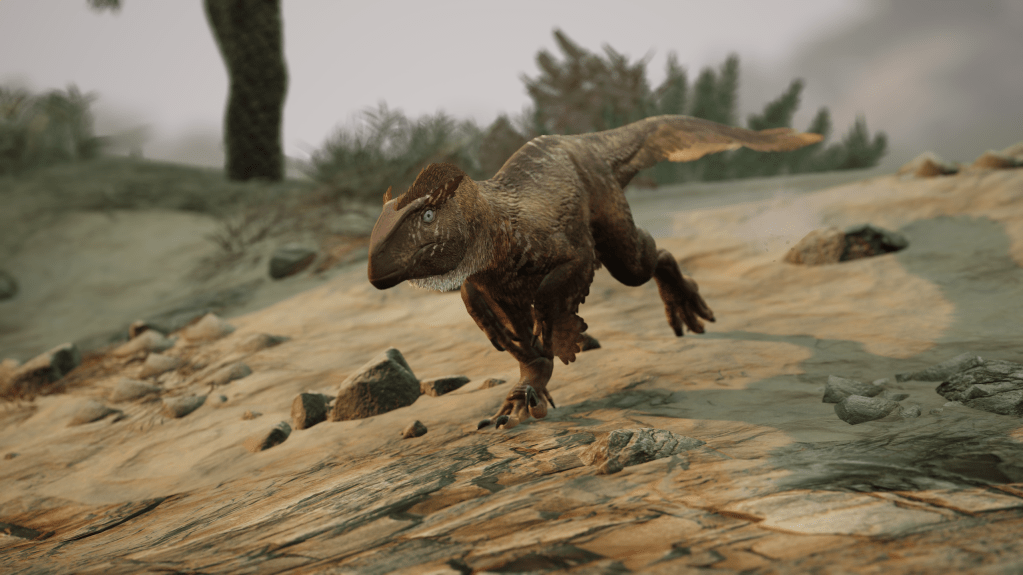
Utahraptor ostrommaysi was the largest known dromaeosaurid ever to exist, and lived in the early Cretaceous period. Discovered in Utah, USA, these raptors were large, apex predators of their time. Utahraptor are believed to have hunted in groups and used an ambush hunting style to bring down prey larger than themselves. They had jaws lined with serrated teeth and a long, sickle-shaped “killing claw” on their second toe, which they used to dispatch prey. Utahraptor cared for their young, who may have been taught to hunt alongside the adults. They also lived alongside other apex predators, such as Allosaurus, and many species of herbivorous dinosaurs.
Tier: 2
Dimorphism: Females have bright and colorful feathers, signaling their dominance. Male Utahraptor plumage consists of dark and neutral colors.
Habitat: Utahraptor prefer arid and semi-arid environments, floodplains, and open forests. Recommended areas include:
Riparia: Dry Fang Canyon, Black Fern Hills, Cedrus Forest, and Redwoods
Gondwa: Hoodoo, Broken Tooth, Stego Mountain, Big Quill Lake, Young Grove
Diet: Carnivore
Active Times: Nocturnal; active behaviors such as hunting beginning at dusk and continuing through the night, and more sedentary behavior during the day. Utahraptor do not travel during daylight hours.
Group Size: A Utahraptor pack may include up to 10 adults, with females outnumbering males and at least one dominant female present. Hunting parties are limited to 5 members.
For Flamekin bonds:
- Up to 2 Utahs may bond to a single large carnivore.
- Only 1 Utahraptor may act as a Flamekin for a pair of large carnivores (Tiers 4, 5, & 6).
- Utahraptor cannot bond to a group of more than 2 large carnivores (Tiers 4, 5, & 6). They must leave when the carnivores begin nesting.
- A bonded Flamekin may initiate hunts and provide defensive support for their host.
Attackers/Defenders: 5 individuals
Nesting Season: Spring and Summer
Offspring: Up to 5
Adoption: ✅
Behavior
At the center of a Utahraptor pack lies a social structure defined by matriarchy and kinship. Packs function as cohesive family units, numbering up to 10 adults, within which females outnumber the males and a single dominant female directs the group’s movement and decisions. She is known as the Matriarch, and she determines where the pack hunts, selects den sites, and maintains social order. Her authority is enforced through vocalizations, posturing, and physical correction when necessary.
Within this structure, every member contributes to the survival of the group. Hunting is done in coordinated parties that do not exceed 5 adults and/or subadults, allowing for controlled and efficient ambushes. These hunting parties operate with precision, using terrain, darkness, and communication to isolate vulnerable prey. The remainder of the pack may stay behind to guard the young and defend the den, often maintaining watch over their immediate territory, remaining vigilant while the hunting party engages.
Male Utahraptor occupy a more subordinate role in the pack hierarchy. They act as perimeter guards for the pack during daylight hours and may play key roles in hunting and defense. However, the rigid matriarchal system places pressure on maturing males, many of whom disperse upon reaching adulthood rather than remain in a low-ranking position beneath multiple dominant females. Those that stay tend to be individuals who have proven their worth to the pack through hunting ability, vigilance, or compatibility with the group’s females.
Courting and Nesting
Mating behavior in Utahraptor is not only a ritual, but it is also socially significant. Courtship is initiated by males, who advertise their fitness through physical display and resource offering. They exhibit themselves by posturing (? emote) and vocalizing (❤️ emote), as well as walking in slow circling movements, to attract the attention of nearby females. The most important part of the ritual, however, is the presentation of food. Unmated males will hunt independently and deliver portions of prey to a selected female, demonstrating his ability to effectively secure resources and willingness to contribute to the pack.
Females are highly selective in their responses. Acceptance of these offerings signals tolerance and preference, but does not guarantee a pair bond. The male is expected to continue to return with food during the night and stay close by, acting as a guard during the day. Males that fail to meet these expectations may be ignored, displaced, or driven away, particularly in packs where the hierarchy is strongly enforced.
Dominant females maintain priority over mating opportunities, however subordinate females may compete for mating rights. Lower-ranking females may challenge higher-ranking individuals for access to a preferred male, leading to controlled but sometimes intense sparring within the pack. These confrontations rarely escalate to serious injury, as females will only fight to 50% health. In most cases, these spars reinforce the social order of the pack, and in some cases, shift the existing order slightly, allowing a subordinate female to rise in rank.
Females build their nests and lay their eggs together in secluded dens known as “nursery caves.” Nursery caves are carefully selected by the Matriarch, and are usually chosen for their close proximity to reliable resources, such as fresh water, critter spawns, and herbivore migratory routes. Typically, nursery caves are small and may have one or two entrances that are easily defendable, however larger packs may favor expansive cave systems that offer more spacious nesting areas. Some Utahraptors are designated guards of these sites, serving as a barrier between the young and potential intruders. They are known as Nursery Keepers, and these individuals are chosen by the Matriarch for their skills in combat as well as their tolerant and patient nature with young members of the pack.
Orphan and Solitary Behavior
A solitary Utahraptor, whether an orphaned juvenile or a dispersed adult, exhibits different behavior from individuals in a pack. Without the protection and structure of a family unit, survival depends on caution and an acute awareness of the surrounding environment. Orphaned juveniles are among the most vulnerable. Without a pack, they tend to be withdrawn and reclusive, relying heavily on dense vegetation and terrain for concealment. Movement is cautious and deliberate, with individuals remaining low within the underbrush and avoiding open areas wherever possible. Foraging and traveling happen only at night, with young solitary Utahraptor seeking deep cover in thick brush, small caves, or shaded hollows, where they remain still and difficult for predators to detect.
Without the ability to hunt large prey alone, solitary individuals depend on small animals and carrion, or the remains of kills left behind by larger predators. As a result, lone Utahraptors often develop a pattern of trailing or observing larger carnivores. Over time, this may lead to the formation of a Flamekin bond, in which the raptor benefits from access to food while providing the larger predator with their heightened senses, often scouting territory for prey and assisting in defense from intruding threats. Forming a Flamekin bond can be risky, but solitary individuals are far more inclined to seek out these relationships than established packs.
Social bonding remains an important instinct to Utahraptor, even when solitary. They are notably receptive to forming pair bonds with others of their kind, particularly when encountering individuals of similar circumstances. These pairings may be short or long-term, and are often built on the need for survival rather than a strict social hierarchy. These relationships can serve as the foundation for building into a larger pack over time.
Lone Utahraptor who are seeking to join an established pack may attempt to approach the group’s Matriarch. Only she decides whether to allow the rogue individual to join the pack or whether to run them out of the territory.
Mandatory Traits
Ladies First
Matriarchy in the pack means that female Utahraptor take on dominant roles. The most dominant female of the pack, known as the Matriarch, is who makes the decisions as to where to build dens, when and what to hunt, and where to find respite during the day. Oftentimes, larger packs consist of more females than males. This is because male offspring tend to disperse upon adulthood, unwilling to tolerate their sisters and aunts in the pack, nipping and barking at them to reinforce the pecking order.
Ashbound Nomads
Utahraptor exhibits a semi-nomadic movement pattern. Packs may defend a chosen hunting range, particularly when it contains reliable prey or secure den sites, but they are not strictly bound to a single location. A full pack, especially one with young, may aggressively drive off competitors, such as rival raptor groups and even large carnivores, to protect their resources. Packs that contain 6 or fewer individuals remain wary of large carnivores, and display avoidant behaviors instead of aggressive.
Night Stalkers
Utahraptor conducts most of its active behaviors, such as patrolling their territory, hunting, and social interaction, under the cover of night. During daylight hours, packs withdraw into shaded environments such as caves, tree wells, and sheltered cliffsides where they rest in close proximity. These resting periods are not idle, however, as the males act as sentinels to guard the pack against intrusion while the rest of the group conserves energy.
O’Hana Means Family
In a Utahraptor pack, the safety and survival of the young are the top priority of the adults. Mothers raise young together in “nursery caves” in which they are supervised until they reach adolescence. Utahraptor are known to adopt orphans, and they are dedicated parents that never leave their young behind.
The Bear and the Wolf
While a pack of Utahraptor may drive away other, larger carnivores from their hunting grounds, solitary Utahraptor welcome their presence. Lone individuals or pairs may follow behind larger predators such as Allosaurus or Tyrannosaurus in order to secure an easy meal from their kills. Utahraptor may even form companionships with their larger counterparts, known as a Flamekin bond. Utahraptor may scout out territory or prey for its companion as well as hunt alongside them.
- No more than 2 Utahraptors may Flamekin for 1 large carnivore (T4 and higher)
- No more than 1 Utaraptor may Flamekin for 2 large carnivores (T4 and higher)
- Utahraptor may NOT be Flamekin for a group of large carnivores that exceeds 2 individuals.
Optional Traits
Build a Bridge
Because of their strict pecking orders, Utahraptor may get into scuffles and disagreements about prey and dominance. They may settle their differences by sparring.
Sparring is initiated by three barks (broadcast calls) and one threatening call. If the challenged Utahraptor doesn’t submit, they will begin to walk in a circle, facing off with their challenger. The fight begins when the first Utahraptor strikes, and ends when one drops below 50% health. The loser must submit and accept their lowered ranking in the pack.
Moonbrood Guardians
Some Utahraptor specialize in tending eggs and hatchlings, staying near the nursery caves and nests, while others hunt. They guard the young, maintain the nesting area, and guide fledgling raptors through their first lessons in stalking and pouncing. Nursery Keepers are chosen for their patience and steady temperaments, and their role is highly respected within the pack.
Silent Shadows
Not all hunts rely purely on vocal communication. Some packs develop a disciplined silence during their nightly hunts. Individuals minimize unnecessary vocalizations and rely on body language and positioning to communicate. This behavior allows a hunting party to move through dense terrain unnoticed and strike their prey without warning. Packs that adopt this hunting strategy are often seen stalking for a prolonged period of time, and carefully timing their ambushes instead of running down their prey.
Feast or Famine
Feeding within the pack is not equal. Dominant females tend to feed first, while others linger at the edges. Subordinate members, particularly lower-ranking or younger individuals, may attempt to sneak portions of food or wait for scraps once the dominant members have eaten. This can create moments of tension and brief confrontations, and so these attempts are rare, and the social order is mostly respected.
Credits: Onlooker and MisslilBlue
Sources:
https://en.wikipedia.org/wiki/Utahraptor#Social_behavior
https://www.nationalgeographic.com/animals/article/grizzly-bear-wolves-yellowstone-video
https://wolf.org/wolf-info/basic-wolf-info/biology-and-behavior/hunting-feeding-behavior/wolves-and-brown-bears/
Last Updated: 4/6/2025
 Ashes of Apex Fantasy Realism