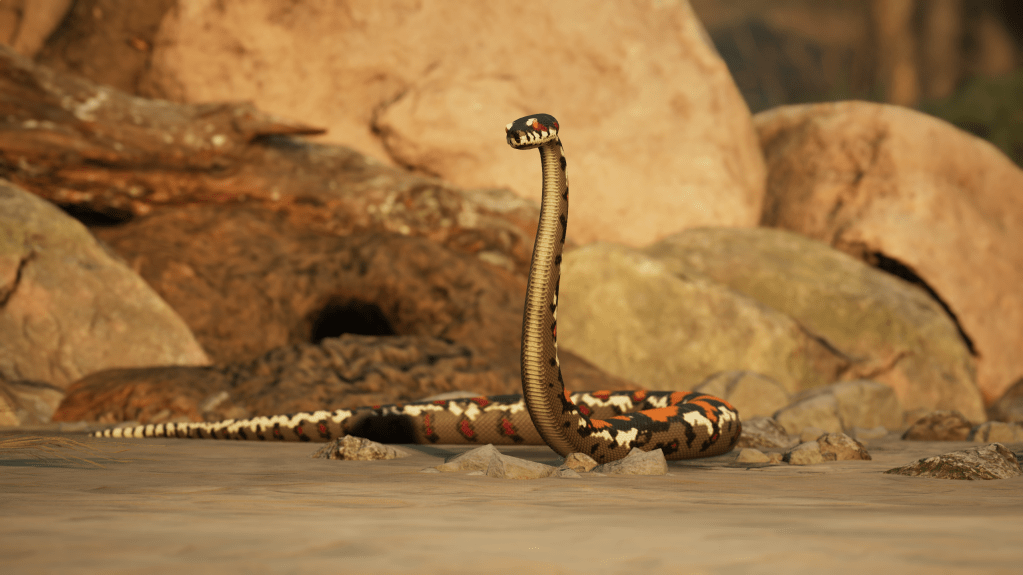
Wonambi was a giant, non-venomous prehistoric snake that lived in Australia from the Pliocene through the late Pleistocene, surviving until approximately 50,000 years ago. Reaching around 5–6 meters in length, it was the largest snake known to have lived in Australia. Unlike modern Australian pythons, Wonambi belonged to an ancient, extinct family of snakes called Madtsoiidae, making it only distantly related to today’s constrictors. It was likely an ambush predator that waited near permanent water sources before overpowering prey, though its relatively rigid skull meant it probably could not swallow exceptionally large animals. Today, Wonambi is remembered as one of the last surviving members of its ancient snake lineage.
Tier: 1
Dimorphism: None
Habitat:
Can be found nesting anywhere in Riparia or Gondwa
Diet: Carnivore
Active Times: Cathemeral
Group Limit: 12 (mated pair and offspring)
Attackers/Defenders: 8 Adults/Sub-adults.
Nesting Season: Spring and Summer
Offspring: Up to 10
Adoption: ❌
Behavior
Wonambi are composed, calculating animals that approach both hunting and conflict with patience. They are generally indifferent toward unrelated members of their own species and rarely display aggression outside of disputes over breeding rights, nest defense, or defending an adopted Nanny Snake position. Rather than forming large social groups, they establish close family units consisting of a mated pair and their offspring, often remaining together until the young are ready to establish their own nest. They favor dense vegetation, fallen logs, caves, wetlands, and warm basking sites with ample cover, instinctively avoiding wide-open areas where concealment is scarce and aerial predators are difficult to evade.
Family groups cooperate as patient ambush predators, using coordinated stalking and carefully timed strikes to overwhelm prey that would be difficult for a single Wonambi to subdue. They readily hunt herbivores such as Struthiomimus, Dryosaurus, Citipati, Suzhousaurus, and Gigantoraptor, while some infiltrate unattended herbivore nests to prey upon vulnerable offspring.
Courting
Wonambi courtship is a slow process built on patience. A courting Wonambi quietly follows and observes a prospective mate from a respectful distance, frequently circling, inspecting, and remaining nearby as trust develops. After a time, the pair forms a group and begins cooperatively stalking the same prey, relying on coordinated ambushes to demonstrate compatibility.
As their bond deepens, they spend increasing amounts of time together, basking, resting, and sharing the same shelter. The male remains close throughout the courtship period, discouraging rival suitors through his presence. Should another male Wonambi refuse to leave, the rivals battle to determine breeding rights.
Nesting and Offspring
Wonambi nest only during Spring and Summer. Nests are carefully concealed inside fallen logs or hollow tree stumps, within dense vegetation, inside small caves, or beneath rock overhangs where both predators and aerial hunters are less likely to discover them.
After selecting a nesting site, the female lays her eggs, often returning to the same location in future nesting seasons. A female may produce up to 10 eggs each year, laid during either or both nesting seasons. Both parents remain attentive throughout incubation, alternating between guarding the nest, basking nearby, and leaving only briefly to hunt or scavenge. Concealment remains their greatest defense, but if the nest is discovered, either parent will aggressively defend the eggs and offspring until they reach adolescence.
The mother stays with her young while they are at their most vulnerable, with the father helping defend the nest and the surrounding area. Wonambi hatchlings are heavily dependent on their parents. Young remain close to the nest during their earliest stages. As they grow, they learn to hide, stalk, and scavenge by observing the adults. Parents protect their offspring until they are capable of surviving independently as sub-adults. As juveniles mature, they gradually spend more time exploring beyond the nest while continuing to return for safety and food.
Once they reach adulthood, offspring looking to establish their own nesting sites disperse. Adult female offspring often establish nests within the same general area where they were raised, returning to familiar nesting grounds across generations. Many young also return to their birth den to overwinter before eventually establishing shelters of their own.
Mandatory TRaits
Sky Terror
Wonambi fear aerial predators above all other threats. The sight of a flying creature overhead sends them diving for cover, freezing in place, or seeking shelter beneath vegetation, logs, rock overhangs, or burrows. While they may boldly stalk terrestrial creatures many times their size, they show far greater caution toward anything capable of descending from the sky.
Where Blood Is Spilled
Wonambi rarely ignore an easy meal. They readily scavenge abandoned carcasses, steal chunks of meat, and linger near larger predators in hopes of obtaining scraps. Rather than challenging stronger animals for a fresh kill, they capitalize on the aftermath of successful hunts, feeding only when the opportunity presents itself. This opportunistic behavior allows them to make efficient use of available resources while avoiding unnecessary risk.
The Art of Ambush
Wonambi are ambush predators rather than pursuit hunters. They rely on concealment, stalking, and carefully timed strikes to secure prey. Because they cannot effectively attack while sprinting, they may not pursue fleeing prey over long distances. However, they may continue to observe, stalk, shadow, or ambush a target that later rests or sleeps.
The Peace Stick
Wonambi have developed a peculiar behavior of carrying sticks or other small debris. This behavior serves as a visual signal that they are not actively hunting or behaving aggressively. Wonambi wishing to form Flamekin bonds must carry a stick or similar object when first approaching a potential host, signaling peaceful intentions before attempting to establish a relationship. Up to three Wonambi can serve as Flamekin to a single Tier 3 or larger terrestrial or semi-aquatic creature.
Winter Brumation
During Winter, Wonambi become noticeably less active, spending much of their time within dens, caves, fallen logs, or other sheltered locations to conserve energy. They leave shelter primarily to hunt, scavenge, drink, or bask in the sun before returning to cover. To conserve warmth, even unrelated Wonambi temporarily share sheltered locations until Spring arrives. Wonambi serving as Nanny Snakes overwinter alongside their adopted family within the safety of the den or nest. Those serving as Flamekin remain close to their host throughout Winter but seek shelter independently whenever suitable refuge is unavailable.
Optional Traits
The Fostering Coil
Some Wonambi integrate themselves into the lives of larger terrestrial and semi-aquatic carnivores. These individuals help watch over nests, dens, and young offspring in exchange for warmth, protection, and access to food. This arrangement also provides an opportunity to practice and reinforce their parental instincts, often leading them to treat their hosts’ young as their own. As these parental instincts strengthen, they often become fiercely protective of their hosts’ offspring, defending them as though they were their own.
A Tier 3 and above family may host up to two nanny snakes at a time (can only nanny for T3 and above). These snakes may be a mated pair or otherwise related to one another, such as siblings or parent and offspring. Wonambi serving in this capacity do not maintain their own nests and often become fiercely defensive of their adopted position, driving away rival Wonambi that attempt to claim the same family. Nanny snakes are treated as members of their adopted family, not as Flamekin.
Where Opportunity Lies
Some Wonambi readily exploit unattended herbivore nests whenever the opportunity arises. Rather than confronting powerful adults directly, they infiltrate nesting sites to prey upon vulnerable hatchlings, avoiding healthy adult defenders whenever possible. Patience, timing, and stealth are their greatest advantages.
Credits: missblue with assistance from onyxmoon & littlerred
Sources:
https://pubmed.ncbi.nlm.nih.gov/10667791/
https://en.wikipedia.org/wiki/Wonambi
Last Updated: 6/27/26

